

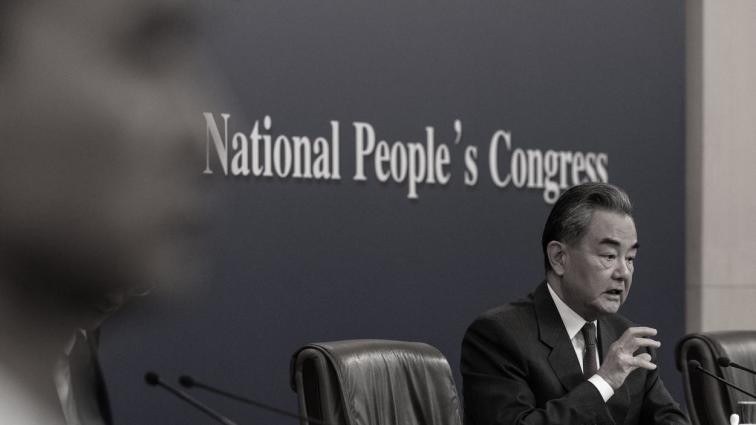
File Photo: On October 23, 2022, Wang Huning, a member of the Chinese Communist Party (CCP) Standing Committee, attended a press conference at the Great Hall of the People in Beijing alongside other newly appointed members of the CCP Politburo Standing Committee and both domestic and international journalists. (Photo by Kevin Frayer/Getty Images)
[People News] According to Chinese state media, on March 20, Wang Huning, Chairman of the National Committee of the Chinese People's Political Consultative Conference, met with Graham Allison, a prominent professor at Harvard University, in Beijing. Allison is known for introducing the concept of the 'Thucydides Trap,' which is viewed as an 'iron law' of international relations, derived from the writings of the ancient Greek historian Thucydides.
Allison argues that when a rising power competes with an established hegemonic power, both parties encounter a scenario reminiscent of the 5th century BC, when the rise of Athens prompted concern from the land hegemon Sparta, often culminating in war. Historically, both Athens and Sparta faced destruction after a protracted 30-year conflict.
As a result, Allison cautions that to prevent an inevitable conflict between the U.S. and China, the United States must acknowledge the reality of China's ascent. This perspective has led some conservative U.S. politicians to view his position as overly sympathetic to China. This context helps explain why Allison has received high-level receptions from the Chinese Communist Party (CCP) and enjoys popularity within Chinese academic circles.
In addition to being received by Wang Huning twice this year and again in 2024, in 2025, Wang Yi, State Councillor and Foreign Minister of the CCP, also met with Allison on two occasions. Given that U.S. President Trump has been actively dismantling the CCP's strategic initiatives in Latin America and the Middle East, and considering the setbacks faced by the CCP's air defense systems and missiles provided to Venezuela and Iran against the formidable capabilities of the U.S. military, one might wonder: is the CCP attempting to convey a specific message by inviting Allison to visit China and meet with Wang Huning?
During this meeting, Wang Huning, representing the Chinese Communist Party, noticeably softened his tone regarding Sino-U.S. relations. According to state media, Wang's remarks included five key points:
1. Xi Jinping and President Trump "maintain good interactions." This serves as a response to Trump's repeated assertions that he is "good friends" with Xi, effectively denying that they are "good friends" while acknowledging that their interactions are relatively "good."
2. Xi Jinping "provides important strategic guidance for the improvement and development of Sino-U.S. relations." This emphasises that the decision-maker steering Sino-U.S. relations remains Xi Jinping.
3. The Communist Party of China "will respond to the changing international situation with the certainty of its own development." This statement appears to express confidence in navigating the complex international landscape, primarily because they believe they will continue to maintain power.
4. The Taiwan issue is at the heart of China's core interests. This serves as a warning to the United States not to infringe upon the Communist Party's core interests.
5. There is hope for both sides to "strengthen dialogue and communication, properly manage differences, expand pragmatic cooperation, and find a correct way to coexist." This suggests that the two sides are currently not on the right path to coexistence.
Turning to Wang Huning's statements during his meeting with Allison on December 19, 2024, there are also five main points:
1. Under Xi's "strong leadership," the Chinese people are "united and striving together." This conveys to the United States that there is significant internal unity in China, and Xi's leadership position is beyond question.
2. The Communist Party's "internal and external policies are consistent and aboveboard." This blatant falsehood aims to refute a series of accusations made by the United States against the Communist Party.
Third, Xi Jinping has proposed 'three principles: mutual respect, peaceful coexistence, and win-win cooperation,' while also establishing 'four non-negotiable red lines' concerning the Taiwan issue, democracy and human rights, institutional systems, and development rights. This serves as fundamental strategic guidance for China-U.S. relations.
These 'four non-negotiable red lines' set by the Chinese Communist Party (CCP) for the United States indicate that the U.S. can only achieve a win-win outcome by respecting the CCP and coexisting peacefully with it.
Fourth, the CCP emphasises the need for continuity and stability in its policy towards the U.S., suggesting that the U.S. should avoid frequently changing its approach to China.
Fifth, it is asserted that the 'Thucydides Trap' is not an inevitable historical fate, and that China and the U.S. should 'enhance dialogue and communication, effectively manage differences, and achieve mutual success through cooperation.' This conveys to the U.S. how Zhongnanhai envisions the future of China-U.S. relations.
When comparing the statements made by Wang Huning during the two meetings, it is evident that his tone has changed significantly when addressing different U.S. presidents, Trump and Biden. He now refrains from making harsh statements towards the U.S. A crucial piece of evidence is the reference to the four non-negotiable red lines that the U.S. is not permitted to cross. This time, state media only referred to the Taiwan issue as 'the core of China's core interests,' without mentioning the other three lines. Moreover, the term 'four non-negotiable red lines' has completely vanished from the discourse.
This shift may be attributed to the fact that Trump does not take the CCP's threats seriously. If the CCP continues to adopt a hardline stance as it has in the past, would Trump, who possesses various strategic advantages, accept being dictated to by the U.S.?
Moreover, it is quite peculiar that Wang Huning did not mention the 'iron law' during his meeting with the proponent of the 'Thucydides Trap'. In recent years, the academic circles and high-ranking officials of the Communist Party of China (CPC), including the military, have openly discussed this concept and even prepared for 'great power competition' with the United States.
For example, during the two sessions of the CPC in March 2021, the British Daily Mail reported that Xu Qiliang, who was then the Vice Chairman of the Central Military Commission, disclosed the reasons for increasing military spending during discussions with representatives of the National People's Congress. He pointed out that following the Trump administration and the outbreak of the Wuhan pneumonia, tensions between the United States and mainland China have escalated, making it difficult for both sides to avoid the 'Thucydides Trap'. As a result, the mainland should boost military spending to modernise its forces and prepare for the inevitable conflict.
Xu Qiliang is confident that mainland China will soon surpass the United States to become a major economic power, with its GDP exceeding that of its rival by 70%. He stressed: 'In light of the Thucydides Trap and border issues, the military must accelerate the enhancement of its capabilities. The CPC military needs to achieve breakthroughs in combat strategies and operational capabilities to establish a solid foundation for military modernisation.'
Currently, Wang Huning's reluctance to address this issue suggests either that the CPC has come to terms with its inability to compete equally with the United States or that it is intentionally signalling weakness to Trump, indicating it has no intention of challenging the U.S. This reflects the internal anxiety within the CPC. After all, with only three months until 2026, Trump's actions in Venezuela, Iran, and Cuba have already caused sleepless nights for the CPC's top officials, who cannot help but contemplate their own future.
Following Wang Huning's remarks, Allison noted that 'the current international peace and order are facing serious erosion, and it is crucial for China and the United States to find a proper way to coexist for the benefit of the world.' This statement further underscores Allison's pro-Communist stance. Such a position evidently has no standing within the Trump administration, and it is unlikely that the Chinese Communist Party will be able to effectively use Allison to communicate their messages; rather, their main objective seems to be to have him serve as a figurehead to mislead the Chinese populace.
(First published in People News) △





News magazine bootstrap themes!
I like this themes, fast loading and look profesional
Thank you Carlos!
You're welcome!
Please support me with give positive rating!
Yes Sure!