
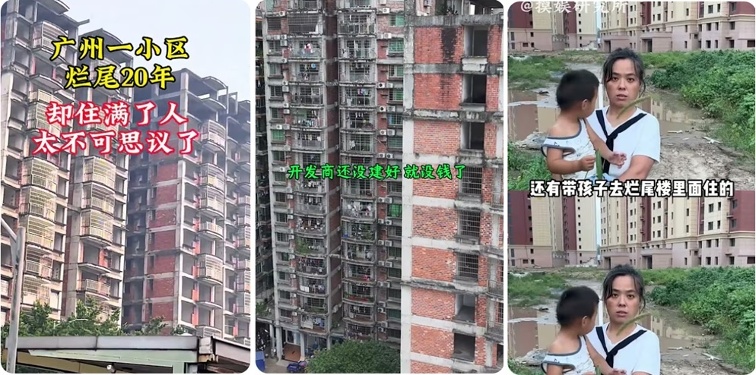
Across major cities and small towns in China, unfinished buildings are widespread, leaving buyers with no option but to move into these properties that lack basic utilities like water and electricity. (Video screenshot)
[People News] Starting at the end of September 2024, Guangzhou will implement a '100% cancellation of purchase restrictions,' allowing anyone to buy property throughout the district, regardless of their household registration or social security contributions. However, the anticipated strong rebound following the complete removal of these restrictions has not materialised; instead, housing prices continue to fall, revealing a crisis of public confidence in the market and, fundamentally, a lack of trust in the CCP's ability to improve the economy.
No One Wants to 'Bargain Hunt'
Many analysts suggest that during the initial phase of policy relaxation, the market did experience a brief surge in 'bargain hunting' and demand for improved housing, particularly with a temporary increase in second-hand home transactions. However, this was short-lived, and the market quickly cooled down again.
Real estate data indicates that in April 2026, the average price of second-hand homes in Guangzhou was approximately 20,500 yuan per square meter, reflecting a decline of over 27% compared to two years prior, which translates to a loss of about 7,800 yuan per square meter.
In particular, popular areas such as Zengcheng, Huangpu Knowledge City, Panyu, Old Huangpu, and Tianhe have seen prices drop by more than 70%, extinguishing the last glimmers of hope among residents.
'Heihu,' a real estate finance blogger who has been active in China for 20 years, recently remarked that regardless of how appealing the prices may seem, the market is devoid of interest. 'The core issue stems from the structural collapse of the broader environment over the past four to five years.'
He noted that economic growth is slowing, income expectations are falling, and the employment environment is worsening. Additionally, the long-term decline in real estate has led to a significant shrinkage of wealth. The elite group that once supported housing prices—comprising private homeowners, business partners, and senior white-collar workers—has been severely impacted during this wave of recession and deflation. Many are facing business closures or bankruptcy, resulting in substantial wealth loss. 'Even if housing prices have halved, for the vast majority of ordinary wage earners, in the context of unstable income and extremely poor future expectations, they still cannot afford to buy.'
Awakening from State Media Brainwashing
The prevailing sentiment among many citizens in Guangzhou is not 'Finally, I can buy a house,' but rather: 'Even if the market is opened up, no one dares to buy.' This is because citizens are primarily concerned about questions like 'Will housing prices continue to drop?' 'Will buying now lead to a financial burden?' 'Will the mortgage overwhelm the family?'
Some real estate agents describe the situation: 'More people are looking at houses, but there are still not many who are willing to make a purchase.'
Why is there such a strong wait-and-see attitude among citizens? The reasons are quite pragmatic.
Over the past two decades, under government control, all media have been actively fostering an atmosphere of 'housing prices will always rise', effectively brainwashing the public into believing that buying a home is a way to preserve and increase wealth. For most citizens, it is easy to accept this media narrative without realising that it is a trap set by the Communist Party to exploit them. Fueled by the belief that 'housing prices will always rise', many people are willing to exhaust the savings of three generations, living frugally to purchase a home without hesitation. However, since the onset of the economic downturn, the real estate market has begun to collapse, with numerous unfinished buildings visible everywhere. In particular, many areas in Guangzhou have experienced continuous declines in housing prices in recent years, and the market for second-hand homes has been sluggish. Many individuals have come to realise that homes not only fail to retain their value but may also turn into negative assets.
Consequently, many people do not lack the qualifications to buy a home; rather, they lack confidence in their income, job security, and the future economy.
Young people, in particular, are increasingly worried about potential salary cuts, layoffs, and business closures, as any of these scenarios could lead to overwhelming mortgage pressure.
In this context, even if the government removes all restrictions, the public remains concerned: 'If I buy now, will I be the last one left holding the bag?' There is a widespread fear that the housing market bubble could burst in their hands.
These various concerns are interconnected.
Many observers believe that even if Guangzhou completely lifts purchase restrictions, the housing market will continue to decline, reflecting a deeper issue: it is not that ordinary people lack the qualifications to buy homes, but rather that the market has lost confidence in its ability to recover.
Many netizens have described the situation as: 'In the past, I wanted to buy but couldn't; now I can buy but don't dare to.' This reflects a broader concern among the public: the real estate crisis is not just a matter of policy, but fundamentally tied to the overall economy and public confidence.
Citizens are genuinely worried about issues such as declining wages, shrinking consumption, falling housing prices, worsening local finances, the risk of unfinished buildings, and increasing bank bad debts. These concerns are interconnected, creating multiple heavy burdens on the minds of the citizens. Furthermore, they understand that the Chinese Communist Party (CCP) is fundamentally incapable of resolving these challenges. Therefore, even if purchase restrictions are lifted, it holds no real significance and may even lead more people into debt. As a result, no matter how many promotional policies the authorities implement, restoring market confidence remains a daunting task.
Many residents of Guangzhou have expressed online: 'It’s not the purchase restrictions that limit me, it’s poverty that limits me.' 'There are too many houses, and people's hearts are too cold.' 'It’s not that I can’t afford it now, it’s that I don’t dare to buy.'
At its core, the public's lack of confidence in the market reflects a lack of confidence in the CCP. After being deceived too many times and suffering significant losses, many individuals have awakened to the reality and are no longer easily swayed by the lies of state media.
Additionally, Guangzhou's status as the first first-tier city to 'completely lift purchase restrictions' is viewed by many analysts as a significant signal—indicating that the authorities are increasingly anxious about the pressures from the declining housing market. This has led to a situation that the CCP would prefer to avoid: while policies are becoming more lenient, the public is growing more conservative, and housing prices continue to decline.
Historically, the Chinese Communist Party has viewed 'purchase restrictions' as a crucial tool for curbing the overheating of housing prices. Now, even first-tier cities are beginning to lift these restrictions entirely. It's no surprise that a local real estate blogger in Guangzhou remarked, 'Confidence has collapsed; Guangzhou has nearly exhausted all its options.' Yet, an increasing number of people are starting to question: 'Is a house still the safest asset?' This shift in mindset represents the most profound and challenging change following the complete removal of purchase restrictions in Guangzhou.
(Originally published by People News) △






News magazine bootstrap themes!
I like this themes, fast loading and look profesional
Thank you Carlos!
You're welcome!
Please support me with give positive rating!
Yes Sure!