

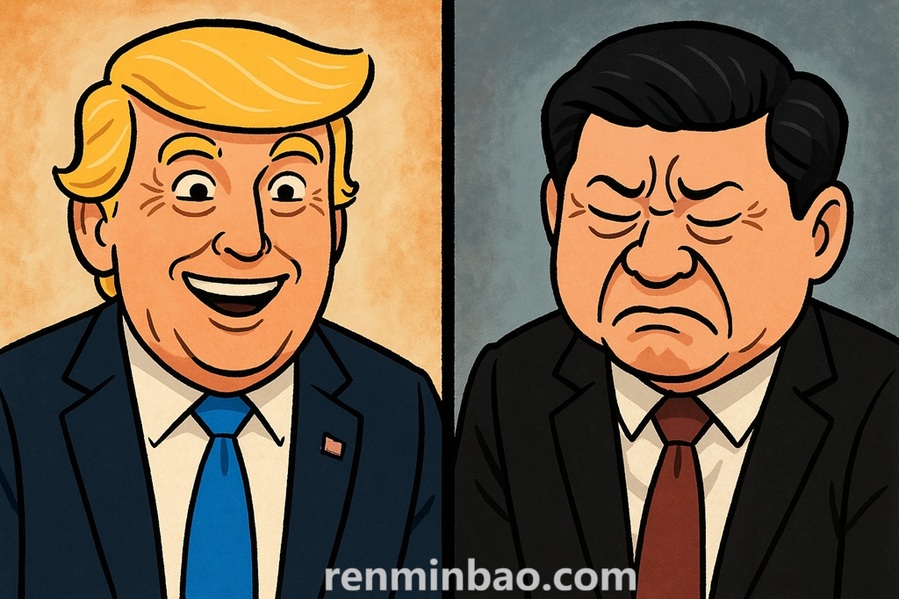
Xi Jinping is more focused on competing with Western powers. (People News Illustration)
[People News] A detailed piece of advice from the core circle is creating significant waves overseas. An entrepreneur with strong ties to various factions in Beijing has taken a considerable risk to disclose a startling revelation.
In early March, the Taiwan Strait experienced one of the most alarming silences in recent years. According to statistics from the Ministry of National Defence of the Republic of China and Agence France-Presse, military activities that had been reported daily suddenly ceased over a ten-day period starting from February 28.
Many might think this is a positive development, right? The daily harassment has stopped, suggesting a cooling of cross-strait tensions? However, experts hold a completely different perspective. Drew Thompson, a senior researcher at Singapore's Nanyang Technological University, expressed on Substack: 'I never imagined I would feel concerned about the PLA halting operations, but this lack of explanation creates an extremely unsettling vacuum.'
Why the concern? Because it contradicts common expectations. Last year during the same period, there were as many as 86 incursions by Chinese military aircraft into Taiwan's air defence identification zone, while the figures for January and February of this year have dropped by 42% compared to last year. Some speculate this is due to the 'Two Sessions' being convened in Beijing, or because Trump is set to visit Beijing, or even to fabricate a false sense of 'reduced threats' to lure the U.S. into decreasing its support.
However, behind this silence, we received a confidential tip from a core circle in Beijing. This Fujian entrepreneur, who has established deep connections with senior officials at Zhongnanhai and the 'red second generation', has risked the arrest or even disappearance of his entire family to share an authentic perspective. This revelation not only clarifies why military aircraft have 'vanished', but also exposes a final scenario anticipated to unfold in 2027.
The 'One Respect' as Seen by the Fujian Entrepreneur
Who is this entrepreneur? For safety reasons, we cannot disclose his name. Nevertheless, his life story is quite typical: born in Fujian, he emerged during the period of rapid economic growth in mainland China, and his business network extends throughout Beijing, where he maintains friendly relations with the 'Secretary Gang' and 'red families' who wield real power.
He once firmly believed in 'understanding politics without engaging in it', thinking it sufficient to focus solely on making money. However, he now states that he 'can no longer stay silent'. He has realised that the leader who wields the highest authority—the so-called 'One Respect'—is driving the entire nation towards a precipice.
In his view, 'One Respect' is an extraordinarily complex individual: patient, bold, ruthless, and suspicious. This character is profoundly shaped by the scars of the Cultural Revolution. The harshness of that era taught him how to paralyse his opponents through prolonged disguise, revealing his true intentions only at the last moment to seize power.
The more alarming aspect is that 'Yizun' harbours a strong, even pathological sense of mission deep within. He aspires to be on par with Mao Zedong, envisioning himself as a timeless emperor akin to 'Qin Huang Han Wu'. This entrepreneur openly admits that behind his 'personal deployment and personal command' lies profound distrust and arrogance. He is surrounded by sycophants—individuals lacking competence yet highly adept at flattery—who intentionally shift all decision-making authority onto 'Yizun'. While they outwardly express admiration, they secretly mock him.
Taiwan as the Key to Re-election in 2027
Why have Chinese military aircraft recently become quieter? Reports suggest that this is not a retreat but rather a strategic forbearance and reorganisation. So, how will the 'timeless emperor' establish his legacy? The answer lies in Taiwan.
According to sources, 'Yizun' has a very clear power agenda: he exploits the narrative of 'the East rising while the West declines' and the 'unification cause' as justifications to forcibly secure a third term in 2022. His next objective is to achieve military unification of Taiwan by 2027, leveraging a 'national emergency' to forcibly secure a fourth term.
A key detail revealed by this entrepreneur from Fujian is that 'Yizun' is hastening the construction of an underground fortress in Beijing's Xishan. Why? Because he is deeply fearful of the U.S. military's 'clearing operations'. A person who frequently professes a desire for war is, paradoxically, more afraid for his own safety than anyone else. This contradiction suggests he is acutely aware of the potential consequences of such a war, yet for the sake of power, he is willing to drag the entire nation down with him.
In recent times, military aircraft activity has decreased, which is closely linked to another conflict—the Middle East war. On February 28, the United States and Israel initiated military actions against Iran, successfully targeting and eliminating Khamenei. As the airstrikes commenced, Beijing recognised that the United States might become entangled in the Iranian conflict.
Xi Jinping promptly convened a Politburo meeting, viewing this as a prime opportunity to take Taiwan. This also clarifies why, from late February to early March, the Chinese military's daily provocations against Taiwan suddenly halted—because they were conducting high-level strategic evaluations and troop redeployments in preparation for a potential 'strategic window of opportunity.'
The Truth Behind Zhang Youxia's Downfall
This reckless venture faced resistance within the Chinese Communist Party. Recent disclosures have revealed a dramatic military purge that occurred in early 2026.
The central figure in this saga is the well-known Vice Chairman of the Central Military Commission, Zhang Youxia. During the 20th National Congress in 2022, Xi Jinping relied on Zhang Youxia to maintain military morale to secure his re-election. However, following his re-election, Xi Jinping swiftly dispatched trusted allies such as He Weidong and Miao Hua to eliminate Zhang Youxia's faction.
This power struggle experienced a turnaround after the Third Plenary Session of 2024, with Zhang Youxia managing to reclaim some military authority. Nevertheless, on January 19 of this year, 'the one' abruptly arrested Zhang Youxia and quickly made a public announcement to cement the decision.
Why is Zhang Youxia being targeted? According to a Fujian entrepreneur, the primary reason, aside from the struggle for power distribution, is Zhang Youxia's opposition to the military unification of Taiwan. As a veteran, Zhang Youxia understands the harsh realities of modern warfare and the extent of corruption within the People's Liberation Army. He believes that launching an attack on Taiwan at this time would be an 'act of self-destruction.' His removal signifies the total suppression of the last rational voice within the military, granting Xi Jinping absolute and unchallenged control over military power.
The situation for the civil service system and the elders is even more concerning.
Reports suggest that the elders, led by Hu Jintao and Wen Jiabao, have been a resolute force against any military action towards Taiwan. They argue that such an action would jeopardise decades of peaceful development in China and devastate the southeastern coast. While some corrupt families may be motivated by the desire to protect their overseas assets, figures like Wen Jiabao still embody a sense of 'gentlemanly integrity,' reminiscent of Hu Yaobang and Zhao Ziyang, representing a clear stream amidst the corruption, as they prioritise the nation's peaceful development.
What has been the outcome? Xi Jinping has resorted to extreme measures. The Fujian entrepreneur revealed that Wen Jiabao's entire family is currently under house arrest.
This is not typical house arrest. In the past, although Zhao Ziyang was confined, his children were still able to work, attend school, and travel abroad. In stark contrast, Wen Jiabao's situation is far more dire: his home is surrounded by plainclothes security, and his entire family is barred from leaving. Even his grandchildren, who are still in school, are confined at home and not allowed to attend classes! This treatment, which even affects children, shows a complete disregard for the law and human decency.
One of the clearest signals came on March 10 of this year, when Hu Jintao and Wen Jiabao's mentor, Song Ping, held a funeral. Traditionally, both would be expected to attend or at least send wreaths. However, Hu Jintao was only represented by a wreath, while Wen Jiabao was completely absent, with no wreath sent at all. This strongly indicates that they have lost their personal freedom.
Taiwan represents a gamble that is destined for destruction.
A Fujian entrepreneur provided a highly professional analysis of why an attack on Taiwan would spell disaster for China.
First, there is the issue of military hard power. Many people draw comparisons between Taiwan and Ukraine, but in reality, Taiwan benefits from the natural defence provided by the strait, making its defence significantly more challenging than that of Ukraine's flat terrain. Taiwan's military capabilities are comparable to those of Ukraine, but its weaponry is far more advanced. In terms of missile capabilities, while mainland China possesses 12,000 missiles, Taiwan has 8,000, and when combined with the 15,000 from the US and Japan, the People's Liberation Army would actually find itself at a disadvantage in terms of firepower.
Secondly, we must consider the economic lifeline. While Russia has energy resources to withstand sanctions, China depends on imports for 70% of its oil and iron ore. If war were to break out and maritime routes were blocked, China's economy would be paralysed almost instantly. More critically, China's economic heart lies along the southeastern coast—Fujian, Guangdong, Zhejiang, and Jiangsu—regions that contribute over 35% of the national GDP. Should conflict arise, these areas would be devastated, directly severing China's economic lifeline and obliterating decades of development in a matter of moments.
Ultimately, it boils down to public sentiment. A Fujian entrepreneur articulated a particularly striking observation: the Communist Party of China's rule has long since lost the people's support. Much like when the Eight-Nation Alliance invaded Beijing, where locals guided foreign troops, many Chinese now even wish for the United States to come and 'decapitate' the leadership.
He disclosed that some frustrated and desperate individuals are even willing to serve as 'human coordinates,' directing foreign missiles to eliminate those high-ranking officials who have driven the country towards disaster. In this scenario, intelligence leaks are unavoidable, which explains why 'One Respect' is so fearful and frequently purges the military.
An 'Alternative Plan' for Reclaiming Outer Mongolia
In this advisory letter, the Fujian entrepreneur put forth an audacious yet logically sound proposal: if 'One Respect' genuinely aims to achieve greatness and secure a place in history, why not consider reclaiming Outer Mongolia?
His rationale is as follows: First, territorial size: Outer Mongolia spans 1.56 million square kilometres, over 40 times larger than Taiwan; this represents true 'territorial expansion.'
Second, ease of military engagement: Outer Mongolia's military capabilities are exceedingly weak, and its borders are predominantly desert and Gobi, meaning that military operations would not lead to significant casualties, nor would they devastate China's economic heart like a conflict in the Taiwan Strait would.
Third, the international landscape: Outer Mongolia has minimal economic ties with the U.S. and Japan, and the West would not impose severe sanctions on that region. Additionally, with Russia currently embroiled in the Ukraine war, it lacks the capacity to intervene, presenting a rare strategic opportunity.
He further questioned: recovering Outer Mongolia could improve the sandstorm environment, alleviate border poverty, and restore territorial integrity according to the law; this is what constitutes a true national hero. Why is there such an obsession with Taiwan, a contentious issue that could lead to 'national destruction'?
Final Appeal
Zhongnanhai currently resembles a pressure cooker, with internal conflicts intensifying and the leader's will prevailing over all rational thought. Hu Jintao, Wen Jiabao, and Zhang Youxia, representatives of different factions, are now being purged for a shared objective—' opposing war.'
While we cannot confirm the authenticity of this leak, the reason for sharing this information today is that these revelations not only expose the inner workings of power struggles but also serve as a wake-up call from a clear-headed Chinese businessman, speaking for ordinary citizens who lack a voice, to alert the world.
Using military force to unify Taiwan is not a path to great rejuvenation but rather a self-destructive act against the Great Wall. If this advice can reach Xi Jinping, and if this leak can garner enough attention from the international community, including the upcoming visit from Trump, it may help avert a potential disaster. △







News magazine bootstrap themes!
I like this themes, fast loading and look profesional
Thank you Carlos!
You're welcome!
Please support me with give positive rating!
Yes Sure!