
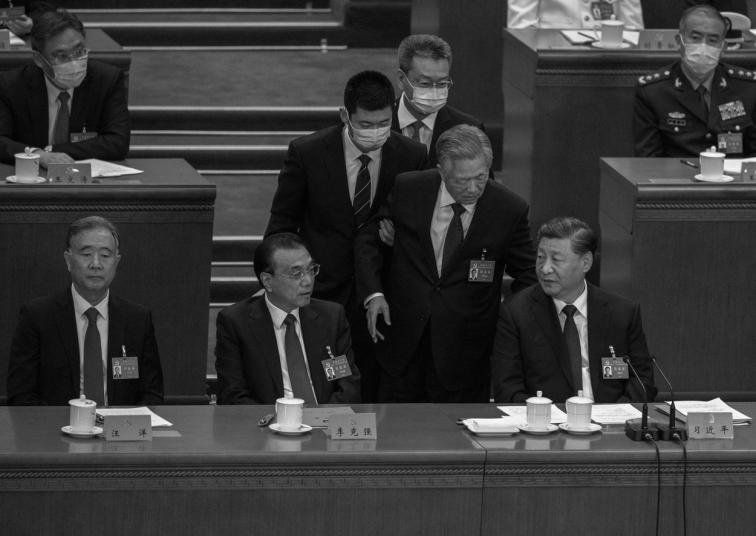
On October 22, 2022, during the closing ceremony of the 20th National Congress of the Communist Party of China, Xi Jinping ordered the removal of former President Hu Jintao from the venue. (Photo by Kevin Frayer/Getty Images)
[People News] Recently, there have been rumours circulating online that Hu Jintao has been placed under house arrest. A significant reason for this is that on March 10, during the cremation of former Chinese Communist Party elder Song Ping at Babaoshan, all current and retired leaders at the level of the Politburo Standing Committee attended the farewell ceremony, with the exception of Hu Jintao, who was considered Song Ping's 'favourite disciple' and had been significantly promoted by him. The rumours indicate that Hu Jintao did not attend the ceremony due to health issues, but rather because he opposed military action against Taiwan and was subsequently placed under house arrest. Former Premier Wen Jiabao is also reportedly under house arrest. At this time, we cannot verify this information from the Chinese Communist Party's side.
Opposing Xi’s risky move to attack Taiwan — have Hu and Wen run into trouble? (Click the video)
Hu Jintao Should Have Attended the Farewell for Song Ping
The relationship between Hu Jintao and Song Ping is indeed remarkable. Song Ping served as Hu Jintao's political 'mentor' and benefactor. It can be said that without Song Ping, Hu Jintao might have remained a minor official in a local capacity. From the late 1970s to the early 1980s, when Song Ping was in charge of Gansu, he personally promoted the then-unknown Hu Jintao, who was the deputy director of the Gansu Provincial Construction Committee, recommending him all the way from a deputy department level to being formally recommended to Deng Xiaoping before the 14th National Congress of the Communist Party in 1992, allowing Hu Jintao to enter the Politburo Standing Committee as a dark horse, until he was later designated as the General Secretary of the Communist Party by Deng Xiaoping.
It can be said that without Song Ping, there would be no Hu Jintao's 'Tuanpai Era.' Song Ping is acknowledged within the party as 'the greatest talent scout in Chinese politics,' and Hu Jintao is indeed his most significant political legacy. Logically, with Song Ping's passing, Hu Jintao should have gone to Babaoshan to pay his respects; even if he had to crawl there, he should have sent someone. However, Hu Jintao only sent a wreath, which was reportedly specially approved. They are preventing Hu Jintao from making any public appearances, fearing he might say or do something that could undermine the current facade of 'unity' in Zhongnanhai, and to warn a small group of officials: do not speak out against the authority of the supreme leader.
On March 11, Australian-Chinese writer Li Jun shared a lengthy article by a Fujian entrepreneur on the X platform. This entrepreneur mentioned that due to the need for political connections and information in his business dealings in China, he has come to know some second-generation red elites and officials, gaining insight into many high-level Communist Party matters. He recently learned that following the US-led coalition airstrikes on Iran, Xi Jinping convened a Politburo meeting to prepare for the military unification of Taiwan, ensuring his fourth term through wartime measures. Consequently, the southeastern coastal regions, including his hometown of Fujian, are on the brink of war, prompting many entrepreneurs to expedite their overseas immigration and asset transfers. He decided to expose this information in an effort to prevent the war as much as possible.
Opposition to Xi Jinping's actions is not limited to Hu Jintao; Wen Jiabao is also among the dissenters. Wen Jiabao is another favoured disciple of Song Ping, a steed that Song Ping highly recommended. He did not attend Song Ping's final farewell, as his entire family has also been placed under house arrest. Ultimately, that entrepreneur urged Trump to be cautious of the Communist Party's deception.
At present, the authenticity of this news cannot be verified. However, there have been previous disclosures from the U.S. military regarding Xi Jinping's plans to attack Taiwan before 2027. As we mentioned in earlier broadcasts, the U.S. military has warned companies like Apple, which operate in Taiwan, to evacuate promptly. For those interested, you can refer back to earlier segments; we will not reiterate that information here.
Various sources indicate that the Chinese Communist Party is preparing to attack Taiwan.
In a report by Radio France Internationale on March 11 titled 'Taiwan Issue - Multiple Factors Indicate: China May Launch an Attack as Early as 2026', it was reported that U.S. Navy Admiral Philip Davidson, prior to his departure as commander of the U.S. Indo-Pacific Command, warned Congress that, based on his information, Beijing might launch an attack on Taiwan before 2027. His warning has garnered significant attention from other experts, who have even dubbed it the 'Davidson Window'.
The report states that, given the current tense relations across the Taiwan Strait, the interplay of political, military, and strategic factors in the coming months could drastically change Taiwan's precarious balance.
Additionally, the report highlights that 2027 is symbolically significant for Xi Jinping. This year will mark the 21st National Congress of the Communist Party, and he has consistently asserted that he aims to make 'unification' the cornerstone of his political legacy... The current circumstances may present him with a prime opportunity to pursue this goal.
Meanwhile, the U.S. has amassed a substantial military presence around Iran while continuing to provide support to Ukraine... Engaging in a third battlefield would entail considerable risks. Furthermore, the domestic approval ratings of Taiwan's regional leader, Lai Ching-te, are declining, which could potentially benefit his political opponents.
According to a report by Foreign Affairs magazine, a combination of various factors could create a genuine 'perfect storm,' leading Beijing to take action whenever provoked or when an opportunity presents itself.
Several pieces of information support the notion that the Chinese Communist Party (CCP) is preparing and laying the groundwork for a military unification with Taiwan.
One significant development is the passage of the 'National Unity and Progress Promotion Law' during the recently concluded Two Sessions of the CCP. Zhang Jun, the President of the Supreme Court, highlighted in his work report that judicial authorities will firmly defend national security and continue to intensify the fight against 'subversion and separatism.'
In response, relevant departments of the Republic of China have cautioned that this law could serve as a 'legal basis for addressing cross-strait issues.' Some political analysts suggest that this provides the CCP with a legal justification for a potential attack on Taiwan.
Another noteworthy piece of information is that several media outlets reported a few days ago that the CCP has been working around the clock to expand a large underground bunker in the Xishan area of Beijing.
Liu Min, a former entrepreneur from Sichuan now in exile in the United States, shared on the social media platform 'X' earlier this month that residents in Beijing have disclosed that large-scale underground construction has been ongoing in the Xishan area since last year, and it has recently entered a 24-hour construction phase. Local residents are speculating that this may be a dedicated underground command centre being built for leaders like Xi Jinping, which has caused considerable anxiety among the local population. Some even speculate that this is an order from Xi Jinping to accelerate the expansion of underground shelter facilities.
Is Beijing stockpiling oil in preparation for an attack on Taiwan?
Sina Finance, a Chinese media outlet, reported on March 10, citing the American Consumer News and Business Channel, that despite the escalating military conflicts between the U.S. and Iran, Iran continues to export large quantities of oil through the Strait of Hormuz, with China as the sole destination.
On the same day, Samiul Madani, co-founder of the maritime tracking platform TankerTrackers, revealed that since the war began on February 28, Iran has shipped at least 11.7 million barrels of crude oil through the Strait of Hormuz, all of which is headed for China.
The online media outlet Observer reported that after navigation through the Strait of Hormuz was hindered, many vessels disabled their tracking systems and entered a 'gone dark' state. It is reported that the platform utilises satellite imagery to monitor vessel movements and can detect those ships that have turned off their signals.
Shipping intelligence data provider Kpler estimated that approximately 12 million barrels of crude oil have passed through the strait since the onset of the war.
Recent statistics from the General Administration of Customs of the People's Republic of China indicate that, as the world's largest oil importer, China imported 48.045 million tons of crude oil in February, with a total of 96.934 million tons imported from January to February, marking a year-on-year increase of 15.8%. Refined oil imports stood at 4.775 million tons, with a cumulative total of 9.032 million tons from January to February, reflecting a year-on-year increase of 43.3%.
The report highlighted that over the years, China has built up substantial crude oil reserves. According to estimates from the Atlantic Council, China's crude oil reserves were approximately 1.2 billion barrels as of January, enough to satisfy domestic demand for 3 to 4 months.
The American "Wall Street Journal" reported on the 10th that the outbreak of the Iran war has largely brought long-standing concerns to fruition, posing a significant challenge for China as it seeks to bolster its economic resilience and respond to what it perceives as American "adventurism." So far, Beijing has generally managed to maintain stability amid the "storm."
Some analysts suggest that the oil reserves and the multi-energy structure adjustments being pursued by the Chinese Communist Party (CCP) are preparations for a potential attack on Taiwan. Additionally, some analysts have noted that the recent decrease in military aircraft and ships from the CCP in the Taiwan Strait does not signify a halt in military harassment of Taiwan, but rather serves as a prelude to a major offensive, a calm before the storm.
Nearly 60% of Taiwanese are willing to resist at all costs.
On the 13th, Radio France Internationale revealed the results of a poll conducted by Academia Sinica in Taiwan. The poll, carried out in January, targeted adults aged 20 and over who are registered in Taiwan, with a total of 1,206 valid samples. The survey asked, in the context of the U.S. strategic ambiguity policy, "If China attacks Taiwan, are you willing to resist at all costs?"
In the scenario where the U.S. does not send troops for defence, the poll indicated that 58.7% of respondents are willing to resist at all costs. In the scenario where the U.S. sends troops for defence, approximately 56.5% of respondents expressed a willingness to resist.
The Academia Sinica poll also included a question on whether respondents agree with the government increasing the defence budget to 3% of GDP, with results showing that 53.5% expressed support.
At a press conference on the 12th, Associate Researcher Pan Xinxin from the Institute of Sociology at Academia Sinica, one of the scholars involved in the program, highlighted that surveys conducted by both academic institutions and government think tanks reveal a strikingly consistent trend. The vast majority of Taiwanese people indicate a willingness to resist foreign adversaries and defend Taiwan. Notably, the overall percentage of those willing to resist at any cost is quite high.
(Originally published by People News)
△







News magazine bootstrap themes!
I like this themes, fast loading and look profesional
Thank you Carlos!
You're welcome!
Please support me with give positive rating!
Yes Sure!