
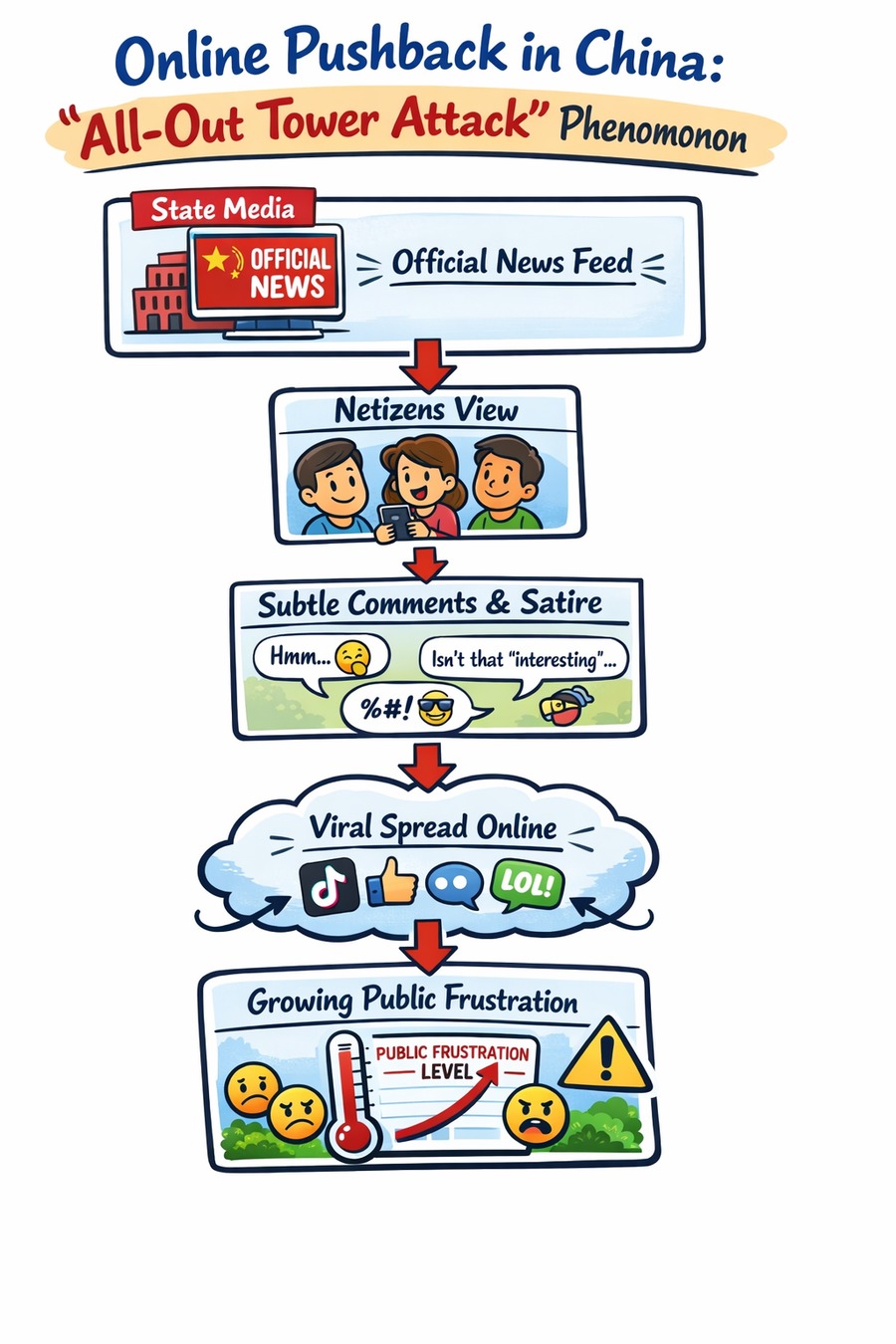
“All-Out Tower Attack”: Chinese Netizens Express Grievances Indirectly
[People News] Recently, a trend has emerged online in China: netizens posting comments in response to official websites, videos, images, or articles that subtly contradict the government. Even comment sections under official Chinese news broadcasts contain numerous messages opposing the official line.
On platforms like Douyin, highly sensitive content has surfaced, including footage from the June 4th Tiananmen protests, images of Zhao Ziyang and the Tank Man, and even coded references to Xi Jinping using nicknames like “Winnie.” Netizens call this phenomenon “All-Out Tower Attack”, a low-risk way for ordinary people to express dissatisfaction.
For example, on January 4, under a report about the U.S. capturing Venezuelan President Maduro, many netizens celebrated the liberation of the Venezuelan people, subtly implying hope that Trump would similarly “rescue” Chinese citizens suffering under the CCP. Douyin video comment sections were filled with calls for help like “SOS” and “Save me.” One comment read, “Old Trump, will you come for a big rescue?” and received over 10,000 likes.
A Chinese user posted a photo of Tiananmen Tower on Douyin with the caption, “I’m hiding here—who dares to catch me?”, hinting at a desire for U.S. intervention against Xi Jinping.
Many comments suggested, “Anyone who betrays the people will be caught.” Others mocked, “No need to capture alive—a single bunker-buster will do!” and “Turtle retracts its head and is safe.” Some even directly said, “Support beheading; primary targets first.”
This indirect method of expressing dissatisfaction has existed online before, but it has become much more frequent since late last year.
On December 3, 2025, when Poland officially banned the Polish Communist Party, mainland Chinese netizens praised the move on Douyin.
Recently, after Japanese Prime Minister Sanae Takaichi made remarks about Taiwan, a short video from Xinjiang police titled “Do not go to Japan” was widely criticized online and subsequently removed.
In December 2025, an article revealed that retired officials from China’s tobacco system could receive up to 19,000 RMB per month in pension, while a young person, 18 years old, with parents working in a state-owned tobacco company, claimed to have 200,000 RMB monthly living expenses, 7–8 properties, and all designer brands—sparking public criticism.
Additionally, starting January 1, 2026, the CCP increased cigarette prices by 20% and banned sales below 10 RMB. Some Chinese smokers called for a “50 million people quit smoking” campaign online, chanting, “Stop supporting those bastards!”, which quickly gained traction.
Recently, a blogger posted a call for volunteers to organize a “revolt,” prompting widespread responses, including from retired military personnel. One blogger reported 40,000 likes and 13,000 comments, claiming this reflected the popular sentiment.
At the end of 2025, the CCP Party-run newspaper People’s Daily published on its front page: “Chinese people worldwide must be ready to resolutely defend peace and justice—stand by at all times.” The comment section erupted with criticism.
Netizens wrote: “If Takaichi dared to reveal her assets, do you dare? On behalf of 1.4 billion people, I declare war!”
“If anyone dares to incite war, I will target them first.”
“Send me a gun; I’ll go to the airport now and guarantee no familiar faces escape!”
“You eat and drink without me, but ask me to fight? Sorry, my phone’s dead.”
Another video from the CCP Ministry of Defense Douyin account titled “All Citizens Are Soldiers” saw its comment section turn into a sarcastic relay of “Leaders’ children go first.”
Zhou Fengsuo, executive director of China Human Rights, noted that in late 2025, this “tower attack effect” continued. Under strict CCP surveillance, many people found subtle ways to mock the political system and Xi Jinping. It is obvious—everyone sees it—and yet obscure enough that automated monitoring systems cannot detect it. For example, netizens create new nicknames and codes for Xi daily.
Commentator Guo Jun told Elite Forum that this trend does not mean ordinary people suddenly became brave; their mindset has changed. First, China’s economy is really struggling, particularly affecting young people. Second, people see that no matter how hard they try, there is still no way forward. The phenomenon also shows that CCP-style nationalism no longer works. A few years ago, if state media promoted a topic, online trolls would echo it immediately. Now, the same topics provoke sarcasm and mockery instead—not because people suddenly became liberal, but because nationalism cannot solve unemployment or life difficulties.
Guo stated this trend is a dangerous signal for the CCP: the regime may still be in power, but the hearts of the people no longer support it.△



News magazine bootstrap themes!
I like this themes, fast loading and look profesional
Thank you Carlos!
You're welcome!
Please support me with give positive rating!
Yes Sure!