

Since mid-January 2025, hundreds of thousands of U.S. TikTok users have flocked to the Chinese social media platform Xiaohongshu (RedNote). (Screenshot composite / Dajiyuan)
[People News] For many Taiwanese users, the Chinese social media platform Xiaohongshu serves as a space for sharing life experiences, searching for tags, shopping, and selling products. However, following the ban imposed by Taiwanese authorities, the average monthly number of fraud cases associated with Xiaohongshu has seen a significant decline, yielding impressive results. Scholars have noted that Xiaohongshu offers users a wealth of filtered content from a singular perspective, which, with prolonged exposure, may influence their cognition and lifestyle.
Fraud Risks Associated with Xiaohongshu
Statistics from the Anti-Fraud Command Centre of the Republic of China Executive Yuan indicate that after the ban on parsing was enforced, the average monthly fraud cases on Xiaohongshu dropped by 73%, and financial losses decreased by 51%. This suggests that effective preemptive measures have successfully reduced the public's risk of fraud. To lift the restrictions, Xiaohongshu must still fulfil three requirements, including cooperating to remove fraudulent advertisements; however, the company has not responded within the deadline despite three attempts to reach out.
In December 2025, the Republic of China Ministry of the Interior announced that Xiaohongshu, a platform operated by the Chinese Communist Party, failed its cybersecurity assessment and had been implicated in 1,706 fraud cases over the past two years. After sending a letter that went unanswered, the ministry issued an order to halt parsing and restrict internet access in accordance with Article 42 of the Fraud Crime Hazard Prevention Regulations, declaring an emergency regarding fraud crimes, with a provisional duration of one year.
The Anti-Fraud Command Center of the Executive Yuan of the Republic of China informed a Central News Agency reporter that, concerning the fraud risks associated with Xiaohongshu, it has been evaluated that, without restrictions, this platform will become a rapidly growing source of fraud cases in the future, making them completely untraceable. Therefore, it is essential to implement preventive measures, such as halting analysis, in advance. Following these measures and ongoing monitoring and analysis, there has been a notable decline in the number of fraud cases utilising Xiaohongshu recently, demonstrating that effective preemptive actions have reduced the public's risk of falling victim to fraud.
The Anti-Fraud Centre reported that from January to November 2025, there were 756 fraud cases related to Xiaohongshu, resulting in financial losses amounting to NT$114,778,531, with an average of 68.7 cases per month and an average monthly financial loss of NT$10,434,411. After the announcement to cease analysis and limit access from December 2025 to February 2026, there were only 55 fraud cases, leading to financial losses of NT$15,159,784, averaging 18.3 cases per month and an average monthly loss of NT$5,053,261.
The Anti-Fraud Centre highlighted that, in comparison to the period from January to November 2025, the average monthly number of Xiaohongshu fraud cases decreased by 73% from December 2025 to February 2026, while the total financial losses dropped by 51%.
Regarding the criteria for lifting access restrictions, the Anti-Fraud Centre stated that first, Xiaohongshu must formally submit a comprehensive technical and management improvement plan to the government of the Republic of China and effectively implement relevant risk control measures. Second, Xiaohongshu should actively address the widespread issue of fraudulent advertisements and cooperate with law enforcement by providing necessary information for investigations to safeguard public interests and prevent complications such as difficulties in seeking compensation.
Third, in light of the fact that none of the 15 cybersecurity indicators in the national security assessment met the required standards, Xiaohongshu must present specific improvement measures.
The Anti-Fraud Centre highlighted that the Executive Yuan requested the operator of 'Xiaohongshu', 'Xingyin Information Technology (Shanghai) Co., Ltd. (Representative: Ren Shuang)', to propose specific improvement measures on October 14, 2025, December 30, 2025, and January 30, 2026. These requests were delivered on behalf of the Straits Exchange Foundation, but the company failed to respond by the deadline.
Xiaohongshu has been gradually exerting its influence over a long period.
According to a BBC report, there are currently 3 million active Xiaohongshu users in Taiwan, which translates to about one in ten people. Data from the Taiwan Communication Survey Database indicates that 85% of high school and junior high school students in Taiwan use Instagram, 82% use Facebook, and 29% use Xiaohongshu. Some scholars have analysed that while the content on Xiaohongshu may not directly influence the political identity and electoral behaviour of Taiwanese users, the censorship and agenda-setting framework imposed by the Chinese Communist Party still exerts a 'slow and long-term cognitive impact' on users. Authorities need to remain vigilant regarding the associated national security and cybersecurity risks.
Following Taiwan's ban on Xiaohongshu, some individuals expressed their support on the social media platform Threads, arguing, "Avoid using things that raise doubts, especially from enemy countries," and described it as a "subtle version of united front tactics."
Numerous Taiwanese users of Xiaohongshu reported that they mainly use the platform to view and share lifestyle information, life experiences, make friends, and search for data, insisting that their use of Xiaohongshu does not alter their identity as Taiwanese.
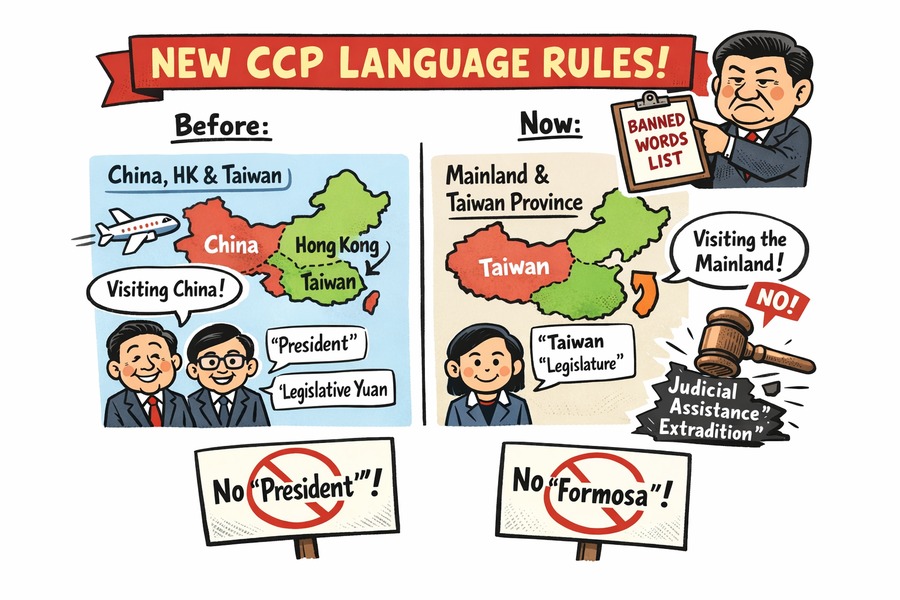
In this context, scholar Dai Yuhui argues that the platform's seemingly "depoliticised" nature is a significant issue. While Xiaohongshu offers a wealth of information, it avoids sensitive vocabulary, thereby presenting a world filtered through Chinese government censorship.
Documents from 2022 reveal that Xiaohongshu conducts strict reviews of politically related content on its platform, with monitoring and censorship targets that include major collective events, significant natural disasters, and social security incidents. The platform reportedly added over 500 sensitive terms related to Xi Jinping within a span of two months.
Dai Yuhui noted that Xiaohongshu embeds political messages within entertainment content. For instance, the topic of Japan's discharge of nuclear wastewater generated extensive discussion on Xiaohongshu, where many beauty bloggers portrayed themselves as "ocean fairies" to highlight ecological damage, aligning with the narrative set by the Chinese Communist Party.
She further elaborated that users, through algorithms, are exposed to filtered, abundant, and singular perspectives of content, which can impact their cognition and daily lives. While this may not lead to immediate changes in national identity or voting behaviour, it represents a long-term and gradual process. △







News magazine bootstrap themes!
I like this themes, fast loading and look profesional
Thank you Carlos!
You're welcome!
Please support me with give positive rating!
Yes Sure!