

In the Xi Jinping Era, Economic Growth Has Plunged 43%
[People News] If one annual Chinese character were used to explain the scene at this year’s Chinese Communist Party Two Sessions, the character xia (“down”) would be the most fitting. What a character xia is! The xia of “base” and “despicable.”
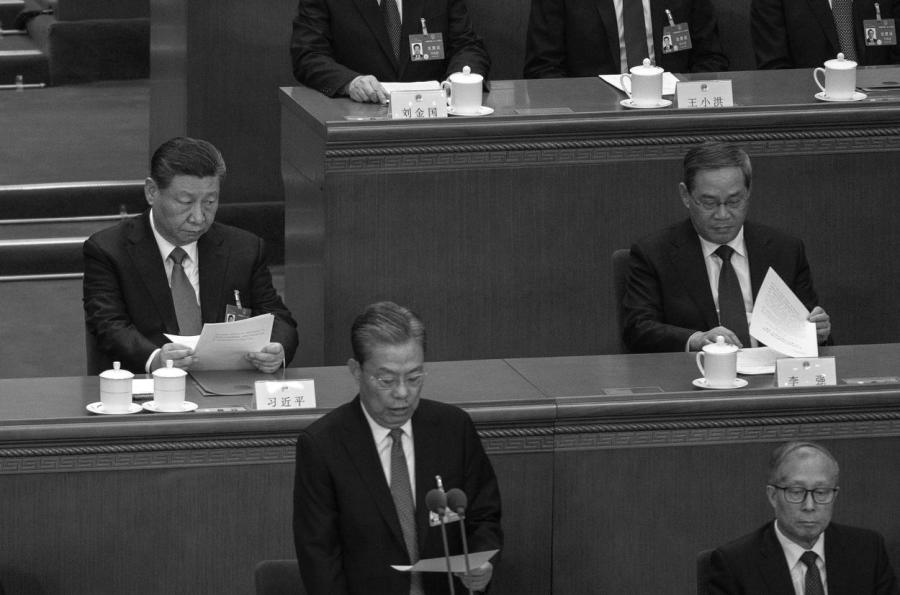
As soon as the Two Sessions began, heavy snow fell in Beijing, and the temperature dropped sharply; the number of national representatives attending the meetings fell drastically, especially the military delegates; Xi Jinping for the first time suddenly stepped down from the dais and voluntarily took a seat among the delegates, with the head of state staging his own delisting—so it turns out that “being taken down” can also be performed as a political show; and in Li Qiang’s government work report, the Chinese Communist Party’s GDP growth target for this year was unwillingly lowered.
It was supposed to be a year of swift success, instant wealth, instant happiness, and dragon-horse spirit; galloping forward with flying hooves, taking the lead with good fortune arriving on horseback—so how is it that none of it came? The year had only just opened, and already the Chinese Communist Party’s Two Sessions had ruined its luck. Truly: “The trembling delegates arrive, the muddled Two Sessions make a racket, near the platform below they force bitter smiles, their thin fate in the Western Hills makes the days hard to bear.”
In fact, every one of the Two Sessions delegates, and even the entire Party, the entire military, and all the people of the country, are hoping Xi Jinping will be brought down—immediately.
To return to the main point. Li Qiang’s Two Sessions report has flooded the screens, not because the self-congratulatory official boilerplate narrative suddenly became popular, but because this year’s GDP target slipping below 5, together with the political logic behind it, has detonated global public opinion.
On March 5 at the Two Sessions, Premier Li Qiang submitted the government work report to the National People’s Congress on behalf of the State Council. The report used strings of retrospective data to boast of the “remarkable achievements” of 2025, and then used a series of forward-looking figures to set the economic goals for 2026. The seamless connection between the cross-year data seems on the surface to sketch an optimistic picture of the Chinese Communist Party economy’s resilience and high-quality development. But on close examination, the official data and hidden narrative are not at all about the economy improving in a new and better direction. Rather, they are plainly “data lying flat” and an “economy rotting away”—flowers fall helplessly with the passing stream.
Let us first look at the evaluations from foreign media and the international community.
Bloomberg called this China’s lowest GDP target since 1991, showing that the old growth model has failed and that Beijing is tolerating slower expansion in order to search for sustainable sources. Nikkei Asia said that China’s GDP target this year is the lowest in decades, and that the Chinese Communist Party premier has acknowledged “difficulties and challenges,” while still pursuing the 2035 economic target.
CNN analyzed that, faced with a “severe and complex situation,” the Chinese Communist Party’s 2026 economic growth target is the lowest in decades, and that its policies for rebalancing toward consumption still appear timid. This is consistent with Capital Economics, which believes that although Li Qiang’s report claims to seek economic rebalancing, its specific policy plans remain cautious. Union Bancaire Privée of Switzerland was even more direct and bold: a shift toward consumption is unlikely unless real estate first stabilizes.
Foreign media first set the tone by stating that since 1991, over a span of 35 years, China’s government GDP target is now at a historic low. The year 1991 was the third year after the Chinese Communist Party’s June 4, 1989 incident. The Chinese Communist Party’s GDP growth in 1989 and 1990 was 3.94% and 4.21% respectively. In 1992, just as international isolation was being lifted, GDP growth that year reached 9.36% because of the low-base effect of the previous two years, but the three-year average GDP growth from 1989 to 1991 was 5.8%. In 2026, China’s government has suddenly knocked the GDP target back to the original level of the early 1990s, meaning economic development has regressed nearly forty years.
Second, foreign media generally believe that the Chinese Communist Party’s so-called stimulus policies for 2026 are conservative and cautious. Based on the literal presentation in Li Qiang’s work report, foreign media believe that China’s economic development goals are moving in a more pragmatic and higher-quality direction, attempting to shift from the old investment model toward stimulating domestic demand, but that the policy measures themselves seem too weak to achieve this.
This is the conclusion foreign media draw from analysis of China’s official text. In reality, China’s official narrative from top to bottom is utterly lacking in transparency and truthfulness. Public data are no longer a reliable basis for judging the real condition of the Chinese Communist Party economy. Making data lie has already become the main melody of Cai Qi’s narrative of economic brightness. For three consecutive years, the statistics bureau has perfectly matched each year’s Two Sessions growth target. The production of such a perfect script is less something planned than something produced by the statistics bureau’s keyboard warriors burning the midnight oil. In 2025, total fixed-asset investment fell 11%, yet contributed 0.9 percentage points under the GDP capital formation category. This logical paradox exposes how even the most meticulous data manipulation cannot compensate for the holes in the system itself. This is not the original sin of data, but the unavoidable price of data falsification.
Total GDP and GDP growth, within the Chinese Communist Party’s system of political discourse, are widely recognized as natural symbols of regime legitimacy. Continuously rising GDP figures are not only the certificate of qualification for authoritarian power, but also the practical basis for internal interest distribution within the ruling group and the glue that maintains officials’ loyalty. In other words, the cake is getting smaller and smaller, nobody is getting enough to eat, and not only will the common people revolt, but the officialdom will also lie flat and rot away—shouting “long live” while cursing inwardly, and criticizing the central leadership whenever given the chance. This is Xi Jinping’s real dilemma at present. It is not that he does not want to anchor GDP growth, but that the broken ship of the economy is already close to sinking to the bottom and simply cannot be anchored anymore.
This is not active macro-control, but passive loss of control; not an orderly transition, but a forced relocation. First, the Chinese Communist Party economy faces severe structural challenges and a debt crisis. The supply-side and investment model have already created an overcapacity economy that cannot be eliminated in the short term. Decades of疯狂 real-estate development by local governments have accumulated a mountain of debt, and the real hidden local debt may already exceed 300% of total GDP. This means the Chinese Communist Party can no longer keep levering up. It cannot keep the game going, and the target simply cannot be achieved.
Second, China’s population aging is accelerating, and the labor force population has been declining since its peak in 2012. United Nations data show that in 2023, the Chinese Communist Party’s working-age population fell by about 7 million. The fertility rate is below 1.0, the pension burden is rising, and both consumption and innovative momentum are weakening. Unlike the highly inclusive institutional transitions of developed countries, China lacks a sufficiently broad and balanced social security system. The real youth unemployment rate is as high as 40% to 50%, and the demographic dividend has already exited the stage. This creates a vicious circle and a dead loop: on the one hand, because labor prices rise, companies face heavy burdens and cannot afford to hire; on the other hand, huge numbers of unemployed people are crying out to be fed. At present, the Chinese Communist Party is vigorously developing the AI industry, and in a few years wants robots to enter thousands of households. That means tens of thousands more people will lose their rice bowls and be left waiting to die. Setting the economic growth target too high not only makes it impossible to achieve, but will instead intensify involution.
Third, during 2023–2024, CPI remained persistently weak, at its lowest point close to 0%, reflecting ongoing weak consumption. Although stimulus measures such as central bank interest-rate cuts and fiscal expansion supported growth in 2024, their effect was truly limited. Household savings rates remain too high, corporate loan data reflect a chilling lack of confidence, and money is circulating outside the real economy. Only by solving the consumption problem can deflation be solved; only by solving deflation can GDP growth receive positive support. If someone sets economic targets merely by aligning upward without considering the reality of deflation, it is very likely to produce economic stagflation.
Fourth, there is external geopolitical and trade pressure. The geopolitical pressure that Trump 2.0 is bringing to Xi Jinping is becoming increasingly evident. It is not just about tariffs. The Chinese Communist Party’s authoritarian tentacles and global long arm are being ruthlessly chopped off by Trump. Authoritarian regimes globally are facing an unprecedented structural collapse: Syria, Bangladesh, Venezuela, Iran, Cuba—one after another, falling like dominoes. On top of that, potential tariff escalation from the United States and the European Union against China makes the Chinese Communist Party regime even more fragile under global economic volatility, and its economy more prone to snapping. Matching a high GDP target under such conditions is unrealistic magical thinking and will only place pressure on the Chinese Communist Party’s exports and capital markets.
In 2026, Li Qiang lowered the GDP target in the government work report by a 0.5 percentage-point range. Put nicely, this signals a pragmatic economic orientation and a transformation and upgrading of the development model. Put bluntly, even driving ducks onto the perch will not make them move anymore.
Look at the changes in China’s GDP growth during the more than ten years since Xi Jinping came to power. Xi Jinping has been sparing no effort in reshaping a downward spiral curve of the Chinese economy. From 2012 to 2014, GDP was still in the high 7-percent range; in 2015 it fell below 7 into the 6-percent range; after that, it took only five years to plunge vertically to the bottom—2.34% in the pandemic year of 2020. During the three years of dynamic zero-COVID from 2020 to 2022, everything except the virus was zeroed out. From 2023 to 2025, GDP fell below 6 into the 5-percent range. The era of 5 only lasted three years, and in 2026 it is heading into the 4s.
Basically, the speed at which Xi Jinping’s economy is breaking down and sinking is measured in three-year standard units: every three years it falls by 1 percentage point. In the 14 years since Xi Jinping took power, China’s GDP has gone from 7.9% in 2012 to an expected target of 4.5% in 2026—a sheer plunge of 43%. What a clean halving! By comparison, the statistics bureau almost seems to have become an obstacle. Without the statistics bureau, the Chinese Communist Party’s GDP figures might have lost even their last shred of cover and been chopped off at the knees entirely.
(First published by People News) △







News magazine bootstrap themes!
I like this themes, fast loading and look profesional
Thank you Carlos!
You're welcome!
Please support me with give positive rating!
Yes Sure!