
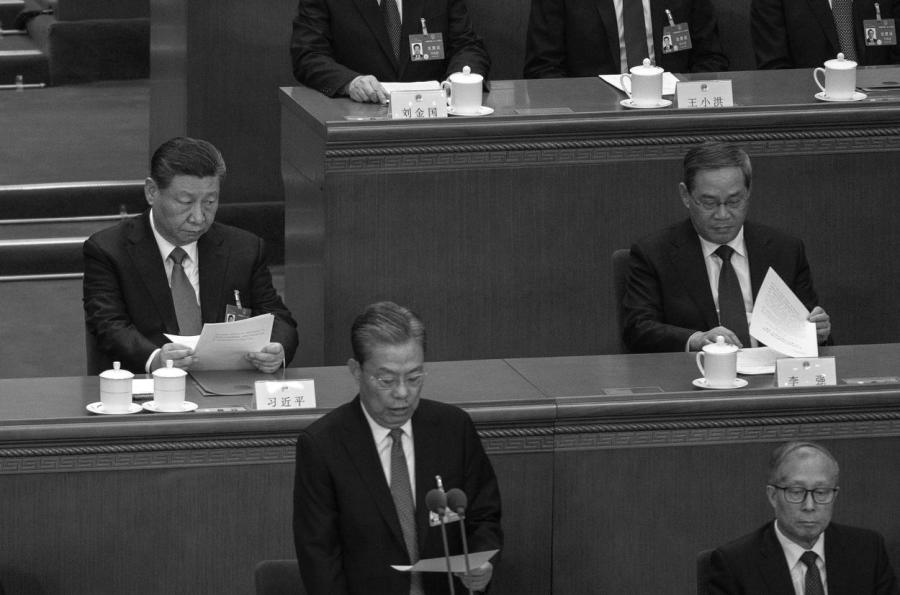
Chinese Communist Party leader Xi Jinping and Premier Li Qiang (second row, right) at the closing meeting of the National People's Congress in the Great Hall of the People. (Photo by Kevin Frayer/Getty Images)
[People News] On March 5, the opening session of the Fourth Session of the 14th National People’s Congress of the Chinese Communist Party was held, and the 2026 Government Work Report was formally released. Premier Li Qiang personally revealed the true state of China’s economy. As for this report, Xi Jinping’s greatest feeling certainly would not have been excitement, but embarrassment. Why say that? Because every figure Li Qiang read out on stage was, so to speak, a dagger to the heart. Each one sounded like a merciless slap in the face of Xi Jinping’s rhetoric about the “rise of a great power.” Could it be that even the most loyal follower has turned against him?
First, let us look at the number that is the most “face-slapping”: the GDP growth target.
Li Qiang announced that the 2026 growth target would be set between 4.5% and 5%. Some people may think that sounds acceptable. But if you open a history book, you will see that this is the lowest target since 1991 — the lowest in a full 35 years.
What does this show? It shows that Beijing has realized it can no longer keep exaggerating without limit. In the past, it always talked about “ensuring 5%” and “ensuring 6%.” Now, according to Li Qiang’s formulation, even 4.5% has become a threshold that requires “room to spare.” Even more ironically, officials once said that by 2035, per capita GDP should double, which would require annual growth of no less than 4.6%. Now Li Qiang has set the lower bound at 4.5%. This is equivalent to publicly admitting that Xi Jinping’s grand “2035 long-range goal” has now failed.
Second, let us look at why things have ended up this way. It is because the dividends of “reform and opening up” have been exhausted.
The well-known China expert Carl Minzner once said something especially incisive: “Deng Xiaoping’s era is over, and China has entered the ‘anti-reform era.’”
Think back for a moment: why was the economy able to take off during Deng Xiaoping’s era? Because at that time the emphasis was on “pragmatism,” local officials were given freedom, and the introduction of foreign ideas was allowed. But what has Xi Jinping been doing over the past decade? He has been systematically destroying those advances. He has placed “security” ahead of “growth.” In China today, lawyers are arrested, the media are silenced, and scholars do not dare to speak. The whole society has fallen into a state of “collective silence” and “self-censorship.”
To put it plainly, Zhongnanhai is now a place where one man alone makes the decisions. This led to tragedies such as the “dynamic zero-COVID” policy — even though all of society knew something was wrong, no one dared to oppose Xi Jinping. The price of this extreme centralization is the complete suffocation of economic vitality.
Third, hidden in Li Qiang’s report is an extremely dangerous signal: we are now engaged in a “desperate gamble.”
The report frantically emphasizes “new quality productive forces” and “artificial intelligence, AI.” It sounds lofty, does it not? But if you look at the data behind it, it is enough to make you break out in a cold sweat. China’s investment now accounts for a share of GDP that is 20% higher than the global average, while household consumption is 20% lower.
What does that mean? It means the government is borrowing desperately and producing desperately, but ordinary people simply do not have the money to buy, and foreign markets cannot absorb so much capacity either. In the end, this can only trigger a global trade war.
In addition, the real estate sector once contributed nearly one-third of China’s economy, but today its crisis has dealt a heavy blow to the overall economy. The property sector has collapsed, local governments are heavily in debt, yet Li Qiang still wants to maintain the deficit ratio at the historically high level of 4%, while also issuing 1.3 trillion yuan in ultra-long-term government bonds. This is not putting out a fire; it is borrowing money to prolong life.
Even more absurdly, the report actually listed “promoting CPI from negative to positive” as an annual task.
What does that show about the severity of deflation? In a normal country, inflation is the risk; but in China today, even a tiny bit of mild price recovery is being treated as a “policy success.” Behind this are the unemployment of countless young people and the shrinking assets of the middle class.
Xi Jinping has spent ten years destroying the political legacy and growth engine left behind by Deng Xiaoping. Li Qiang now can only try, on this ruined foundation, to buy time with debt and so-called “new technology.”
In the end, one sentence sums it up: because power is so highly concentrated, this system has lost the ability to repair itself.
When the growth target falls back to the level of 35 years ago, what people see is not a turning point, but despair. When the “China Dream” has turned into a “deflation dream,” what illusions can ordinary people still have about this model?
(First published by People News)
△





News magazine bootstrap themes!
I like this themes, fast loading and look profesional
Thank you Carlos!
You're welcome!
Please support me with give positive rating!
Yes Sure!