
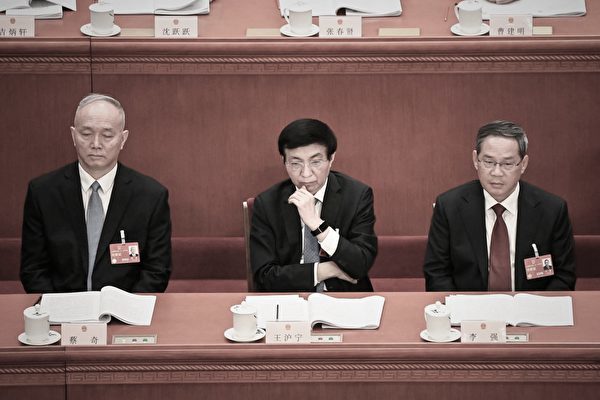
On March 7, 2023, (from left to right) Cai Qi, Wang Huning, and Li Qiang at the Chinese Communist Party's National People's Congress. (Greg Baker/AFP via Getty Images)
[People News] At this year's Beijing Two Sessions, the performance of Wang Huning, Chairman of the National Committee of the Chinese People's Political Consultative Conference, was notably "active." He not only engaged in secret message exchanges with other senior Chinese Communist Party leaders during the meeting but also participated in a note-passing game. However, a camera captured him bowing to Xi Jinping, which may suggest an underlying political storm behind these actions.
According to Ming Pao, Wang Huning frequently conversed with Xi Jinping, who was seated to his left, and then seemed to relay messages to Vice Premier Ding Xuexiang, who was seated to his right. Ding then communicated the information to Vice President Han Zheng. The specifics of what these high-ranking officials discussed during this "message-passing game" remain unclear, but they all appeared to be smiling.
After a while, Wang Huning seemed to have an urgent matter to discuss with State Councilor Chen Yiqin, who was seated in the back row. In such a serious setting, he surprisingly asked a CCTV photographer, who was moving around the podium, to act as a "messenger" and handed a small note to Chen Yiqin. Subsequently, Chen Yiqin requested the photographer to pass back another note. Wang Huning then directly handed a piece of paper with four lines of text to Xi Jinping, who read it, offered a few comments, and returned the note to Wang. After the session concluded, Xi Jinping even turned around to engage in conversation with Chen Yiqin.
Wang Huning's public display of playing the "message-passing and note exchange game" at the opening ceremony of the Two Sessions seems to indicate his particularly close relationship with Xi Jinping within the core leadership circle. Next, we will examine another, more significant action of this "three-term national advisor," which may conceal a daunting political storm behind it.
The Storm Behind Wang Huning's Bow to Xi
On March 4th, the Chinese People's Political Consultative Conference convened in Beijing. After delivering his speech, Wang Huning bowed to Xi Jinping as he returned to his seat. Observers noted that this gesture from Wang Huning has established a new dynamic in the relationship between the Central Standing Committee and the top leader.
However, there is an extremely shocking piece of news hidden behind Wang Huning's bow.
Recently, overseas media and political commentators have reported that Wang Huning's daughter and her family, who were originally living in Shanghai, were abruptly instructed by the Central Office to pack their belongings and relocate to Beijing overnight under the guise of 'ensuring the safety of the leader's family' just before the Two Sessions.
While this may sound like 'organisational concern', it is clear to those with insight that this is essentially taking them to Beijing as 'hostages'.
Why would Xi Jinping take action against this 'old minister'? Media commentator Jiang Feng suggests that Xi Jinping is concerned that when the regime is on the brink of collapse, the first to abandon ship and privately pledge allegiance to the Americans could be this exceptionally astute scholar. By holding Wang Huning's vulnerabilities, he is issuing a warning.
Wang Huning is certainly an outlier in the ranks of the Chinese Communist Party. A graduate of Fudan University, he entered Beijing during the Jiang Zemin era and has navigated through Hu Jintao's leadership to the current Xi Jinping era, earning the title of 'state master of three generations'.
However, his reputation in academic circles and personal life is quite complicated. Scholar Xia Ming, who has had a ten-year mentor-mentee relationship with him, described him as intelligent but lacking a solid academic foundation, cautious in nature, highly perceptive, and 'capable of acting'. Additionally, some have revealed details of his marital history, stating that 'the higher his official rank, the younger his wives become', with one of his four wives being 30 years his junior, thus earning him the label of 'scumbag' in officialdom.
This cautious and theatrical individual once confessed at a political meeting that he had, against his better judgment, established a theory for Jiang Zemin. This 'fence-sitting' nature has made him a 'roly-poly' in the political landscape, but it has also caused the suspicious Xi Jinping to feel uneasy.
Wang Huning bowed to Xi Jinping, and behind that gesture may lie not respect, but rather profound fear and humility. When a regime starts to depend on controlling family members to ensure loyalty, even without external intervention, its internal collapse becomes inevitable, which is precisely what Xi Jinping fears the most at this moment.
(First published in People News)
△






News magazine bootstrap themes!
I like this themes, fast loading and look profesional
Thank you Carlos!
You're welcome!
Please support me with give positive rating!
Yes Sure!