
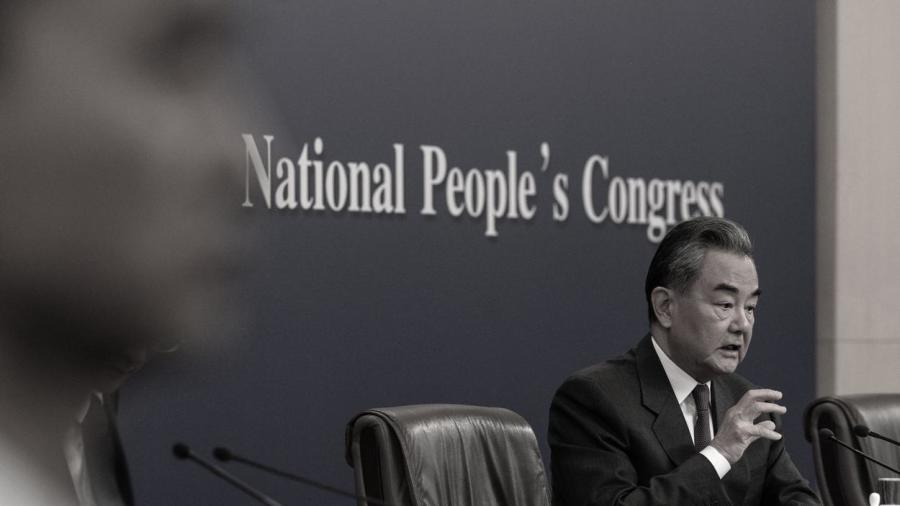
Image: Chinese Foreign Minister Wang Yi. (Photo by Kevin Frayer/Getty Images)
[People News] In a CIA recruitment advertisement aimed at Chinese intelligence sources, the CCP leadership was referred to as “madmen.” To save face, the CCP changed the Chinese transliteration of the U.S. Secretary of State’s name from “卢比奥” (Lu Bi’ao) to “鲁比奥” (Lu Bi’ao with a different first character), in order to avoid the embarrassment of having “卢比奥” listed on its sanctions roster. Some netizens commented, “Only madmen could come up with this kind of shameless tactic just to save face.”
On February 13 local time, CCP Foreign Minister Wang Yi met with U.S. Secretary of State Rubio while attending the Munich Security Conference. Facing Rubio, who had been placed on the CCP’s sanctions list, Wang Yi declared that between China and the United States, “dialogue is better than confrontation, cooperation is better than conflict,” prompting ridicule online. Before taking office, Rubio had been sanctioned twice by the CCP for criticizing its human rights record. After he assumed the role of U.S. Secretary of State, CCP officials quietly altered his Chinese name to “鲁比奥” to mask the awkwardness.
According to Reuters, this was the second face-to-face meeting between Rubio and Wang Yi. The two shook hands and posed for photos before the talks, then entered the hotel conference room with their respective teams and sat down opposite each other to begin discussions. Neither made public remarks nor responded to media questions.
It is worth noting that U.S. President Trump is scheduled to visit China in April. Whether Rubio will accompany Trump remains to be seen. If he does, will the CCP issue him a visa? It appears that sanctioning Rubio—part of its “wolf warrior” diplomacy—has ended up backfiring on the CCP, effectively creating trouble for itself.
In January 2025, former U.S. President Trump returned to the White House, a development that left the CCP both resentful and fearful. Trump’s appointed Secretary of State, Rubio, has also been a figure the CCP finds particularly troublesome. Rubio has long focused on China’s human rights issues. While serving as a Republican U.S. Senator from Florida, he was sanctioned twice by the CCP in July and August 2020 for condemning the CCP’s repression of Uyghurs and Hong Kong citizens, and was even singled out by CCP state media. After Rubio became Secretary of State in Trump’s new administration, the CCP did not lift its sanctions against him.
Later, observers noticed that the CCP quietly made a small adjustment. On January 16, 2025, in the transcript of that day’s press conference published on the CCP Foreign Ministry’s website, Rubio’s name was rendered as “鲁比奥.” Prior to that, the official translation had consistently been “卢比奥.”
On January 22, the day after Rubio formally took office as Secretary of State, CCP Foreign Ministry spokesperson Mao Ning was asked whether changing “卢比奥” to “鲁比奥” meant he was no longer under Chinese sanctions.
Mao Ning appeared slightly embarrassed and responded: “Oh, oh, I hadn’t noticed that, but I can look into it. But I think what’s more important is his English name.”
Rubio frequently criticizes the CCP. Just days before Mao Ning’s awkward response—on January 15, 2025—Rubio, in his opening statement at a Senate Foreign Relations Committee hearing, criticized the CCP for achieving superpower status through repression, lies, deception, hacking, and theft. “All of this has come at the expense of our interests and the well-being of their own people,” he said.
In August 2020, the CCP announced sanctions against six U.S. lawmakers, including five senators and one representative, as well as the heads of four organizations. Rubio was listed first. The CCP claimed these individuals had “behaved egregiously” on Hong Kong-related issues, “blatantly interfered in Hong Kong affairs,” and “grossly interfered in China’s internal affairs.”
Rubio did not take the sanctions seriously. At the time, he remarked: “Last month, the CCP banned me from entering China. Today, they announced sanctions against me. I don’t want to be overly sensitive, but I’m starting to think they may not like me very much.”
The CCP did not specify the details of the sanctions at the time, though later counter-sanctions included specific measures. For example, sanctions against U.S. Congressman Jim McGovern included freezing movable and immovable property and other assets in China; prohibiting organizations and individuals in China from engaging in transactions or cooperation with him; and denying visas and entry to him, his spouse, and children.
The lack of specific measures in 2020 may have been because the CCP had not yet passed its Anti-Foreign Sanctions Law, which was enacted in June 2021. Most subsequent sanctions cited this law.
However, the CCP may now be relieved that it did not specify measures at that time. Otherwise, if it had explicitly barred Rubio from entry or visa issuance, his later appointment as Secretary of State would have created an awkward situation for Beijing.
Chen Yonglin, former political consul at the CCP Consulate General in Sydney, told Radio Free Asia that the CCP Foreign Ministry’s translation office and Xinhua’s name translation office maintain standardized and strictly regulated translations of foreign political figures’ names. The change by CCP diplomats and state media was clearly an official decision made after internal discussion, aimed at providing a way out of the earlier sanctions and saving face.
Chen said: “They could say the one sanctioned was ‘卢比奥,’ and this ‘鲁比奥’ is the Secretary of State—not the same person. The CCP never admits mistakes. Using ‘鲁比奥’ to extricate itself is actually unnecessary.”
This meeting between Wang Yi and Rubio in Munich once again sparked heated discussion on the X platform.
Netizens commented: “The sanctioned one’s surname was ‘卢,’ not ‘鲁’—not the same person.” “This is the CCP’s logic of squeezing and releasing—bluffing as if it were truly the boss!” “The Party has survived to this day by opportunism and shifting with the wind.”
Others wrote, “Rubio doesn’t care about being sanctioned by the CCP,” and “Let’s see whether Rubio accompanies Trump to China this time. If he goes without sanctions being lifted, who wins?”
On other platforms, users remarked: “When they need him, he’s ‘卢比奥’; when they want to achieve their own goals, he becomes ‘鲁比奥.’ Changing his name is just the CCP acting according to its own needs,” “I’ve seen shamelessness, but never this shameless,” and “Rubio is considered one of the Republican Party’s rising stars—if he runs for president in the future, that will be something to watch.” △







News magazine bootstrap themes!
I like this themes, fast loading and look profesional
Thank you Carlos!
You're welcome!
Please support me with give positive rating!
Yes Sure!