
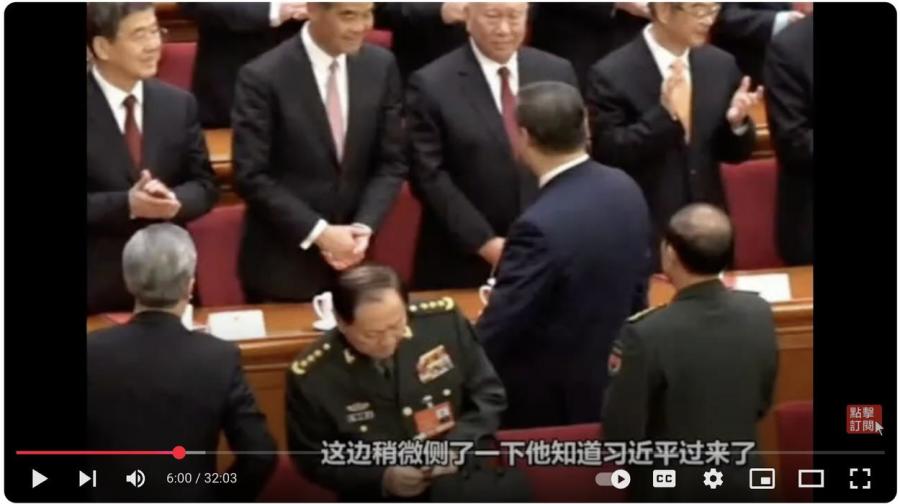
During the closing ceremony of the Two Sessions, video footage showed that as Xi Jinping was leaving, several Politburo members, (Screenshot from video)
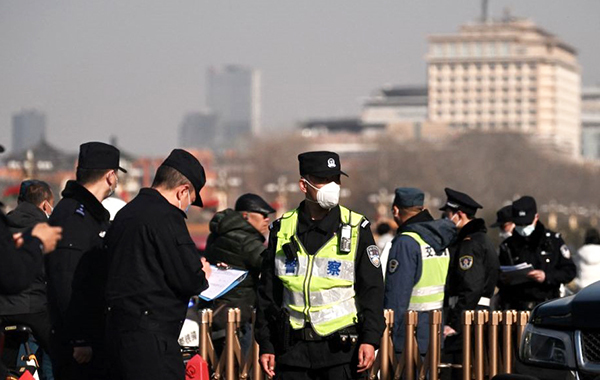
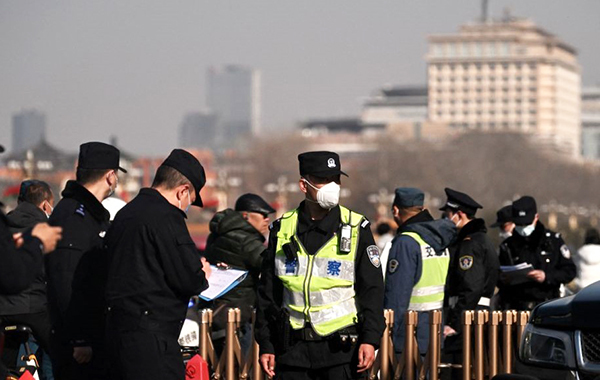
[People News] Over the past two days, the hottest topic in Beijing has undoubtedly been the “Two Sessions.” On March 4, Tiananmen Square in Beijing was under tight security as China officially entered its annual week of core political meetings. You might think that such repetitive meetings have nothing interesting to watch—aren’t they just a group of so-called representatives sitting together, raising their hands and going through the motions? But the 2026 Two Sessions are full of drama everywhere.
According to official CCP information, the Fourth Session of the 14th National Committee of the Chinese People’s Political Consultative Conference opened at 3:00 p.m. on March 4 and will close on the morning of March 11, lasting seven days. The Fourth Session of the 14th National People’s Congress opened on March 5 and will close on the afternoon of March 12, lasting eight days.
According to the official agenda, the “Two Sessions” involve the government work report and the draft outline of the “15th Five-Year Plan (2026–2030) for National Economic and Social Development.”
Will China’s Economy Follow the Xi Route? Li Qiang’s Difficult Performance
The issue attracting the most outside attention is first and foremost the economy. Premier Li Qiang will deliver the government work report to the National People’s Congress, which for him will be a difficult performance. He is expected to announce China’s economic growth target for 2026, which experts predict will be set between 4.5% and 5%.
Although the CCP government claims that last year’s GDP growth reached the expected 5%, public sentiment clearly shows a gap with the official narrative. The real estate sector remains cold, and young people are still struggling to find jobs.
As everyone knows, economic data can be adjusted at any time to meet the needs of political stability. Liu Jieyi, spokesperson for the CPPCC, also unusually admitted at a press conference on the 3rd that China’s economy is currently “advancing under pressure.”
The “15th Five-Year Plan” to be decided at this year’s Two Sessions represents Beijing’s response plan. The authorities want to force the economy away from the old path of “borrowing money to build housing and construction” and redirect it toward “high technology and innovation-driven growth.”
But the problem is that when people lack confidence in the future and prefer to save money rather than spend it, can technological research and development alone really save the livelihoods of ordinary citizens? Zeng Ruisheng, director of the China Institute at SOAS University of London, said bluntly in an interview with Radio France Internationale that current policies still appear aimed at reinforcing the “Xi Jinping line,” which may find it difficult to address the fundamental problem of weak household consumption.
At present, China faces multiple pressures including a sluggish real estate market, high youth unemployment, heavy local government debt, and deflation. According to the latest official data, manufacturing activity contracted more than expected in February, indicating that economic recovery remains weak.
Despite the economic slowdown, the defense budget is still expected to increase. Observers predict that this year’s defense budget growth will remain similar to previous years, slightly above 7%. For Beijing, military spending is not only about fighting wars but also about “protecting the regime.”
Absences on the Rostrum — Have the “Actors” Disappeared?
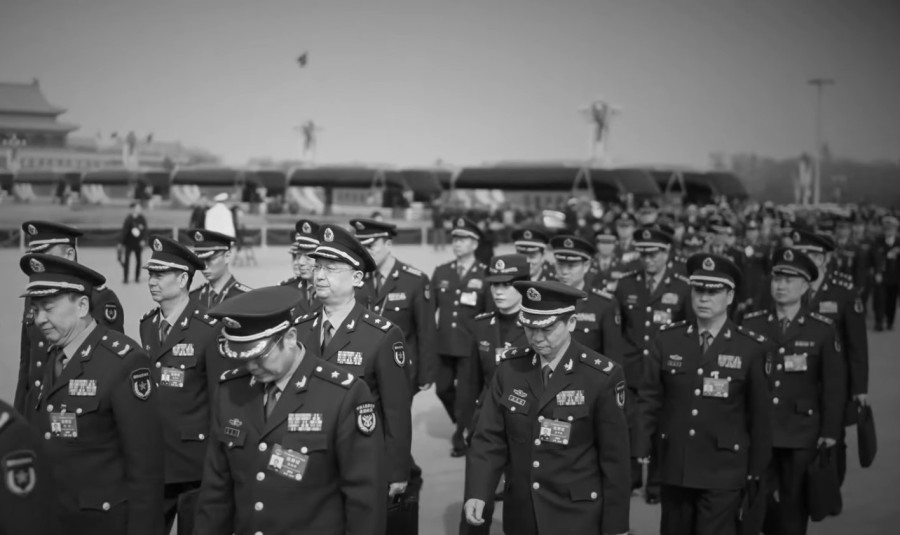
In addition to the economy, personnel developments at the Two Sessions have also drawn intense attention. At the opening ceremony of the CPPCC on the 4th, the “absence” on the rostrum became the focus of media attention worldwide. Among the 23 members of the Politburo, 21 attended. The absentees were Zhang Youxia, vice chairman of the Central Military Commission who was placed under investigation in January, and Ma Xingrui, former Xinjiang Party secretary who has disappeared from public view since last October.
In fact, the reduction in delegates before this year’s Two Sessions has been described as “the most serious since the Cultural Revolution.”
The 14th National People’s Congress originally had 2,977 deputies but currently has only 2,878, a reduction of 99. Among them, the military delegation has seen the most significant reduction. According to incomplete statistics, over the past two-plus years about 36 military deputies to the National People’s Congress have been removed. The 14th CPPCC National Committee originally had 2,169 members but currently has around 2,100.
Khamenei and Trump Stir Up Zhongnanhai
Just a few days before the opening of the Two Sessions, Xi Jinping’s good friend Khamenei died. For Beijing, this was a heavy blow. More than 90% of Iran’s oil is sold to China, and the two sides also have a $400 billion cooperation plan.
Now that Iran’s political situation has become unstable, China’s energy supply faces potential threats. More importantly, what Beijing’s leadership actually fears most is the precedent of the United States carrying out “targeted eliminations,” as well as the possibility that anti-government protests within Iran could create a chain reaction affecting ordinary people at home.
Meanwhile, China–U.S. relations remain fragile. The U.S. president who killed Xi Jinping’s good friend Khamenei—Donald Trump—is expected to visit Beijing in early April. What expression Xi Jinping will use to greet Trump, the man who eliminated his good friend, will certainly be a major test of his acting ability. Even if he hates him to the bone, he must still put on a smiling face. Even if he fears becoming the next target of the U.S. military, he must still brace himself to exchange polite greetings with Trump.
Of course, to understand why Agence France-Presse described the Two Sessions as a “highly ritualized event with almost no room for improvisation,” one only needs to look at this scene: Chinese actor Jin Dong, who once played Xi Jinping’s father Xi Zhongxun, and martial arts star Donnie Yen were among celebrity delegates surrounded by the media the moment they entered the venue, becoming the most popular members of the CPPCC.
You then understand that the Two Sessions function as a rubber stamp for CCP decision-making and will not solve the livelihood problems faced by ordinary people.
(First published by People News)
△




News magazine bootstrap themes!
I like this themes, fast loading and look profesional
Thank you Carlos!
You're welcome!
Please support me with give positive rating!
Yes Sure!