
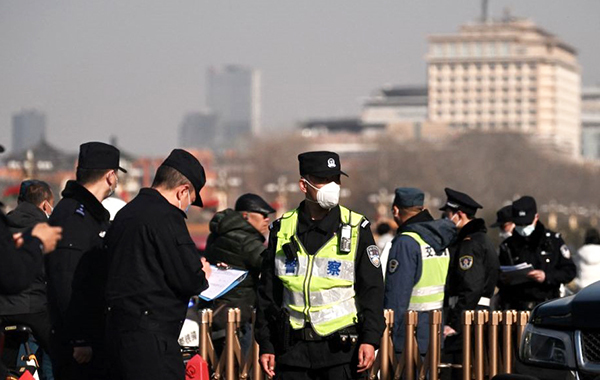
Before the CCP's Two Sessions convened, Beijing police conducted inspections at Tiananmen Square.
[People News] China’s annual “Two Sessions”—the meetings of the National People’s Congress (NPC) and the Chinese People’s Political Consultative Conference (CPPCC)—have long been criticized as a waste of taxpayer money. In 2026, the gatherings are taking place under the shadow of internal power struggles and the volatile situation in the Middle East. As in previous years, the Chinese Communist Party (CCP) has treated the event as if facing a major threat. Observers note that the extreme secrecy and control of the regime reflect the deepening decay within the political system, with some even suggesting that the CCP may be approaching its final stage.
High Alert: “Men in Black” Monitoring Participants
Whenever the CCP holds a nationwide meeting, the atmosphere resembles a state of emergency. On the morning of March 5, as delegates arrived at the venue, the area was filled with plainclothes security personnel dressed in black, closely watching every movement around them.
Videos from the scene show delegates stepping off buses and entering the hall one by one while numerous black-clad personnel monitored the surroundings.
On the roads leading from Chang’an Avenue to Tiananmen Square, multiple security checkpoints were set up. Police guarded every intersection. Only visitors or pedestrians with reservations were allowed through after presenting identification, undergoing facial recognition, and having their bags inspected.
Before entering Tiananmen Square, visitors had to pass strict security checks:
-
Down jackets had to be removed for inspection.
-
Written papers and notebooks were examined page by page.
-
Items inside packages had to be opened.
-
Certain medications, such as sleeping pills, were prohibited.
-
Phone cases had to be removed for inspection to ensure nothing was hidden inside.
Access to the square also required scanning official event credentials.
Armed police patrolled Chang’an Avenue, while on Wangfujing Street, security personnel stood guard with shields. In the Zhushikou area, every pedestrian overpass was staffed with at least two guards on duty around the clock. Observers speculated that the measures might be intended to prevent incidents similar to the Sitong Bridge protest, or to stop possible acts such as jumping from bridges or sabotage.
Some commented that the scene resembled the Japanese occupation era, when civilians were forced to show identification papers under military inspection.
GDP Growth Target Lowered
During the Two Sessions, official data showed that China’s military budget has increased by more than 7 percent annually for five consecutive years. This year’s budget exceeds 1.9 trillion yuan, the lowest growth rate in five years but still higher than the country’s GDP growth target.
Premier Li Qiang announced that the economic growth target for this year is 4.5 to 5 percent, slightly lower than the previous target of “around 5 percent.”
Financial commentator Caijing Lengyan suggested that the slight slowdown in military spending growth may reflect severe fiscal pressures.
“Both central and local tax revenues have dried up. After the collapse of the real estate market, government finances at all levels are under serious strain, so they no longer have the ability to keep increasing military spending the way they did over the past two decades.”
U.S.-based economist Huang David told The Epoch Times that the lower growth target reflects China’s economic slowdown, with major problems including the real estate crisis, local government debt, and weak consumption. At the same time, the authorities cannot set the target too low for fear of undermining market confidence.
Commentator Chen Pokong, also speaking to The Epoch Times, said that with political upheavals in Venezuela and Iran, which supply China with cheap oil, combined with the U.S.–China trade conflict, China’s economic outlook has become even more uncertain. In his view, even the 4.5 percent growth target is not credible.
Analysts such as Shen Ming-shih from Taiwan’s Institute for National Defense and Security Research say that comparing the defense budget with the economic growth target shows that the CCP continues to prioritize military spending over economic development, reflecting a “military-first” approach similar to North Korea’s policy.
Observers also note that the publicly announced military budget only reflects official figures, while domestic security spending—used to maintain political stability—is believed to be enormous.
Military Delegates No Longer Named
On March 4, 2026, the day the CPPCC meeting opened, the PLA’s official newspaper published a 2025 review of military members’ performance in the CPPCC.
Unlike previous years, the report did not mention the names of any military delegates. Instead, it used vague phrases such as “military CPPCC members,” “many military members,” or “some members.”
In contrast, the 2024 report clearly listed names, noting, for example, that delegate Gao Jin conducted research in Hunan, Tianjin, and Hebei, and that Zheng He focused on artificial intelligence development and application.
Analysts believe the omission of names is intentional, possibly to avoid embarrassment because so many military CPPCC members have recently been removed from their positions.
For instance:
- On February 6, 2026, Major General He Song, deputy head of the PLA Logistics Support Department, was stripped of his CPPCC membership.
- On March 2, 2026, Gao Jin was removed from his posts as a CPPCC Standing Committee member and deputy director of the Economic Committee, and his membership was revoked.
Multiple Crises Facing the CCP
Observers believe the CCP is facing multiple crises. China’s economy continues to deteriorate, industries are struggling, and public dissatisfaction is rising. Meanwhile, Xi Jinping’s governing ability is increasingly questioned, and elite power struggles appear to be intensifying.
As a result, the authorities are highly alert to any potential “black swan” or “gray rhino” events—unexpected crises that could emerge suddenly.
The situation in Iran has also cast a shadow over the Two Sessions.
At a press conference before the meetings on March 4, NPC spokesperson Lou Qinjian said China was closely monitoring developments in Iran.
Observers believe the CCP is feeling simultaneous political and economic pressure, both domestically and internationally. The unusual scenes surrounding the Two Sessions, they argue, reflect a regime under strain.
Some commentators even speculate that if current trends continue, Beijing might not hold the Two Sessions in the next year or two.
(People News first published) △






News magazine bootstrap themes!
I like this themes, fast loading and look profesional
Thank you Carlos!
You're welcome!
Please support me with give positive rating!
Yes Sure!