

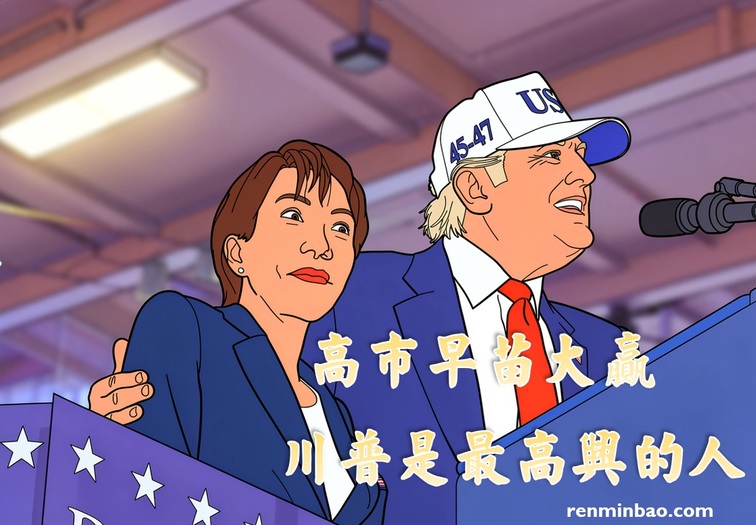
After winning by a large margin, Sanae Takaichi holds a press conference. (Video screenshot / Xintangren)
[People News] According to the results of the recent House of Representatives election, the 221st extraordinary session of the Diet was convened on February 18. The outgoing cabinet resigned collectively, and that afternoon, the newly elected members of the House of Representatives, together with the current members of the House of Councillors, voted separately to select a new prime minister and form a new cabinet.
In the House of Representatives’ prime ministerial nomination vote, Sanae Takaichi received 354 votes out of 464 valid ballots. In the House of Councillors, after two rounds of voting, Takaichi ultimately won 125 out of 246 votes.
After being elected, Prime Minister Takaichi immediately began forming her cabinet. She has stated that all current cabinet members will remain in office. Following the prime ministerial appointment ceremony and the attestation ceremony for ministers at the Imperial Palace, the “Second Takaichi Cabinet” was expected to be formally inaugurated on the evening of the 18th.
Subsequently, Prime Minister Takaichi would hold a press conference to outline her governing policies, including her long-advocated positions on “responsible proactive fiscal policy” and “strengthening information security.”
Before the nomination vote, Takaichi had told a joint meeting of LDP members in both houses: “To make Japan strong and prosperous, we will unite the entire party and implement the policies promised in the election platform in the fastest and most effective way, living up to the trust placed in us by the people.”
Chinese “Little Pink” Netizens Make a Spectacle of Themselves
When Takaichi led the cabinet in a collective resignation (a normal procedural step), Chinese nationalist “little pink” netizens—who do not understand Japan’s cabinet procedures—became excited, claiming that “only she is left, all alone,” and some even thought Takaichi had stepped down, creating a huge misunderstanding.
According to Liberty Times, trending keywords on China’s Weibo include “Takaichi cabinet collectively resigns.” Related posts claimed that “Takaichi’s mission has been completed, and now it’s time to change to a more agreeable person.” In the comment sections, many “little pinks” cheered: “This is Takaichi’s retribution” and “This is good news.” Clearly, they misunderstood the situation and thought Takaichi was facing a political crisis.
Some Chinese netizens further claimed that Japan’s cabinet resignation meant Takaichi wanted to replace all ministers with her own confidants so that right-wing forces could take full control. This again shows a lack of access to overseas news, since members of Takaichi’s first cabinet were set to remain in office, with no reshuffle involved.
In fact, the reason “little pink” netizens often make such embarrassing mistakes is that they believe CCP propaganda and, due to the Great Firewall’s strict information control, cannot access the outside world. With one-sided information, they frequently end up making fools of themselves.
Overseas commentator Duolunfang Lian said, “I actually understand why the CCP dislikes Sanae Takaichi. But Chinese media have a bad habit—they love to lie. If they dislike her, they just keep fabricating stories that she is unpopular. If you only watch domestic media, you’d think she’s about to be forced out any moment, and then elections come, and reality slaps them in the face. What’s most absurd is that every time they still claim it was ‘foreign media’ that said so.”
A reader of People News, posting under the name “Lizhi,” wrote that Global Times only reported that Takaichi’s approval rating had dropped by 10%, but did not mention what her actual approval rating was. In fact, historically, Takaichi’s support ranks among the top prime ministers in Japan’s history. The CCP uses such half-true information to brainwash “little pinks,” leaving them unable to distinguish truth from falsehood and causing them to rush around making fools of themselves. “Little pinks” are merely tools of the CCP’s propaganda machine.
Another netizen, “Free-spirited Cat,” wrote: “State media are the biggest rumour-mongers: they’re allowed to spread rumours, but ordinary people are not allowed to question them.”
User “wrios” commented: “The CCP’s greatest trait is smearing anyone it dislikes as being unpopular, as if only they themselves enjoy public support.”
“Fat Three Jin”, said, “I can understand disliking her. But the funniest thing is: they don’t just dislike her—they have to fabricate that ‘she’s also unpopular in Japan.’ Then, when elections come, domestic audiences are collectively slapped in the face by reality.”
Some netizens concluded: “All of this is the Communist Party’s cognitive warfare, attempting to influence global perceptions.” △





News magazine bootstrap themes!
I like this themes, fast loading and look profesional
Thank you Carlos!
You're welcome!
Please support me with give positive rating!
Yes Sure!