

(CCP agents Sun Yaoning and Jun Chen. (NTD Television))
[People News] Sun Yaoning, who once styled himself as the “Chief Director of Large-Scale Chinese American Gala Shows,” was sentenced to 48 months in prison in Los Angeles on February 9. He had already pleaded guilty last October, admitting that in 2022, while serving as a campaign advisor to a local city council candidate, he acted as an unregistered agent of the Chinese Communist Party (CCP) government.
Born in Nanjing, Sun moved to the United States in 1996 and long worked to shape a positive image of the CCP through music and film projects. During the height of the pandemic, he directed Spring Blossoms · Global Dream Together, broadcast online in 15 countries; on the 70th anniversary of the CCP’s founding of the PRC, he promoted the slogan of “forging a shared future for mankind.” Together with another CCP agent, Jun Chen, he allegedly conspired to infiltrate U.S. local politics and influence issues related to Taiwan and opposition to Falun Gong.
This case not only involves violations of the Foreign Agents Registration Act (FARA), but also provides a rare judicial perspective revealing how the CCP exerts covert influence within U.S. politics and public opinion through local elections, Chinese American communities, cultural activities, and media operations.
(Sun Yaoning appears for sentencing at a federal district court in Los Angeles. (Han Bing / Dajiyuan))
Case Background and Key Timeline
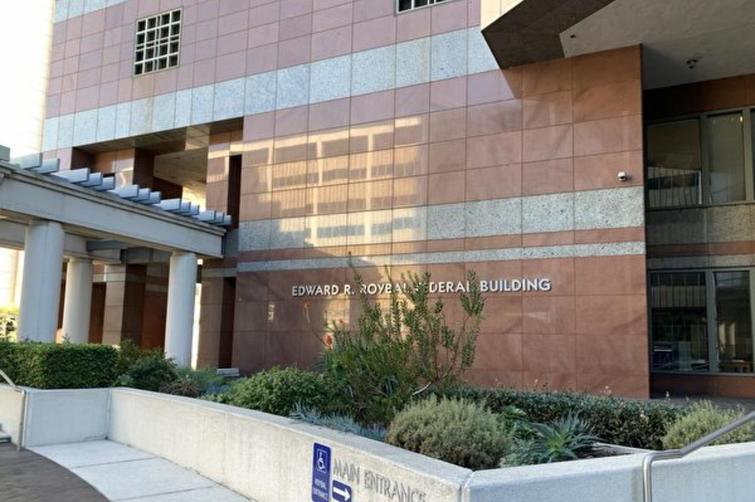
In mid-December 2024, police arrested Sun in California, accusing him of participating in activities deemed “malicious foreign influence” and of interfering in local elections. Although court documents did not disclose the name of the city council member involved, election records in Arcadia, Los Angeles County, show that Sun served as campaign treasurer for city council candidate Eileen Wang. Wang was successfully elected in November 2022 and is currently serving as mayor.
In a sentencing memorandum filed late last month, prosecutors stated that Sun had for years “knowingly and continuously” operated as a covert CCP agent, systematically reporting his influence in U.S. local politics and Chinese American communities back to CCP authorities through written reports, funding requests, organizational mobilization, and opinion-shaping efforts.
Prosecutors emphasized that Sun “submitted written reports to senior CCP officials detailing the tasks he carried out on their behalf, including monitoring the movements of Taiwanese leaders visiting the United States; expanding the CCP’s persecution of Falun Gong and suppression of Taiwan-related communities; assisting like-minded individuals in winning public office in Southern California; and disseminating pro-CCP propaganda to Chinese communities through a fake ‘news’ website. All actions were conducted under the direction of officials from the Chinese consulate.”
The criminal indictment thus presents an influence operation chain operating from the grassroots upward. Based on the evidence listed in the indictment, seven key points are summarized below.
1. Local Elections as an Entry Point for Influence
One defining feature of the case is the “covert agent” model described by prosecutors. Sun did not operate openly as a registered foreign agent, but instead used multiple roles—cultural event organizer, Chinese community leader, media operator, and local campaign staffer—as cover to create hidden channels of political influence.
At the center of the case is Sun’s relationship with Eileen Wang. Sun served as her campaign manager and boasted in reports to CCP officials: “What I am most proud of is that in the 2022 U.S. midterm elections, I carefully planned and organized a team to help a city council candidate win the election.”
The indictment does not indicate that Wang knew of Sun’s CCP ties. At one point, Sun and his superior Chen discussed not disclosing their CCP connections to Wang and referred to supporting her as cultivating a “new political star.” They reported campaign developments, networks, and media contacts back to CCP officials.
This support extended beyond her election to her political development. Court documents show that Sun and Chen reported Wang’s contacts with mainstream U.S. political figures, military officials, members of Congress, and government officials to CCP authorities, viewing these connections as political “assets” to enhance their value within the Chinese system.
Sun traveled to China multiple times to meet CCP officials and brought along the “new political star” Wang, saying they would “meet leaders there.” Wang was sworn in in January 2023; in March, Sun and Chen discussed taking her to China; in August, Sun took Wang to Beijing and Shanghai before returning to the U.S. together.
2. The Key Intermediary: The Role of Jun Chen
The indictment repeatedly mentions Jun Chen (also known as John Chen), a former Tianjin official who long served in CCP United Front–related roles in Los Angeles.
Prosecutors state that Chen was “a senior member of CCP intelligence agencies, frequently attending high-level CCP events, including military parades.” He had been received by CCP leader Xi Jinping and boasted of “climbing step by step to this position,” claiming “Xi met with me three times in ten years.”
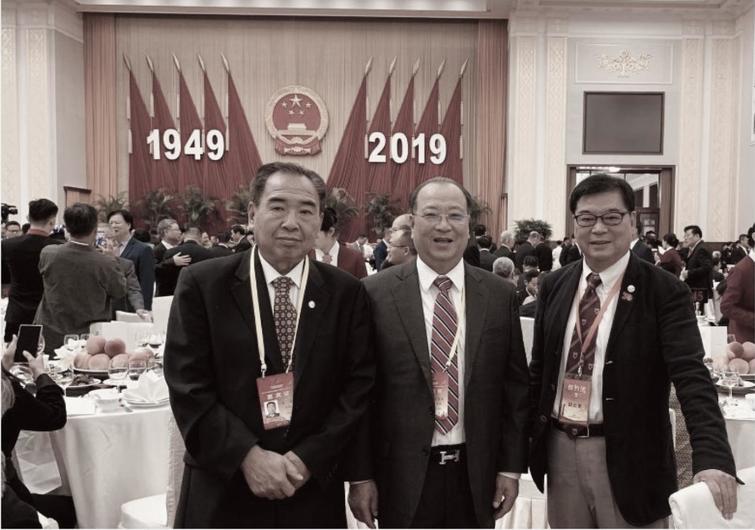
(Photos backed up to Chen’s iCloud show Chen (left) frequently invited to CCP official events, including the 70th anniversary of the PRC. (Indictment screenshot))
A 2019 YouTube video shows Chen at a pro-Taiwan event in Los Angeles, holding a loudspeaker and threatening participants: “If you have a Chinese passport, I’ll take your photo and you’ll be arrested when you return to China; if you have a U.S. passport, you won’t get a Chinese visa.”
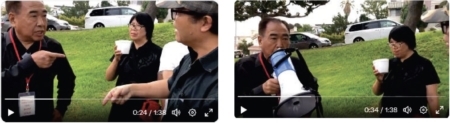
(Chen threatens Taiwan supporters at a 2019 Los Angeles event. (Indictment screenshot))
Prosecutors state that Sun had served as Chen’s “right-hand man” in the United States for decades. In November 2024, Chen was convicted in New York in a bribery conspiracy case involving an attempt to use the IRS whistleblower program to revoke the tax-exempt status of Shen Yun Performing Arts, a nonprofit founded by Falun Gong practitioners. Shen Yun has long been regarded as a target of the CCP’s transnational repression.
3. Falun Gong and Transnational Repression
Prosecutors indicate that one of Sun’s core missions was targeting Falun Gong. In a joint performance report written by Sun and Chen, Sun reported his resume to CCP officials, including prior service in the Chinese military, and emphasized that since 1996 he had operated in the U.S. to “resolutely resist all hostile forces that undermine Sino-U.S. friendship and separatist forces dividing China.”
The “hostile forces” referenced include the five groups the CCP sees as threats to its rule: Falun Gong, Tibet, Xinjiang, pro-democracy activists, and Taiwan independence supporters. In Arcadia, the primary targets were Falun Gong practitioners and Taiwan community activists. Sun proposed specific countermeasures, including organizing pro-CCP groups at large U.S. parades and cultural events to visually contrast with Falun Gong or Taiwan groups and reduce their visibility.
Sun was accused of collecting information on Falun Gong sites and activities in Los Angeles and applying for funding under the pretext of “dealing with” these groups. Such actions involve not only FARA violations but also raise concerns regarding freedom of speech and religion.
4. Politicization of Parades and Cultural Activities
Freedom House stated in a 2021 report that the CCP is conducting “the most sophisticated, global, and comprehensive transnational repression campaign in the world.” The Sun case provides a local-level example of this assessment.
According to the indictment, Falun Gong practitioners demonstrated their exercises in parades while Taiwan community members waved Republic of China flags—images that drew CCP attention and attempts to suppress them. Chen and Sun planned CCP-funded counter-groups, including organizing floats and a 100-person drum band in Washington, D.C., for U.S. Independence Day parades to overwhelm dissenting groups with “Chinese elements.”
Sun wrote in reports that overseas “anti-China forces” frequently appear in major parades and events with global impact, such as the Independence Day and Rose Parade, and therefore they must organize large, uniform “China red” performances to “create a sensation,” stating explicitly that “without sufficient funding, we cannot create a big impact.”
5. Funding Flows and Budget Requests
One striking aspect of the indictment is the funding provided by CCP officials. For the parade counteraction alone, Sun and Chen requested approximately $80,000, along with funds for meals with local politicians and community leaders.
Another revelation is that after Chen’s arrest in 2024, he reportedly told inmates at Brooklyn’s Metropolitan Detention Center that he was employed by the CCP’s “610 Office,” earning $52,000 per month, describing it as a “secret service agency 100 times more powerful than the FBI.”
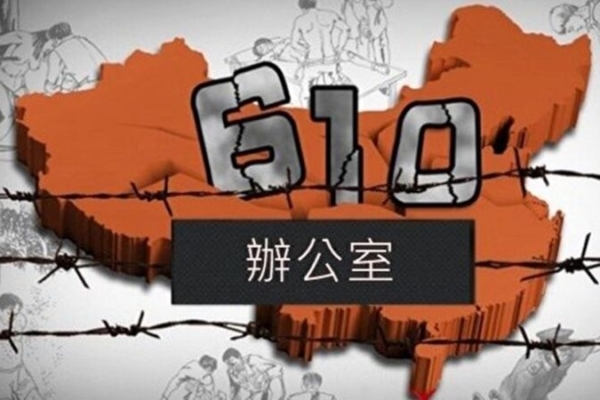
(The 610 Office, dubbed China’s “Gestapo,” is an extralegal body with extraordinary powers coordinating persecution of Falun Gong. (Dajiyuan composite image))
If true, and assuming Chen was only one of many operatives, it suggests that the CCP may spend tens of millions of dollars annually overseas on influence, surveillance, and pressure campaigns.
6. Fake News Platform and Interaction with the Chinese Consulate
Prosecutors state that Sun and Wang jointly operated “N&N Media Group,” branded as an “American News Center,” to disseminate pro-CCP propaganda to Chinese communities.
Between 2023 and 2024, Sun maintained frequent contact with Chinese consulate officials in Los Angeles regarding Taiwan-related activities in Southern California. When Taiwan President Tsai Ing-wen visited the U.S. in 2023, Sun closely monitored her itinerary and reported updates to consulate officials, even refraining from publishing reports without approval and sending photos of supporters and opponents.
Communications show direct contact between Sun, Chen, and the Chinese consulate. In April 2023, Chen instructed Sun to arrange a meeting with the consulate, preferably with the consul general, to report on a “major project,” including an article targeting Falun Gong described as “national-level, strictly confidential.”
Chen repeatedly instructed Sun to compile updates on Wang’s campaign and connections for transmission to the CCP United Front system, eventually to a “big boss.” The indictment does not identify this individual but notes Chen reported to a Tianjin government office whose leader said Beijing leaders had acknowledged Chen’s capabilities and agreed to provide funding.
Because consular officials enjoy diplomatic immunity while Sun did not, this cooperation blurred the lines between diplomacy and covert influence, complicating the legal and political dimensions of the case.
7. FARA and Legal Significance
The core charge is violation of FARA, which requires disclosure of political activities conducted on behalf of foreign governments. Prosecutors argue Sun worked for CCP officials without registering, making this a significant recent FARA enforcement case.
The 2025 U.S. Intelligence Community Annual Threat Assessment identified China as a principal state actor conducting coercive and subversive influence operations aimed at weakening U.S. democratic institutions and global standing.
Prosecutors emphasized the difficulty of detecting and prosecuting foreign influence campaigns, particularly when backed by substantial resources. They argued that only meaningful prison sentences can reflect the seriousness of the offense and deter others.
Sentencing documents note no mitigating factors: Sun was not coerced, had a stable upbringing, received a good education (Nanjing Institute of Music, Shanghai Theatre Academy, China Open University), joined the Chinese military at 22, and lived a middle-class life in the U.S., yet chose to collaborate long-term in covert influence operations.
Sun’s case highlights the complexity and sensitivity of Chinese American political participation: the political figures involved may not have known of the influence, yet influence occurred. It also underscores that Chinese Americans are a diverse community and should not be collectively stigmatized. Balancing prevention of CCP infiltration with avoiding community stigmatization remains a key challenge. While imperfect, FARA remains a critical tool in countering foreign malicious influence and deterring potential collaborators.
(Special report by Dajiyuan reporter Cai Rong) △






News magazine bootstrap themes!
I like this themes, fast loading and look profesional
Thank you Carlos!
You're welcome!
Please support me with give positive rating!
Yes Sure!