
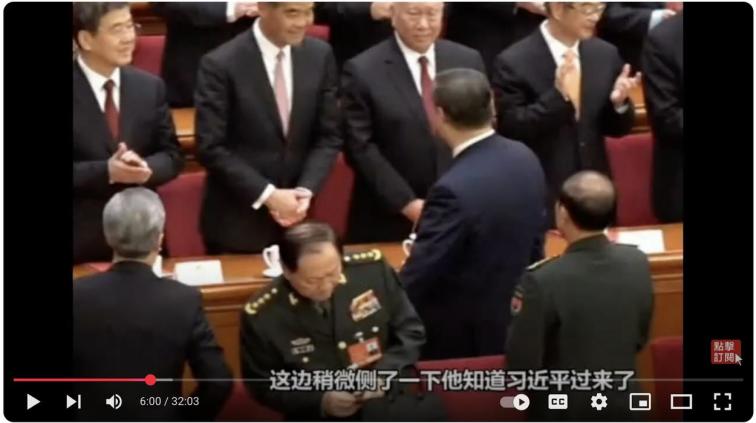
During the closing ceremony of the Two Sessions, video footage showed that as Xi Jinping was leaving, several Politburo members, including Vice Chairman of the Central Military Commission (CMC) He Weidong, turned around and stood by their seats to watch Xi depart. However, Zhang Youxia remained facing forward, not even glancing back as Xi walked past behind him. (Screenshot from video)
[People News] On February 4th, the 20th meeting of the Standing Committee of the National People's Congress took place in Beijing. While the meeting reviewed the qualifications of 'individual representatives' and terminated the qualifications of three National People's Congress representatives, it did not remove Zhang Youxia and Liu Zhenli from their representative positions, contrary to many external expectations. Does this unexpected outcome suggest that Xi Jinping's attempts to address the situations involving Zhang and Liu have faced obstacles? At this juncture, many are still questioning why Zhang Youxia, who was once Xi Jinping's 'military confidant' and was allowed to remain in his position despite breaking age norms at the 20th National Congress, has reached this point with Xi. In reality, the situation is not as straightforward as it seems; the grievances between Xi Jinping and Zhang Youxia have a long history, having evolved through a complex process from power checks to direct conflict.
The Real Grievances Between Xi and Zhang
Zhang Youxia is three years older than Xi Jinping. The two attended school in Beijing during their childhood, albeit at different institutions, so they did not grow up together. Zhang's father, Zhang Zongxun, was a comrade of Xi Jinping's father, Xi Zhongxun, during their time in the Northwest Field Army. Zhang Youxia and Xi Jinping can be considered 'childhood friends,' and Zhang has always viewed himself as the elder brother. If Xi Jinping had not ascended to the top leadership, it might have been a different story; however, contrary to expectations, Zhang Youxia's mindset and straightforward character have laid the groundwork for future conflicts.
Before Xi came to power, opportunities for Zhang Youxia to meet with military leaders were limited, and his rise to prominence was not connected to Xi Jinping. Zhang Youxia's ascent, rooted in his strong family background and bolstered by his own capabilities and military achievements, was the result of negotiations among various factions of the Communist Party elders, similar to Xi's own rise to power.
Zhang Youxia holds significant prestige within the military. In 2017, he was promoted to Vice Chairman of the Central Military Commission during the 19th National Congress of the Communist Party of China, a move that seemed quite natural.
By the time of the 20th National Congress, 72-year-old Zhang Youxia continued to serve as Vice Chairman of the Central Military Commission. Many at the time believed that Xi Jinping aimed to extend the tenure of his loyal ally to help stabilise military authority. Independent commentator Du Zheng revealed in 'Shangbao' that, in reality, Zhang was forcibly retained with the backing of discontented elders who opposed Xi Jinping's regressive policies, allowing him to influence the trajectory of China's political situation.
Had Zhang not been retained, Xi's original plan was to appoint He Weidong and Miao Hua as Vice Chairmen of the Central Military Commission, with He overseeing military operations and Miao handling political affairs.
With the support of the elders, Zhang Youxia also managed to bring two of his trusted aides, the former Minister of Defence Li Shangfu and Liu Zhenli, who have since fallen from grace, into the 20th Central Military Commission.
Following the 20th National Congress, Zhang Youxia maintained close ties with several anti-Xi elders, which raised suspicions of undermining Xi's authority within the military. He also undertook actions that significantly angered Xi.
One such issue was the 'Training Order Dispute'.
This personal grievance deeply frustrated Xi Jinping. From 2018 to 2022, at the start of each year, Xi would don camouflage and personally visit training grounds to issue 'training orders' to the entire military. State media widely reported that soldiers would shout in unison, 'We listen to Chairman Xi's command.' This experience of being the commander of the armed forces and receiving loyalty from the masses was something Xi Jinping relished.
However, by 2023, this annual grand spectacle abruptly came to a stop, primarily due to opposition from Zhang Youxia. He openly criticized this approach as 'showing off' and 'promoting personal worship', arguing that formalism undermines actual combat effectiveness. As the first vice chairman of the Central Military Commission, Zhang Youxia firmly blocked Xi Jinping from continuing this practice. Although Xi Jinping remained patient at the time, he internally perceived this as a direct challenge to his authority.
Secondly, there are significant disagreements regarding the strategy in the Taiwan Strait.
On the Taiwan issue, Xi Jinping harbours strong political ambitions, while Zhang Youxia, as a career military officer, adopts a more pragmatic approach. In discussions within the military, Zhang Youxia clearly articulated his opposition to the rush for military action against Taiwan. He believes that, given the current equipment capabilities and joint operational conditions, initiating a war would likely not yield the desired outcomes and could even result in a major defeat. Zhang Youxia's 'cold water' comments made Xi Jinping, who was eager to achieve results before the 21st National Congress, feel that Zhang Youxia had become a 'roadblock' to his aspirations for unifying Taiwan.
Thirdly, the psychological impact of Li Keqiang's death.
Furthermore, the sudden passing of former Premier Li Keqiang had a profound psychological effect on Zhang Youxia. Li Keqiang had opposed the use of force to resolve the Taiwan Strait issue during his lifetime, aligning with Zhang Youxia's professional judgment. The circumstances surrounding Li Keqiang's demise made Zhang Youxia realise that under Xi Jinping's regime, even the highest-ranking officials lack security guarantees, which prompted him to more openly adopt a confrontational stance following the 20th National Congress.
The 'corruption trap' of the Equipment Department.
When contradictions became irreconcilable, Xi Jinping resorted to his most effective weapon: anti-corruption. The battleground for this struggle was the 'Equipment Development Department,' which had long been under the control of Zhang Youxia.
Xi Jinping enlisted his loyalists from Fujian, He Weidong and Miao Hua, to carry out a significant purge of the equipment system.
In early 2024, Xi Jinping first ousted Li Shangfu, the Minister of Defence appointed by Zhang Youxia. At that moment, in a bid for self-preservation, Zhang Youxia had no choice but to temporarily distance himself from Li Shangfu.
He Weidong then made a statement at a military meeting, calling for a crackdown on the military's 'false combat capabilities.' This remark was essentially aimed at the defective equipment procured by Zhang Youxia, including scandals such as missile fuel being diluted with water and launch silos failing to open. Xi Jinping sought to address corruption in equipment procurement, ultimately directing the fallout towards Zhang Youxia.
However, Zhang Youxia was not passive. He had deep roots within the military and had previously exploited the indecisive stance of Military Discipline Commission Secretary Zhang Shengmin to counter Xi's factional generals, leading to the subsequent disappearance or loss of power of figures like He Weidong and Miao Hua. This 'internal military turmoil' persisted until the end of 2025, eventually culminating in Xi Jinping deploying his private army for a surprise arrest of Zhang and Liu.
The Zhang Youxia case inflicted a devastating blow to the military of the Chinese Communist Party.
Zhang Youxia's downfall was not merely the fall of one individual; it represented a catastrophic strike against the military structure of the Chinese Communist Party.
Zhang Youxia has been in charge of equipment systems and joint operations planning for a long time, particularly the specific strategies for operations against Taiwan, which he has nearly all memorised. With the arrest of Zhang Youxia and his close associate Liu Zhenli, the entire operational plan concerning Taiwan is now in jeopardy. The top secrets and operational strategies that Zhang Youxia controlled are no longer reliable, and the military will require 5 to 10 years to develop a new practical combat plan.
Additionally, Xi Jinping's extensive purge has left only 7 out of 30 active generals capable of fulfilling their roles. This has created a significant 'vacuum period' within the military's leadership. Zhang Youxia's arrest, as a highly esteemed veteran, has disheartened many officers and soldiers. The decline in military morale is not something that can be easily restored.
While Xi Jinping appears to have temporarily triumphed in this power struggle, he has paid a steep price: the discontent within the military has not calmed down; rather, it has morphed into a 'silent protest.' Some frontline military leaders have even expressed intentions to act against Xi Jinping. He now finds himself in a difficult position; if he imposes a severe sentence on Zhang Youxia, it could trigger unpredictable military coups or chaos. Moreover, there are already calls within the Politburo for Xi Jinping to 'rectify mistakes' regarding the 'arrest of Zhang Youxia.'
Today, reports have emerged suggesting that Zhang Youxia is under house arrest in Shenzhen, Guangdong. Huang Kunming, the Guangdong secretary, even had lunch with Zhang Youxia. It is possible that Huang Kunming is acting as a mediator, implying that Zhang Youxia is engaging in a political deal with Xi Jinping. If this rumour holds true, it would suggest that Xi Jinping is 'showing weakness' or 'compromising.' However, such actions are likely to backfire on Xi Jinping in the end. This indicates that he can no longer fully control the situation and cannot regain his status as 'the sole authority'; the will of heaven and the sentiments of the people are no longer in his favour.
(First published by People News)
△



News magazine bootstrap themes!
I like this themes, fast loading and look profesional
Thank you Carlos!
You're welcome!
Please support me with give positive rating!
Yes Sure!