

Pictured: File photo of Zhang Youxia (Lintao Zhang/Getty Images)
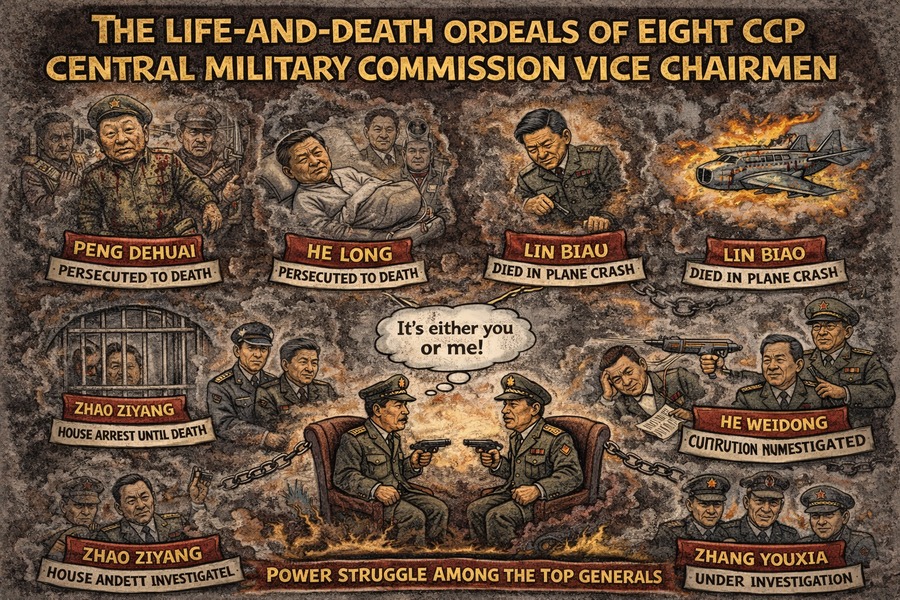
[People News] Recently, reports concerning the Chinese Communist Party (CCP) military and its senior officials have been widespread, making it challenging for the public to distinguish between truth and falsehood. However, a closer examination reveals that these distractions primarily centre around Zhang Youxia. As the current Vice Chairman of the Central Military Commission, he is regarded as the 'big brother' within the military. Despite being in a difficult position, he remains the only military leader capable of providing a counterbalance to Xi Jinping's power. Recently, doubts have emerged from the top echelons of the CCP—the Politburo leaders—regarding Xi Jinping's decision to arrest Zhang Youxia and Liu Zhenli.
Reports indicate that during internal discussions, these Politburo members not only refrained from actively supporting Xi Jinping's actions against Zhang Youxia but also privately expressed sympathy for both Zhang Youxia and Liu Zhenli. Such sentiments are exceedingly rare in CCP history, especially since the justification provided by Xi Jinping—'corruption'—is no longer credible to many.
Politically, the actions from Zhongnanhai have also been quite unusual. On February 2, the Standing Committee of the National People's Congress unexpectedly convened an emergency 'inserted' meeting. Observers speculate that this may be aimed at removing Zhang Youxia and Liu Zhenli from their roles in the National Military Commission and their representative qualifications.
It is understood that the relationship between the Central Military Commission of the Communist Party of China and the National Central Military Commission is essentially 'one team, two banners.' However, under normal circumstances, the Standing Committee meeting of the National People's Congress is typically held at the end of the month, and a meeting is still scheduled for the end of February this year to prepare for the National People's Congress session in early March.
In fact, on January 30, the Politburo had already convened a meeting, and the official report referenced 'other matters.' This phrase often conceals significant personnel changes.
On January 30, Mr Tang Boqiao, a Chinese-American pro-democracy activist, quoted internal sources on platform X, revealing that a consensus has emerged within the Chinese Communist Party (CCP): the arrests of Zhang Youxia and Liu Zhenli are deemed illegal detentions that bypassed legal procedures, which constitutes a serious violation of the CCP's own internal rules and national laws. The meeting held on January 30 is suspected to have been convened to finalise the formalities and 'legalise' these actions.
Even more startling was the news on February 3, when Tang Boqiao again referenced internal communications from the CCP, indicating that during the January 30 meeting, someone openly questioned the legitimacy of the arrests and even suggested that Xi Jinping should correct his mistakes, which received agreement from other participants.
According to relevant regulations, any disciplinary actions against members of the CCP Politburo, particularly those at the level of Vice Chairman of the Central Military Commission, must be collectively discussed and voted on in a Politburo meeting. However, the arrests of Zhang Youxia and Liu Zhenli did not undergo any discussion in a Politburo meeting, nor was there any voting procedure followed, and Xi Jinping did not convene any related meetings.
It appears that not only is there a prevailing atmosphere of hesitation within the military, but there are also divisions within the party and government that contradict Xi Jinping's decisions. As Tang Boqiao stated, 'The matter is not over yet!'
Does Xi Jinping want to take action against Zhang Youxia? Absolutely. Since last year, Xi Jinping has been attempting to force Zhang Youxia into retirement, even eliminating all his associates. Xi Jinping has managed to deal with Li Keqiang and even pushed Hu Jintao out in front of the world, so why has he been reluctant to take decisive action against Zhang Youxia?
Zhang Youxia wields genuine military power, while Xi Jinping only holds the nominal title of Chairman of the Central Military Commission.
To the military, Xi Jinping is seen as an outsider who has "never served a day as a soldier," whereas Zhang Youxia and Liu Zhenli are seasoned veterans with real combat experience and military accomplishments. Military commanders prioritise mutual understanding and prestige, which is earned through actual service. If Xi Jinping were to impose severe punishment on Zhang Youxia, it would likely provoke an immediate backlash from the military, putting his own life at risk.
When Xi Jinping issues commands, they reach the combat zones and various military branches, where officers begin to employ "delay tactics": either claiming procedural non-compliance or requesting further instructions. This form of soft resistance is even more concerning for Xi Jinping than an outright military coup.
Currently, while Xi Jinping maintains control over public discourse and the party apparatus, he is unable to influence the military. The two sides are in a stalemate: Xi Jinping has attempted to "bring Zhang Youxia under control," but Zhang Youxia refuses to take a stance or admit guilt, and he may even be secretly directing military operations. Zhang Youxia is effectively in a state of "self-isolation," with the initiative resting in his hands.
Xi Jinping finds himself in a precarious situation, as the circumstances in China have reached a critical juncture. The rampant rumours reflect a collective disconnection between public sentiment and military morale. Although Xi Jinping seems to hold an advantage on the surface, he has actually fallen into the "Tacitus Trap."
(First published by People News)
△



News magazine bootstrap themes!
I like this themes, fast loading and look profesional
Thank you Carlos!
You're welcome!
Please support me with give positive rating!
Yes Sure!