

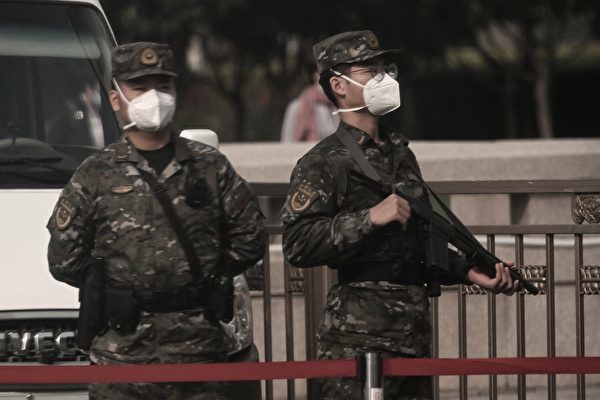
March 10, 2025, Beijing Great Hall of the People—A security guard stands at the entrance before the closing ceremony of the Chinese People's Political Consultative Conference. (WANG ZHAO/AFP via Getty Images)
[People News] The detention of Zhang Youxia, Vice Chairman of the Central Military Commission, marks one of the most shocking political upheavals in China's political landscape at the start of 2026. As Xi Jinping's most trusted military figure for over a decade, Zhang was unexpectedly taken away for investigation on charges of 'suspected serious violations of discipline and law.' This incident has gone far beyond the usual anti-corruption measures, causing significant ripples both domestically and internationally. More strikingly, in the aftermath of this event, a series of unusual signals has emerged within China's political sphere and public discourse. These concentrated anomalies suggest not only the fate of an individual but also reveal deep fractures and instability within the entire power structure. Here, we outline the seven most notable abnormal phenomena.
Firstly, the official website of the Central Commission for Discipline Inspection (CCDI) is significantly out of sync with other state media. The news of Zhang Youxia's arrest was initially released by the Ministry of Defence on January 24, but the CCDI and National Supervisory Commission website only provided a brief mention of 'suspected serious violations of discipline and law,' with almost no further details. This is in stark contrast to the past few years, where nearly all high-ranking officials (especially military leaders) who have been dismissed were immediately followed by extensive 'reports + background information + typical case analysis' on the CCDI website. Major state media outlets like the People's Daily and Xinhua News Agency maintained an unusual silence for several days, with little to no in-depth analysis or 'positioning' articles. This disconnect in the timing of information release indicates a significant internal disagreement regarding the nature of the incident and the messaging strategy.
Secondly, the "Liberation Army Daily" has frequently included subtle hints of criticism. Following the incident, the military newspaper's editorials have repeatedly employed phrases like "moulting and rebirth," "rebirth through fire," and "phoenix nirvana." While these terms ostensibly call for military innovation, in light of Zhang Youxia's arrest, they have been widely interpreted as a veiled critique of the current leadership for being "overzealous in purging" and "injuring the core." Such language is quite rare in previous editorials of the military newspaper, and when considering Zhang Youxia's long-standing control over the Equipment Development Department of the Military Commission and critical points in military reform, it is difficult not to connect this with underlying tensions within certain factions of the military.
Thirdly, there have been frequent and unusual troop movements reported across various regions. Reports from Beijing, Northeast China, South China, and the East have surfaced, showing images of heavy equipment moving at night, tanks on the streets, and large-scale troop rotations in combat zones. Although the authorities have not confirmed these movements, videos and photos circulating on overseas social media and among some military enthusiasts suggest that the scale and frequency of these movements far exceed typical exercises or readiness mobilisations. Notably, the Southern Theatre Command and Eastern Theater Command have experienced the most frequent changes, leading external analysts to believe that this is a "control-style" deployment aimed at preventing unforeseen events within the military. Such large-scale movements are a strong indicator of political instability.
Fourth, military leaders and local party and government officials have notably remained silent and refused to take sides. Following the downfall of Zhang Youxia, none of the commanders or political commissars from the five major military regions, nor the top leaders of the Army, Navy, Air Force, and Rocket Force, publicly supported the central decision within nearly two weeks. This stands in stark contrast to the usual practice where military officials quickly 'express loyalty' and 'issue collective statements' after a high-ranking official's fall. At the local level, most provincial leaders also intentionally avoided discussing this issue in recent important meetings, only vaguely referring to 'absolute loyalty' and 'the party commands the gun.' This collective silence and refusal to take a stance reflect the most direct manifestation of the wait-and-see attitude among senior party officials.
Fifth, the red families have unusually maintained a collective silence, refusing to endorse Xi Jinping. Zhang Youxia, a true 'red second generation,' is the son of Zhang Zongxun, a founding general, and has deep ties with several elder families. After the incident erupted, many red families almost uniformly fell silent, with no public expressions of support for the current leadership. Additionally, reports indicate that some members of the older generation have conveyed strong dissatisfaction through private channels, believing that 'one's own people' should not be treated in such a manner. This overall silence from the 'red second generation' is viewed as a subtle protest against the current methods of power operation.
Sixth, the comment sections of state media often reveal public discontent towards Zhang Youxia. Under various reports from central and local party media, numerous comments expressing sympathy for Zhang Youxia and questioning the central government's decisions have emerged, with remarks such as 'the veteran has made significant contributions', 'this is not how to treat a meritorious official', and 'the backbone of the military has been discarded'. These emotional comments frequently remain visible for several hours or even longer before being deleted or blocked, which is much longer than the typical response time of internet regulators. This suggests a partial failure of the grassroots propaganda system in managing public opinion and indicates that widespread dissatisfaction, including among certain groups within the system, regarding the Zhang Youxia incident, is beginning to surface.
Seventh, a significant number of high-ranking officials have recently been dismissed or have died under 'unusual' circumstances. The arrest of Zhang Youxia marks just the beginning; within a span of just over ten days, several military leaders, including Liu Zhenli, have been taken away for investigation. Additionally, there have been reports of several deputy national-level and deputy provincial-level officials suffering from 'sudden illnesses', 'accidental deaths', or going missing entirely. This rapid and extensive combination of 'cleansing + accidents' within such a short timeframe far surpasses the intensity and speed of any previous anti-corruption efforts, leading to extreme panic within the bureaucratic system and a noticeable decline in the efficiency of both administrative and military operations.
The simultaneous appearance of these seven significant abnormal signals suggests that the Zhang Youxia incident has evolved beyond a mere anti-corruption case, marking the onset of a 'domino effect' that has triggered systemic upheaval. The silence within the military, the loss of media control, troop movements, the indifference of influential families, the overflow of grassroots sentiments, and a series of high-ranking officials facing 'issues'—these combined phenomena indicate that the stability of China's top power circle is undergoing an unprecedented challenge. In the weeks and months ahead, how Xi Jinping addresses these anomalies will be crucial in determining whether this situation leads to a temporary political earthquake or a more profound structural crisis. While the truth may still be obscured, these visible fractures are already significant enough to warrant concern.
(Author X account) △







News magazine bootstrap themes!
I like this themes, fast loading and look profesional
Thank you Carlos!
You're welcome!
Please support me with give positive rating!
Yes Sure!