
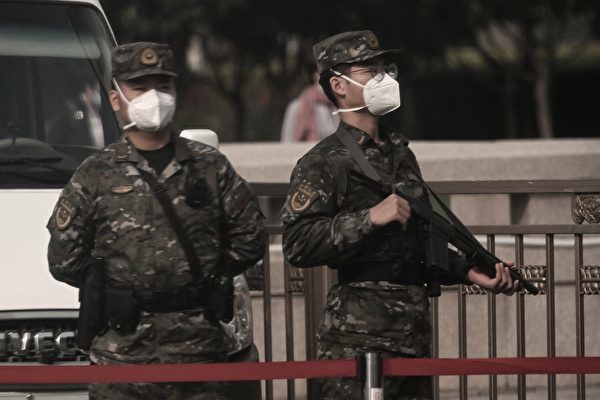
Caption: On October 13, 2022, ahead of the 20th National Congress of the Chinese Communist Party, security personnel were stationed along the road leading to Tiananmen Square. (NOEL CELIS/AFP via Getty Images)
[People News] Recently, former officials from the overseas establishment, led by Du Wen, have initiated a plan to rescue the families of Chinese Communist Party (CCP) military leaders. Shortly thereafter, high-ranking military officials reached out to Du Wen. He reported that the rescue efforts are currently progressing smoothly. Through in-depth discussions with military personnel, Du Wen gained insights into the current dynamics within the CCP military. He noted that there are many individuals with passion and resolve who genuinely wish to rise up; it is merely a matter of timing. So, what is the current state of the CCP? What is the likelihood of an armed coup? What challenges lie ahead?
Current Realities in the Military
First, we need to grasp the atmosphere within the military. According to Du Wen's interactions with military personnel, there is a startling statistic: over 60% of soldiers and more than 80% of officers actually sympathise with and support Zhang Youxia and Liu Zhenli.
The standing of these two figures in the military can be described as 'god-like.' Zhang Youxia enlisted in 1968 and possesses combat experience from the Laoshan frontline, with a career that spans from the group army and military region to the Central Military Commission. He has spent nearly 60 years in the military, building not just simple positions, but a tightly-knit personnel network. Any cadre he has promoted or endorsed, under the logic of the system, naturally becomes part of his 'faction.'
Regarding the military report's suggestion of 'rebirth through moulting,' Du Wen explained that this refers to Xi Jinping's intention to implement a 'rebirth through moulting' within the military. This term is extremely harsh, signifying a complete overhaul of the existing leadership system, akin to an eagle plucking its feathers and breaking its beak.
This situation has thrown the entire military into a state of extreme fear and confusion—no one is safe, and anyone could become a target for purging.
The General's Helplessness—Executing a Coup is Harder than Climbing a Mountain
Given that dissatisfaction levels are as high as 80%, why isn't anyone taking action? Du Wen directly asked a brigadier facing the risk of being purged. The general's response was blunt: "I also want to arm myself and rebel, but this is harder than climbing a mountain in China."
This general revealed a set of extremely stringent institutional constraints designed by the Chinese Communist Party, which fundamentally suppresses any potential challenges to power:
First, the fractured command chain and the surveillance by the "Little Pink". The general acknowledged that he could only directly command the guard company at his side. To mobilise larger forces, he would have to go through divisions, brigades, regiments, battalions, companies, and squads. This chain is excessively long, and there are now many "Little Pink" and opportunists within the military. If just one person senses something amiss and reports it to "110" or to superiors, the entire plan could be exposed in an instant. In today's world of advanced communication, the space for confidentiality is nearly nonexistent.
Second, the "remote allocation" of ammunition and supplies. This is a crucial technical detail. While weapons are in the hands of the troops, large-scale ammunition supplies are often not local and may even be stored across different combat zones. The existing ammunition barely suffices for a single exercise, and it fundamentally lacks the sustained combat capability necessary to initiate military operations.
Third, the constraints of 'branch-based main construction and theatre-based main combat.' The military reforms implemented by Xi Jinping have completely separated command authority from management authority. Logistics support and communication command are managed by their respective departments, which has created significant barriers to coordination. Horizontal communication is extremely challenging, making it nearly impossible for different units to 'connect' for a rebellion.
Zhongnanhai is an insurmountable fortress.
This general also assessed the challenges of launching an attack on Beijing.
If the troops opt for a rebellion in place, they would essentially be waiting for their demise, facing 'decapitation-style' bombardments from land, sea, air, and missile forces. Choosing to attack Beijing presents even greater difficulties.
Firstly, there are nearly 10,000 personnel in the Central Guard Bureau within Beijing, along with over 20,000 in the Beijing Armed Police Corps on the outskirts, not to mention the troops from the Beijing Garrison and the Central Theatre Command. Furthermore, the underground system of Zhongnanhai is extensive; once gunfire erupts outside, the targeted individuals will immediately evacuate.
Additionally, the Central Theatre Command in Beijing has established a strict no-fly zone and deployed the most advanced air defence missiles. Any helicopters or fighter jets attempting a surprise attack would be shot down in an instant.
The conclusion drawn by this general is that unless there is a coup within the Central Guard Bureau, the likelihood of successfully attacking from the outside is virtually zero.
The wave of mutual exposure within the military.
In this environment of high pressure and despair, the internal state of the Communist Party's military has become increasingly distorted.
The Political Work Department of the Military Commission requires all military personnel not only to verbally express their support for the central leadership but also to write guarantees and ideological reports. Although privately, many are reluctant to publicly support Xi Jinping, they must present themselves as 'double agents' in front of the public.
An even more alarming development is that mutual denunciations have begun within the military ranks. In a bid to protect themselves, individuals are reporting on those who express sympathy for Zhang Youxia. The severity of this internal conflict may far surpass the casualties of an actual war.
An inevitable outbreak on the horizon
While the current system has temporarily confined the military, Du Wen argues that this does not equate to stability.
The extreme purging measures implemented by Xi Jinping are driving the military to the brink of a catastrophic breakdown. One general made a striking remark: 'If Xi Jinping comes to inspect our troops, I guarantee I will personally take him out.' This statement reflects the mindset among grassroots generals that 'death is inevitable, regardless.'
Although an armed coup has not yet materialised, the ongoing purges and escalating economic and social tensions are causing this instability to grow exponentially. This institutional repression resembles a pressure cooker that is continuously building pressure; an explosion is merely a matter of time.
What lies ahead for the Chinese Communist Party's military? When anger reaches its boiling point, and when 'rebirth through transformation' shifts to 'rebirth through destruction,' genuine change may be just around the corner.
If you have any thoughts on the military situation, please feel free to share your comments below. Remember, your voices can also be heard by the soldiers on the front lines.
(First published by People News)
△









News magazine bootstrap themes!
I like this themes, fast loading and look profesional
Thank you Carlos!
You're welcome!
Please support me with give positive rating!
Yes Sure!