
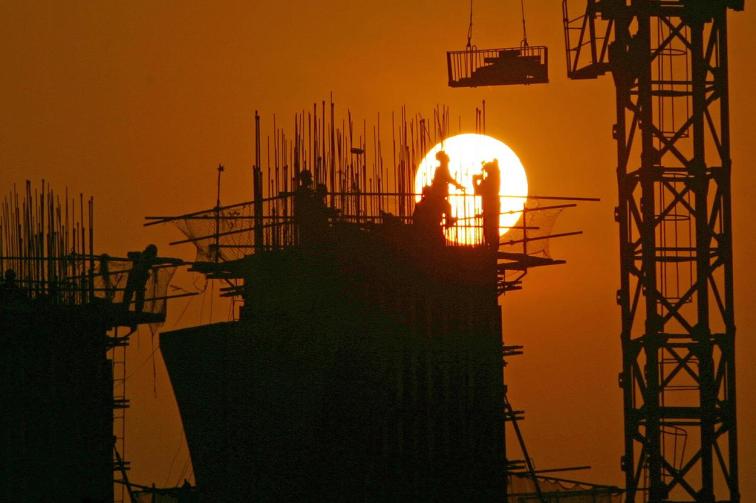
Illustration: China's economy continues to decline. (Photo by China Photos/Getty Images)
[People News] In April of last year, the Communist Party of China introduced the slogan 'focusing on stabilising employment, stabilising enterprises, stabilising the market, and stabilising expectations' to revive the economy. Nine months later, various data reveal that these four 'stabilizations' have not succeeded, failing to provide any hope for the Chinese economy, not alleviating its challenges, and not altering the ongoing negative perceptions of both the international community and Chinese billionaires regarding China's economic trajectory.
Bloomberg's data indicates that capital outflow from China is projected to exceed one trillion yuan in 2025, a figure closely aligned with the foreign exchange surplus of 1.189 trillion US dollars expected for that year.
In recent years, the affluent class in China has increasingly sought to immigrate and settle abroad. As the Chinese economy continues to decline, this trend has intensified. The latest report from international investment immigration consultancy Henley & Partners estimates that in 2024, around 15,200 wealthy individuals in China, each with at least one million dollars in investable assets, will transfer their assets and relocate to other countries. This marks an increase of 1,400 from 2023 and a 28% rise from 2022, setting a new historical record. For the third consecutive year, China has become the country with the highest outflow of millionaires.
Additionally, a recent report from the Hurun Research Institute indicates that the economic confidence index among Chinese billionaires has dropped for the fourth consecutive year, reaching its lowest level since 2012. The high-end consumer market in China shrank by 5% last year, and surveys suggest that wealthy households anticipate a reduction in material consumption by an average of 242,000 yuan over the next year.
On January 30, the Hurun Research Institute released the '2026 Hurun Best Quality Products - Report on the Quality of Life of China's High-Net-Worth Individuals.' The report's data is derived from a survey of 470 Chinese millionaires with assets exceeding 10 million yuan, including 70 individuals with assets over 100 million yuan. The average total family assets of the respondents stand at 61 million yuan, which is 38% higher than the average over the past five years, with an average of 23 million yuan in investable assets.
The report highlights that the economic confidence index among Chinese millionaires for the next two years has fallen to 5.4 points, marking the fourth consecutive year of decline and reaching its lowest level since 2012. Only 26% of respondents expressed 'full confidence' in the economy, while 59% indicated they are 'somewhat confident.'
In comparison, the economic confidence index for Chinese millionaires was 6.6 during the 2018 global financial crisis, remained between 6.7 and 7.2 during the COVID-19 pandemic, and peaked at 7.2 points in 2022. However, three years post-pandemic, as the Chinese economy continues to struggle, the confidence of Chinese millionaires in the economy is still on the decline.
The report also notes that the scale of China's high-end consumer market is projected to reach 1.56 trillion yuan in 2025, a 5% decrease from the previous year. The uncertainty in the global landscape and the changing consumption attitudes of high-net-worth individuals pose new challenges for the traditional luxury goods sector. The market for traditional luxury goods in China, which includes clothing, shoes, cosmetics, jewellery, bags, and watches, is expected to shrink from 450 billion yuan in 2024 to 430 billion yuan in 2025.
Additionally, the luxury car market is showing signs of weakness, as a decline in the willingness of the wealthy to purchase vehicles has led to a noticeable drop in the market size for luxury cars priced above 500,000 yuan. Specifically, the market for luxury cars priced between 500,000 and 1 million yuan has seen an 11% decline, while the market for luxury cars priced at 1 million yuan and above has experienced a 14% drop. The high-end market for tobacco, alcohol, and tea, valued at 300 billion yuan, has also decreased by 6%.
In their plans for the upcoming year, wealthy families in China are expected to reduce their average annual material consumption by 242,000 yuan. More specifically, planned expenditures on watches are set to decrease by 123,000 yuan, spending on collectables is projected to drop by 86,000 yuan, and jewellery purchases are anticipated to fall by 55,000 yuan.
Hu Run, chairman of the Hurun Report, noted that Chinese billionaires are becoming increasingly cautious regarding investments and international strategies. In the coming year, the assets that respondents are most inclined to increase their holdings in are gold and overseas investments, such as U.S. stocks and Hong Kong stocks. Conversely, the assets they are most likely to reduce include real estate, artworks, and collectables, indicating a clear trend towards risk aversion and the pursuit of diversified opportunities.
After the COVID-19 pandemic ended, the long-anticipated economic rebound failed to materialise. Now, no matter how many times the Chinese Communist authorities “point out” development directions or roll out slogan-style policies claiming that things are “stabilising and improving,” more and more people have begun to believe that China’s economy has little chance of rebounding at all. People believe that China’s economic problems may not be temporary, but long-term and chronic. China’s wealthy elites appear to hold a similar view.
An article published by Le Monde (France) in late October 2025 pointed out that China, once so optimistic, has now become profoundly pessimistic. Some media outlets have also noted that when economic growth can no longer be sustained, how much longer can the CCP’s authoritarian system continue? △






News magazine bootstrap themes!
I like this themes, fast loading and look profesional
Thank you Carlos!
You're welcome!
Please support me with give positive rating!
Yes Sure!