

China’s economy is declining
[People News] At the start of 2026, China’s economy appears caught between two extremes. On one side are blazing sectors such as AI chips, new energy vehicles, rare earths, and shipbuilding. On the other is the chill of discounting, price cuts, and product returns seen in shopping malls and retail stores across the country.
On January 20, China’s National Bureau of Statistics announced that 2025 GDP growth reached the official target of 5%. Setting aside questions about data reliability, the quarterly trend shows clear deceleration: year-on-year GDP growth for the four quarters was 5.4%, 5.2%, 4.8%, and 4.5%, respectively. The fourth quarter marked the slowest growth since pandemic restrictions were lifted in 2022.
China’s 2025 growth relied heavily on strong exports. However, many analysts argue that an export-driven growth model is unsustainable because external demand is highly uncertain. As trade with the United States worsened, exports shifted toward ASEAN, the EU, and Africa, offsetting weaker U.S. sales. Yet this strategy of low-priced exports risks triggering global trade barriers, further complicating the external environment for growth.
Behind the glossy export figures, China’s 2025 performance in real estate, consumption, and employment felt bleak.
Since September 2024, the government introduced multiple stimulus measures to revive the property sector, but with little effect. Data released on January 19 showed that in December 2025, new home prices in 70 major cities fell 0.4% month-on-month, with year-on-year declines widening for two consecutive months.
Second-hand home prices have fallen across the board for four straight months. In first-tier cities, second-hand housing prices dropped 7% year-on-year, widening from a 6.7% decline in mid-2024. Beijing, Shanghai, Guangzhou, and Shenzhen saw drops of 8.5%, 6.1%, 7.8%, and 5.4%, respectively.
In December, real estate investment plunged 36.3% year-on-year, worsening from November’s 30.1% drop. New home sales area and sales value declined 15.5% and 23.6%, respectively.
For the full year 2025, national real estate investment fell 17.2%, steeper than 2024’s 10.6% decline. Commercial housing sales area also continued to shrink. Though the drop narrowed from 12.9% to 8.7%, the downward trend has persisted since April last year.
Consumer data is the most direct—and painful—indicator. Official statistics show total retail sales of consumer goods reached 50.1 trillion yuan in 2025, up 3.7% year-on-year, well below GDP growth and far behind industrial output growth of 5.9%. In December 2025, retail sales rose only 0.9% year-on-year, the slowest pace since the pandemic, suggesting that government trade-in stimulus programs failed to reverse weak domestic demand.
Price indices indicate China’s economy is struggling in a deflationary spiral. The GDP deflator has remained negative. The 2025 consumer price index (CPI) was flat compared with 2024, while the producer price index (PPI) fell 2.6% year-on-year, marking 11 consecutive quarters of growth below real GDP.
Meanwhile, nominal per capita disposable income rose 5.0%, which contrasts with weak consumption. This suggests either issues with income data or that income is being diverted into savings and debt repayment rather than spending. A January 16 central bank report showed total household deposits reached 166 trillion yuan by the end of 2025—triple the level of a decade ago and a record high. With a population of 1.4 billion, this equals about 118,000 yuan per person on average. Time deposits accounted for a record 73.4% of household deposits, far exceeding demand deposits. Meanwhile, new household loans increased by only 441.7 billion yuan, the lowest since 2007, reflecting pessimistic expectations and consumer resistance.
Deflation has made it harder for companies to grow profits. According to FactSet data covering 5,000 mainland-listed firms, corporate profit margins are at their lowest level since 2009. This includes traditional sectors such as steel, concrete, and consumer goods, as well as emerging sectors like electric vehicles and robotics. EV prices have fallen for about three years. A survey by the China Automobile Dealers Association found only 30% of auto dealers were profitable in the first half of 2025, with nearly three-quarters selling some models below cost. The humanoid robot industry, with over 150 companies, faces risks of overinvestment and excess competition.
Weak corporate performance directly pressures employment. In 2025, the surveyed urban unemployment rate averaged 5.2%, appearing stable. However, the average weekly working time for employees was 48.6 hours, near historic highs, suggesting job stability partly depends on longer hours rather than more jobs. This aligns with cautious consumption and rising precautionary savings.
Youth unemployment is even more concerning. According to Economic Observer, “employment” became one of 2025’s most emotionally charged public issues. The number of university graduates reached 12.22 million, a record high. Youth unemployment hovered between 16% and 18%, far above the overall rate. Risk-averse career choices increased. Applications for the national civil service exam in 2026 reached 3.718 million, exceeding postgraduate exam applicants for the first time in over a decade.
Employment pressure reflects structural economic challenges: weak consumption, rising policy uncertainty, shrinking job absorption in traditional real estate sectors, and limited job creation in emerging AI and new energy industries, along with mismatches between talent training and market needs.
Demographics pose an even greater challenge. Births fell sharply from 9.54 million in 2024 to 7.92 million last year, the lowest birth rate since records began in 1949. Deaths rose from 10.93 million to 11.31 million. The natural population growth rate was negative 2.41 per thousand. China’s total fertility rate is estimated at 0.97–0.98, below 1, far from the 2.1 needed for population stability.
The gap between stable official data and widespread public anxiety has become a focal point for both experts and citizens. Even local governments can no longer remain as composed as before.
As local “two sessions” meetings take place, provinces are announcing 2026 growth targets. Of more than 20 provinces that have released targets, 13 lowered them. This includes Zhejiang in the Yangtze River Delta and Guangdong in the Pearl River Delta. Zhejiang adjusted its 2026 target from 5.5% to a range of 5–5.5%, while Guangdong lowered its goal from 5% to 4.5–5%.
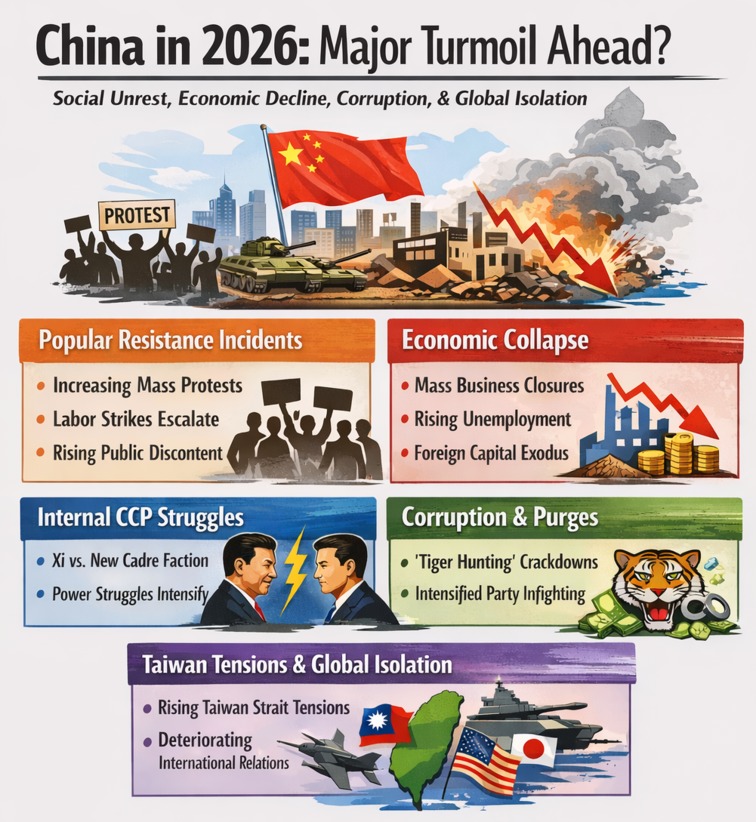
Citi economists currently expect China’s 2026 GDP growth target to fall between 4.5% and 5.0%. Lower local targets do not reflect changes in GDP measurement or greater policy pragmatism. Rather, they suggest that Beijing’s economic policy toolbox is running empty—many tools have been tried, and none have worked effectively.
(First published by People News) △




News magazine bootstrap themes!
I like this themes, fast loading and look profesional
Thank you Carlos!
You're welcome!
Please support me with give positive rating!
Yes Sure!