

Keir Starmer, the 61-year-old newly appointed Labour Prime Minister of the UK. (Photo by Cameron Smith/Getty Images)
[People News] Following the arrest of Zhang Youxia, Chinese Communist Party leader Xi Jinping met with visiting UK Prime Minister Sir Keir Starmer and his delegation on the 29th. Media reports indicate that the discussions between Xi Jinping and Starmer lasted for 1 hour and 20 minutes in Beijing, and with lunch included, the two sides spent approximately three hours together. Reports from the CCP's state media suggest that Xi Jinping was 'full of lies' during the meeting with the UK Prime Minister's delegation. Political analysts argue that this reflects the CCP's inherently sinister nature, warning that if Western nations do not take this seriously, they will inevitably become victims of its deception and harm.
State Media Unintentionally Exposes Party Leader's Lies
The People's Daily, the website of the Chinese Ministry of Foreign Affairs, and other state media outlets have reprinted a report from Xinhua News Agency stating: 'Both sides (Xi Jinping and Starmer) agreed that China and the UK should develop a long-term, stable, comprehensive strategic partnership... Xi Jinping emphasised that China's cultural tradition values 'harmony' and seeks 'harmony in diversity'... Both China and the UK are cultural powerhouses and have made significant contributions to the advancement of human development...
For over a century, since the establishment of the Far East branch of the Soviet Communist Party in China, the Chinese Communist Party (CCP) has consistently sought, maintained, and continued its hold on power through struggle, emphasising conflict and relying on it. From Mao Zedong's call to 'struggle against heaven, earth, and humanity' to Xi Jinping's assertion to 'dare to struggle and be adept at struggle,' the party culture promotes fighting year after year, month after month, and day after day, with life continuing and struggle never ceasing. This relentless pursuit has left China's culture, morality, human relationships, social norms, and natural environment in disarray, leading to the loss of traditional Chinese culture, moral decay, social chaos, ecological imbalance, and environmental pollution. People harm one another, facing issues such as toxic food, 'loyalty pledges,' organ harvesting, and rampant epidemics, while natural disasters and man-made calamities are omnipresent.
In the report presented as the spiritual guidance of the CCP during the 20th National Congress, Xi Jinping mentioned 'struggle' 17 times within a text exceeding 10,000 words. Beyond struggling against nature, traditional Chinese values, adversaries, and the populace, the CCP also emphasises 'self-revolution' and 'the knife-edge turned against oneself,' taking it upon themselves to dismantle 'harmony' and undermine human civilisation and humanity. Thus, when terms like 'Chinese cultural tradition,' 'harmony is precious,' and 'harmony in diversity' are highlighted by the party leader in discussions with foreign dignitaries, it is shockingly shameless and a blatant falsehood, leaving informed individuals and dissenters in disbelief.
Xinhua News Agency further reported: 'Xi Jinping pointed out that for some time, unilateralism, protectionism, and power politics have been rampant, severely impacting the international order. International law is only truly effective when all countries comply; major powers must take the lead, or we will revert to a jungle world. Both China and the UK support multilateralism and free trade and should jointly advocate and practice true multilateralism...' This has further astonished the international community.
Xi Jinping's remarks about 'unilateralism, protectionism, and power politics' clearly evoke the actions of U.S. President Trump concerning tariffs, Venezuela, and the Danish territory of Greenland. This gives the impression that Xi is using a metaphor to criticise Trump, leveraging the British Prime Minister's comments from across the ocean to scold him. Consequently, it strongly suggests that the Chinese Communist Party (CCP) is attempting to win over the UK while creating a rift between the UK and the US. This also hints at Trump's desire to establish a 'jungle principle' in the world.
The concept of the jungle principle was first politically applied by the CCP during the reform and opening-up period, when it encouraged Chinese citizens to disregard all moral, cultural, and natural resource considerations in the pursuit of profit, promoting indulgence in desires and primal instincts. Now, as the CCP accuses other nations of adopting the jungle principle, it reveals its own hypocritical nature through the words of its leader on the international stage.
Xi Jinping further stated that the CCP seeks to collaborate with the UK to foster a more just and reasonable global governance system, aiming for equal and orderly multipolarity and inclusive globalisation. This raises the question: who is truly undermining the global governance system that is just and reasonable? Who disrupts the international order of equality, order, and inclusiveness? The CCP engages in infiltration, theft, interference, and destruction of the technology, culture, military, economy, and politics of Western civilised nations through various means, including intelligence agencies, cyberattacks, and the transhipment of goods via third countries, thereby disrupting international trade operations... It divides China through the persecution of faith, creates divisions between the US and Taiwan through elections, fractures Hong Kong with the 'National Security Law,' and splits the UK through the establishment of super embassies...
The CCP's deception has reached an unprecedented level.
Numerous such falsehoods exist. For instance, in response to concerns from various sectors in the UK about the potential for the 'super embassy' to facilitate espionage activities by the Chinese Communist Party (CCP) or intimidate dissenters, Xi Jinping remarked: 'Good things take time. As long as it aligns with the fundamental interests of the country and the people, leaders will not shy away from challenges but will bravely move forward.'
The establishment of the 'CCP super embassy' serves only the interests of the CCP and is detrimental to both the British and Chinese people. It is only the CCP leadership that will not shy away from difficulties and will insist on pushing their agenda... The CCP has always deceived and misled the world without a trace of shame, openly declaring lies as truths without any preparation.
Warnings from British Politicians
Kemi Badenoch, the leader of the UK Conservative Party, has expressed a cautious stance regarding the risks posed by the CCP. She announced on Wednesday that she would refrain from visiting due to the security risks associated with China (the CCP).
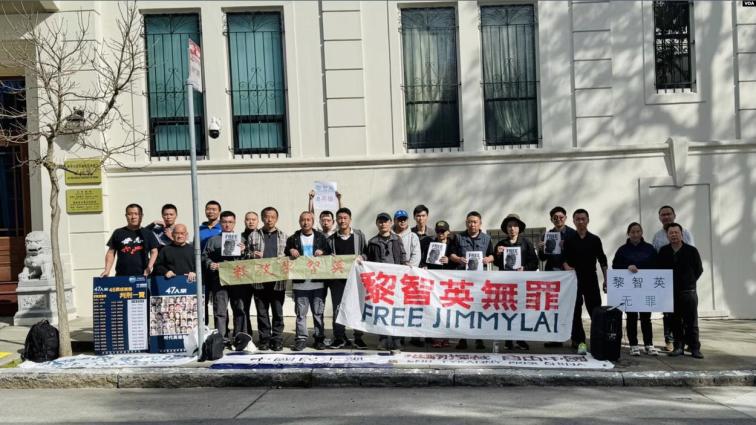
UK security services have indicated that the Chinese side (the CCP) frequently engages in espionage activities against the UK government. In an interview with BBC Radio, Alicia Kearns, the shadow minister for security and home affairs from the opposition Conservative Party, highlighted a series of tense relations between the CCP and the UK, including cyber threats and the CCP's poor human rights record. She referenced the case of Hong Kong citizen Jimmy Lai, who is imprisoned by the CCP, and the sanctions imposed by the CCP on several hardline British MPs. According to Radio France Internationale, Jimmy Lai should return home with Starmer, and the sanctions on the MPs should be lifted.
The Conservative Party is questioning whether the UK should continue to strengthen its ties with the Chinese Communist Party, particularly in light of the recent decision to approve the construction of the CCP's 'super embassy'.
Deutsche Welle references a warning from Rafael Behr, a columnist for The Guardian, who argues that this visit underscores what he terms 'Stamerism'... which only postpones an inevitable crisis... asserting that business interests and national security are 'ultimately inseparable'. Behr contends that Stamer's preferred approach of 'making no choice' will not be effective on either the domestic or international front.
△





News magazine bootstrap themes!
I like this themes, fast loading and look profesional
Thank you Carlos!
You're welcome!
Please support me with give positive rating!
Yes Sure!