
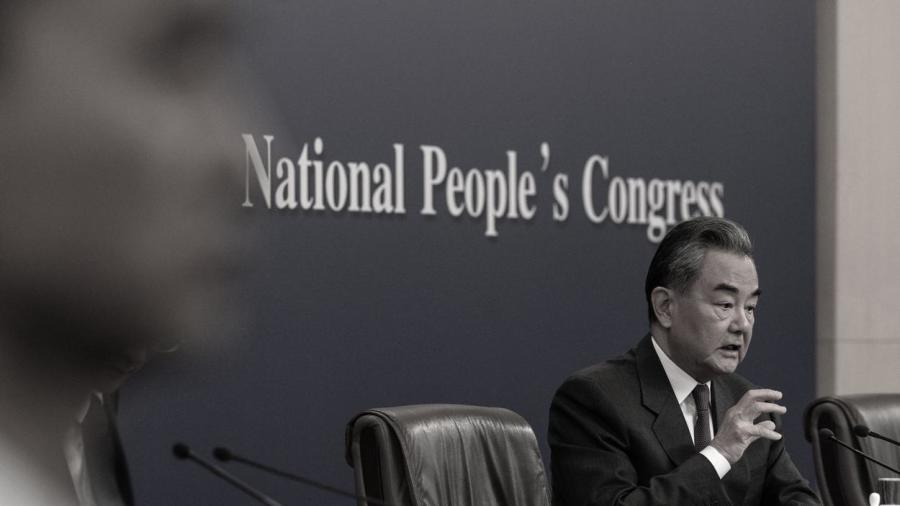
Image: Chinese Foreign Minister Wang Yi. (Photo by Kevin Frayer/Getty Images)
[People News] According to China’s Foreign Ministry, on February 1, Politburo member and Director of the Central Foreign Affairs Office Wang Yi met in Beijing with Russian Security Council Secretary Sergei Shoigu, who is in charge of Russia’s military-industrial complex. Shoigu stayed in Beijing for only one day before flying on to Myanmar. From official reports, he did not meet any other senior Chinese officials during that day. However, when Shoigu visited China on February 28, 2025, he also met Xi Jinping.
Shoigu served as Russia’s defense minister from 2012 until he was replaced in May 2024, but he has long been one of President Vladimir Putin’s closest and most trusted associates. On many occasions, Putin has taken only Shoigu with him to hunt, fish, and camp in Siberia, even celebrating his birthday together there. From this perspective, Shoigu’s trip to Beijing must have involved important matters.
Shoigu’s timing was somewhat sensitive. Zhang Youxia, a vice chairman of China’s Central Military Commission who had previously met Shoigu and traveled to Moscow to discuss military cooperation, had just been arrested less than half a month earlier. Meanwhile, internal turmoil had emerged within the Chinese Communist Party, and there were still doubts externally about whether Xi Jinping had regained firm control over the military and the Party.
Beyond the major internal upheaval in China, important international developments facing China and Russia include:
-
After capturing Maduro alive, U.S. President Donald Trump is reportedly preparing possible strikes on Iran, while Cuba is also moving toward collapse. China and Russia are both key supporters of Venezuela, Iran, and Cuba.
-
Trump is aggressively seeking to acquire Greenland, openly saying this is to prevent Chinese and Russian expansion in the Arctic and potential threats to the United States.
-
With Trump’s mediation, the Russia-Ukraine war may be moving toward an end.
-
Trump has clearly expressed support for Taiwan and believes that during his term, the Chinese Communist Party would not dare launch a war.
-
Trump has withdrawn from several United Nations bodies and set up a “Peace Committee,” working to shape a new international order, which has made the CCP—currently exerting influence within the UN—uneasy.
Clearly, beyond the impact of Trump’s various moves on China and Russia, the large-scale military purge triggered by Zhang Youxia’s arrest may also have affected Sino-Russian military cooperation to some extent. Shoigu’s visit, needless to say, was at Putin’s direction. There were many issues requiring clarification and discussion, including who is now actually in charge on the Chinese military side.
Reports from Chinese and Russian state media confirm this. Chinese state media said Shoigu came to China “on President Putin’s instructions for strategic communication.” Russia’s state news agency TASS reported that Shoigu said during the talks: “On the instructions of the Russian president, we will discuss a series of important and urgent issues, as well as matters that need to be resolved in bilateral relations and the global situation.”
According to Chinese official media, both sides focused on China-Russia relations, which should be one of the most urgent issues. Wang Yi spoke about changes in the international order and norms of international relations, saying that China and Russia, “as major world powers and permanent members of the UN Security Council,” should “safeguard the international system with the United Nations at its core.” Speaking of bilateral ties, Wang reiterated that as “comprehensive strategic partners of coordination in the new era,” the two sides should maintain close communication on major issues concerning bilateral relations, strengthen mutual support on core interests, and safeguard both their respective and shared interests.
Wang Yi’s message was that China and Russia should work together to resist Trump’s reshaping of the international order, continue close communication, and further strengthen mutual support on core interests. This likely represents Xi Jinping’s position—aligning with Russia against the United States and reassuring Russia that China will continue to support it, including at the military level.
This interpretation also comes from Wang’s wording. He said, “The guidance of the two heads of state is the greatest advantage and fundamental guarantee for the high-level development of China-Russia relations, and China is willing to work with Russia to implement the important consensus reached by the two heads of state.” From this, can it also be said that after Zhang Youxia’s arrest, Xi has once again consolidated his voice in foreign affairs and will continue his close cooperation with Putin, strengthening support for Russia in economic and material terms?
Somewhat differently from Chinese state media, which reported Shoigu saying they would “closely follow hostile forces undermining stability in the Taiwan Strait” and “firmly oppose Japan’s accelerated ‘remilitarization,’” and that Russia was willing to “continue firm mutual support with China, deepen bilateral cooperation, and strengthen coordination within multilateral mechanisms such as the United Nations, the Shanghai Cooperation Organization, and BRICS,” TASS placed more emphasis on Russia’s stance on Taiwan.
Shoigu said: “We see that certain ill-intentioned actors continue to undermine stability in the Taiwan Strait. I want to reaffirm that we will consistently and firmly support Beijing on the Taiwan issue.” He also said Russia is “closely monitoring Japan’s policy of accelerating militarization.”
This tone is precisely what the Chinese authorities want to hear. As for the so-called “ill-intentioned actors,” it likely refers to Western countries such as the U.S. and Japan that have warned China not to use force against Taiwan. Does Shoigu’s statement imply that if a crisis erupts in the Taiwan Strait, Russia would support China? What secret understandings might exist between the two sides?
According to TASS, the two sides also held “in-depth strategic communication” on various international and regional issues of common concern. This likely includes the five points mentioned earlier.
The author speculates that Shoigu’s visit most likely allowed him to understand the attitude of China’s top leadership toward Russia and Putin after Zhang Youxia’s arrest, and that he received new assurances. The fact that he did not meet Xi may well be related to the still-unstable situation within China, as Xi’s main focus may remain on how to carry out further purges and consolidate his power.





News magazine bootstrap themes!
I like this themes, fast loading and look profesional
Thank you Carlos!
You're welcome!
Please support me with give positive rating!
Yes Sure!