
Marriage Rates Among Young People on the Mainland Decline; Elderly Are Being “Urged to Marry”
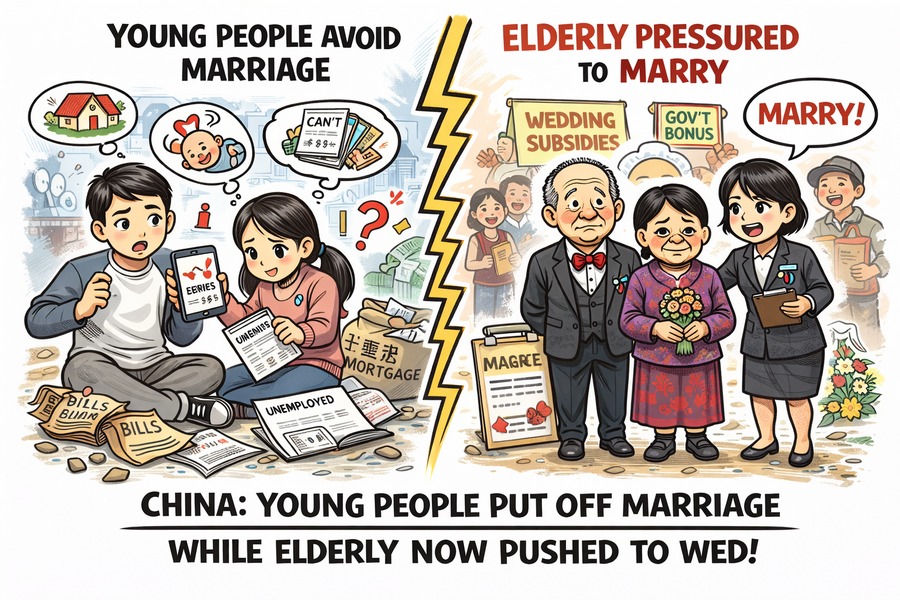
[People News] The long-term economic downturn under the Chinese Communist Party has given rise to many abnormal phenomena, which many commentators describe as signs of the CCP’s end-stage conditions. For example, more and more young people are choosing to “lie flat”: not dating, not marrying, not having children, and not buying homes. This has led to a rapid decline in the national birth rate. Since 2022, the number of deaths each year has exceeded the number of newborns. Recently, it has even been reported that among those getting married, the number of elderly people now exceeds that of young people.
The Number of Marriage Registrations Continues to Decline
According to The Epoch Times, data previously released by the CCP authorities show that in the first three quarters of 2025, approximately 5.152 million couples registered marriages on the Chinese mainland, an increase of 405,000 couples year-on-year. Multiple interviewees and grassroots workers told The Epoch Times that this increase in registrations does not align with young people’s reluctance to marry. The additional registrations are mainly concentrated among middle-aged and elderly people remarrying, with some individuals being encouraged to marry by grassroots organizations such as neighborhood committees.
Huang Baibo, a sociologist who focuses on family structure issues, stated that the authorities only released the total number of marriage registrations and the year-on-year difference, without disclosing the quarterly distribution of the additional 405,000 couples, their age structure, or whether they were first marriages or remarriages. “In absolute terms, 5.152 million couples is still significantly lower than the peak level in 2013 and also below the average of the past ten years,” he noted. He pointed out that without detailed data such as the ratio of first marriages to remarriages and age distribution, it is difficult to determine whether there has been any substantive change in the marriage structure.
Huang Baibo believes that “the authorities are more concerned about whether the data look good, rather than what is actually happening behind the data.” When marriage statistics are simplified into overall increases or decreases while avoiding breakdowns by age groups and first marriages versus remarriages, this effectively avoids confronting the reality that young people are continuously withdrawing from marriage.
A grassroots worker in mainland China said that over the past year, the number of young people coming to register marriages has continued to decline, with the age of first marriage generally being delayed. In some regions, the average age of first marriage for both men and women has approached or even exceeded 36.
An internet industry worker in Suzhou said that although he and his partner have been together for many years, they have still not set a wedding date. Speaking about the reasons for delaying marriage, he said it was not that he did not want to marry, but that he did not dare to marry: “The industry is frequently adjusting, job stability is declining, and there is no long-term expectation for future income. Once you get married, housing, living expenses, and family responsibilities all increase at the same time. So we can only wait and see whether the situation improves.”
From the surface-level data, the number of marriage registrations in mainland China in 2025 appears to have shown a temporary rebound. However, multiple interviewees said that this change does not mean there has been a significant improvement in young people’s willingness to marry; rather, it is more related to changes in the age structure of those registering marriages.
Urging Elderly People to Marry Comes With Quotas
Ms. Wang, a staff member at a subdistrict office in Beijing’s Haidian District, said that in recent years, the proportion of middle-aged and elderly people remarrying among marriage registrations has increased significantly. “There are now policies encouraging elderly people to marry, and we also have quotas for urging marriage. We mobilize divorced individuals to remarry. Some areas even provide matching subsidies or bonuses. So the registration numbers look like they’ve gone up, but not many young people are getting married.”
Ms. Wang said that some middle-aged and elderly people choose to remarry because their children are already settled, their lives are relatively stable, or they are motivated by policy incentives. Statistically, this raises the total number of marriage registrations, but this change does not overlap with the marriage choices of young people.
Huang Baibo said that in the CCP system, which prioritizes stability and controllability, marriage is regarded as a social behavior that needs to be “managed” and “guided,” rather than the result of individual choice. “When the system itself cannot resolve problems related to housing, employment, and expectations, it can only manufacture a sense of recovery in the numbers.”
He believes that while this approach may help maintain official narratives in the short term, in the long run it will deepen public distrust of the data and further weaken young people’s identification with the institution of marriage.
Young Netizens: Now Is Not a Suitable Time to Marry
On social media platforms, discussions around “whether to get married” and “why refuse marriage” continue to intensify. On platforms such as Douyin and Xiaohongshu, many young netizens share personal experiences and emotions to express the reasons for their hesitation and distance from marriage.
On Douyin, some high-view-count videos focus on topics such as “How much does it cost for ordinary people to get married?” and “The real bills after marriage,” listing in detail rent or mortgage payments, bride price, wedding expenses, and future childcare costs. Some creators state in their videos: “After doing the math, there’s only one conclusion left: now is not a suitable time to get married.”
On Xiaohongshu, some users post that marriage means fixed expenses and long-term responsibilities. With income and career prospects uncertain, choosing to remain single is seen as a safer option. One user wrote: “Not getting married doesn’t mean not yearning for a family, but being more clear-eyed about reality.”
A netizen named Huang Yao wrote in a comment: “You want me to get married? I feel like I don’t even want to live anymore. Life is so meaningless right now, and I can’t see any light.” Similar expressions have received large numbers of likes and responses across multiple platforms. △






News magazine bootstrap themes!
I like this themes, fast loading and look profesional
Thank you Carlos!
You're welcome!
Please support me with give positive rating!
Yes Sure!