
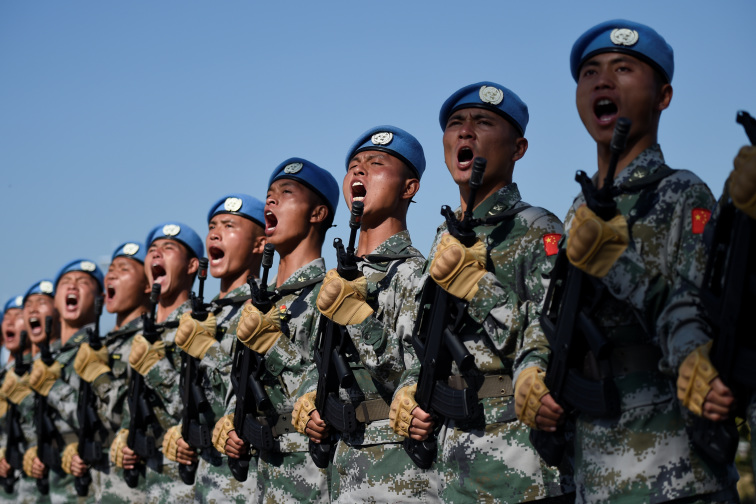
Chinese troops take part in marching drills ahead of an October 1 military parade to celebrate the 70th anniversary of the founding of the People's Republic of China at a camp on the outskirts of Beijing
[People News] At the end of the cold winter of 2025, the Chinese military once again faced a severe storm. Air Force Commander Chang Dingqiu was reportedly dead during an investigation, and before the dust had settled, the official military website released another bombshell, directly targeting the Air Force system.
On November 15, the Military Procurement Network, under the Logistics Support Department, unusually issued an “Announcement on Soliciting Reports of Irregularities in Air Force Procurement,” publicly seeking reports from society regarding irregularities in Air Force procurement, with a reporting deadline of June 30, 2026.
The announcement stated that it mainly accepts reports related to irregularities in material and service procurement activities organized by the Air Force, including but not limited to demand compilation, procurement evaluation, contract performance, supplier sanctions, selection of bidding agencies, and online procurement. The announcement also stated that any personnel participating in Air Force procurement activities could provide leads under their real names.
This is the first time the Chinese military has publicly conducted an investigation targeting a specific branch. Does this imply a major shake-up at the top of the Air Force, a complete reshuffling of its power structure? Who is behind this “Falcon Hunt” operation in the military?
On July 26, 2023, the All-Military Weaponry Procurement Information Network, under the Equipment Development Department of the Central Military Commission, issued an “Announcement on Soliciting Leads on Violations and Disciplinary Offenses by Experts in Military Equipment Procurement Tender Evaluations,” publicly collecting reports and claiming to trace irregularities back to October 2017.
Following that, the top levels of the Rocket Force experienced a massive upheaval. Rocket Force Commander Li Yuchao, and two successive Ministers of Defense, Wei Fenghe and Li Shangfu, were removed. The Rocket Force purge was seen as Xi Jinping’s “shock-and-awe” against Zhang Youxia, a prelude to acting against him.
At the Third Plenary Session of the 20th CPC Central Committee in July 2024, Zhang Youxia allied with CPC elder factions, the Tuanpai, and Liu Yuan to counteract Xi. Over the following year, Xi’s military confidants, including Miao Hua, He Weidong, and Zhong Shaojun, suffered successive mishaps, being removed from office one after another.
After the Fourth Plenary Session, Xi appeared to hold power over Party, government, and military, but in reality, he was in a nominal position, with power slipping away. Recently, Politburo member Ma Xingrui has repeatedly missed major meetings and key events, signaling that Xi’s grip over Party and government is being forcefully undermined, and one side of the CPC power scale is quietly sinking.
Recently, Air Force Commander Chang Dingqiu, a general, was reportedly detained for questioning and died of an unexpected heart attack, while Air Force Political Commissar Guo Puxiao was reportedly involved in a mishap. Combined with the sudden death of Air Force General Xu Qiliang, former Vice Chairman of the Central Military Commission, the Air Force system seems to be repeating the Rocket Force’s “total annihilation” scenario.
Public information shows that both Chang Dingqiu and Guo Puxiao were protégés of former Air Force Commander Xu Qiliang. Their rapid promotions were related not only to Xu Qiliang’s elevation to CMC Vice Chairman but also reportedly benefited from Miao Hua, Director of the Political Work Department. In other words, they were all Xi loyalists, firmly part of Xi’s military faction.
Another rumored Xi loyalist involved is Xu Xueqiang, Minister of the Equipment Development Department of the CMC. In October, independent media figure Cai Shenkun reported that Xu Xueqiang had been removed. At the Central Economic Work Conference on December 10-11, Xu Xueqiang was notably absent, while he had attended the conference for the previous three years.
Xu Xueqiang, a general from the Air Force system, previously served as commander of an Air Force Aviation Division, commander of the Shanghai Air Force Command Post, Air Force Chief of Staff of Nanjing Military Region (2014), Chief of Staff of Eastern Theater Air Force (2016), Commander and Deputy Commander of Northern Theater Air Force (2017), President of National Defense University (2021), promoted to general (September 2021), and appointed Minister of Equipment Development Department (October 2022 after the 20th CPC National Congress).
Xu’s rapid promotions to lieutenant general, general, and successive theater positions coincided with Miao Hua’s tenure as Director of the CMC Political Work Department. Xu’s disappearance aligns closely with the critical timing after Miao Hua’s mishap, strongly suggesting he has been categorized under the anti-Party political faction of Miao Hua and He Weidong.
Curiously, Xu Xueqiang’s Baidu Encyclopedia page has not been deleted like Chang Dingqiu’s and Guo Puxiao’s, but contains only minimal information. Even more strangely, on the discussion page of Xu’s entry, netizens openly posted comments such as “Hasn’t he already been removed?” and “I heard he’s in custody,” which have rarely been deleted by authorities. This effectively constitutes an official acknowledgment of Xu Xueqiang’s fall from power.
Anti-corruption is a double-edged sword: outwardly a self-revolution, inwardly political purges and power struggles. If the Rocket Force’s annihilation was Xi Jinping’s Pearl Harbor strike against Zhang Youxia, the Air Force purge is Zhang Youxia’s Midway counterattack against Xi, signaling that Zhang has seized the initiative in this power struggle.
It is noteworthy that the military’s recent solicitation of reports on Air Force corruption was issued by the Military Procurement Network under the Logistics Support Department, whereas the Rocket Force purge two years ago was ordered through the All-Military Weaponry Procurement Information Network under the Equipment Development Department. What is the difference?
The Weaponry Procurement Information Network mainly handles procurement for weapons research, production, and maintenance projects, under the Equipment Development Department of the CMC. China’s defense budget is divided into three main categories: personnel living expenses, logistics and training maintenance costs, and military equipment expenditures. Military equipment costs constitute the core part of defense budget for weapons procurement, historically about 33.2% of total defense spending, approximately 550 billion RMB according to the 2024 budget.
The Military Procurement Network handles non-weapon daily procurement, such as military supplies, engineering services, and medical supplies, under the Logistics Support Department Procurement Bureau. It serves daily logistics and resource allocation, funded mainly from training maintenance costs, smaller than weapon procurement but broader in scope and more socially interconnected. Military logistics procurement emphasizes transparency and digital processes, but all decisions are controlled by the bidding authority.
Thus, Zhang Youxia’s current strike against Air Force logistics procurement corruption may seem smaller in monetary scale than equipment procurement and might appear to hit political enemies less severely. However, Air Force logistics procurement covers fuel, food, clothing, medical equipment, spare parts, engineering services, IT hardware and software, HVAC systems, and other miscellaneous equipment, as well as logistical equipment for weaponry.
The procurement process involves more stages—demand compilation, procurement evaluation, contract performance, supplier sanctions, selection of bidding agencies, online procurement—and thus involves more complex personnel and social networks: suppliers, evaluators, bidding agencies, agents, and relevant military personnel. While the military is the main body of anti-corruption, “pulling out a carrot can bring up mud,” potentially implicating officials’ intermediaries, making the impact wider.
Additionally, Xu Xueqiang, appointed Minister of Equipment Development in October 2022 and from the Air Force, would likely be implicated if Air Force equipment procurement—such as J-20 stealth fighters, Y-20 transporters, air defense missile systems, electronic warfare equipment, radar arrays, drones, electronic defense networks, general powered equipment, and battlefield command and control protection equipment—was investigated, linking military industries and the factions behind them.
Crucially, the reporting deadline for whistleblowing is June 30, 2026. This is strategically interesting, as the Fifth Plenary Session and next year’s Two Sessions are expected during this period, along with monthly Politburo meetings. Every high-ranking Air Force official investigated will impact military personnel arrangements, power struggles, and further weaken and disrupt Xi’s power structure, delivering deep, irreversible damage to Xi’s military loyalist network.
The CPC emphasizes the philosophy of struggle: in power struggles, there is no ceiling. The internal conflict drama is still unfolding.
(First published by People’s Daily) △




News magazine bootstrap themes!
I like this themes, fast loading and look profesional
Thank you Carlos!
You're welcome!
Please support me with give positive rating!
Yes Sure!