

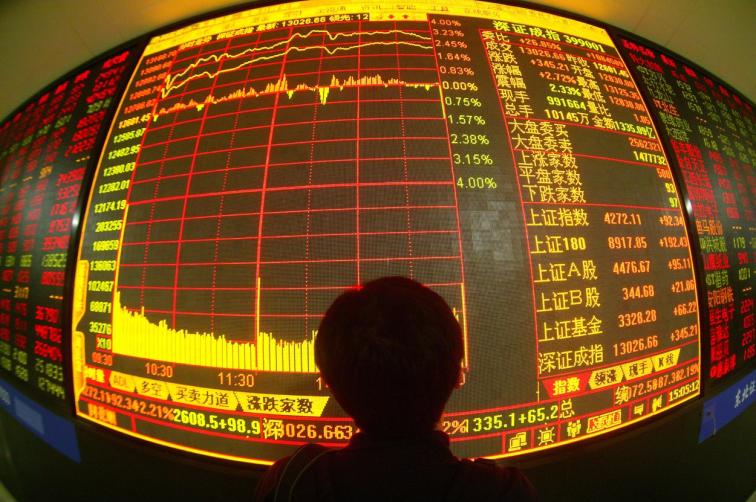
China‘s Economy on a Roller Coaster, Shaking and Sliding Downward (Graphic by People News)
[People News] China's economy is currently facing unprecedented challenges. During the recently concluded Central Economic Work Conference, the CCP preemptively announced that this year's economic targets would be successfully met. On December 15, the National Bureau of Statistics of China released economic data for November, indicating that China's economic indicators have reached a low point for the year, reflecting a comprehensive deterioration in economic conditions.
Comprehensive Deterioration of China's Economy
The Wall Street Journal recently highlighted that China's economic momentum generally slowed in November, with a notable decline in consumer spending, which has increased pressure on the Chinese government to stabilise household and business demand.
The article further pointed out that the total retail sales of consumer goods in China grew by only 1.3% year-on-year in November, down from 2.9% in October. This marks a continuous slowdown in year-on-year growth for six consecutive months, the longest period of deceleration since 2020. The consumer goods subsidy program introduced last year has prematurely released purchasing power, making it challenging to sustain current growth momentum.
From January to November, fixed asset investment decreased by 2.6% year-on-year, a decline greater than the 1.7% drop recorded from January to October. According to reports from Nikkei Chinese Network, month by month, China's fixed asset investment has been on a downward trend since February this year, indicating that the economy, which has relied on 'investment' as its mainstay, is beginning to show signs of strain. It is projected that China's fixed asset investment for the entire year of 2025 will experience negative growth for the first time since this statistic has been tracked since 1995.
In November, the industrial added value grew by 4.8% year-on-year, a slight decrease from the 4.9% recorded in October. During the same month, the national industrial producer price index (PPI) fell by 2.2% compared to the previous year, while it rose by 0.1% from the previous month. Additionally, the national industrial producer purchase price index dropped by 2.5% year-on-year, with a month-on-month increase of 0.1%. From January to November, the national industrial producer price and purchase price indices saw year-on-year declines of 2.7% and 3.1%, respectively. The producer price index (PPI) has now experienced negative growth for three consecutive years, indicating a persistent deflationary cycle.
Data from the National Bureau of Statistics also reveals that the average urban survey unemployment rate across the country was 5.2% from January to November. In November, this rate stood at 5.1%, remaining stable compared to the previous month. Importantly, this data does not account for the hundreds of millions of migrant workers. Over the past two decades, these workers have formed the backbone of the Chinese Communist Party's major infrastructure projects and the real estate sector. However, with investment declining and the real estate market in decline, the employment challenges faced by migrant workers have become increasingly severe, contributing to a high youth unemployment rate and intensifying the anxieties of the Communist Party regime.
The real estate crisis continues to deepen.
According to a report by The Wall Street Journal, sales of newly built commercial residential properties in China fell by 11.2% year-on-year in the first 11 months of this year, surpassing the 9.4% decline recorded in the previous 10 months. During the same period, national real estate development investment decreased by 15.9% year-on-year, widening from the 14.7% drop seen in the previous 10 months.
The area of new residential construction initiated by national real estate development companies saw a year-on-year decline of 20.5% in the first 11 months, compared to a 19.8% decline in the first 10 months of 2025.
Meanwhile, housing prices in major cities across China continue to decline. In November, housing prices in 70 large and medium-sized cities fell by 0.39% month-on-month. A total of 59 cities reported a month-on-month decrease in housing prices. According to official data, these cities experienced a year-on-year decline of 2.78% in November, which is greater than the 2.6% drop recorded in October. Over the first 11 months of this year, housing prices in these 70 cities have decreased by 3.9% compared to the same period last year.
The real estate market continues to deteriorate, and official confidence in market rescue efforts is also waning. In this year's Central Economic Work Conference, real estate was ranked last among the key tasks for the coming year, mentioned primarily as a means to address risks in critical sectors. However, in the 2024 Central Economic Work Conference, real estate was elevated to the fifth position among next year's key tasks, with officials emphasising the need to stabilise the housing market.
The extensive monetary easing implemented over the past two years has largely been ineffective.
The anticipated decline of the Chinese economy in 2025 is not unexpected; it is the result of a combination of structural economic issues, a real estate crisis, and external pressures. Over the past two years, the Communist Party has enacted a dual approach of significant monetary and fiscal easing. By the end of November 2025, the total social financing stock reached 440.07 trillion yuan, reflecting an 8.5% year-on-year increase, with government bond issuance being the largest contributor, as the balance of government bonds hit 94.24 trillion yuan, up 18.8% year-on-year. Fiscal spending has risen, pushing the fiscal deficit beyond the 3% threshold to between 3.5% and 4%. The monetary policy has adopted unprecedented easing measures not seen in the past 15 years, including multiple interest rate cuts and reductions in reserve requirements.
The stimulus plan for 2024-2025 is projected to be equivalent to 5-7% of GDP, encompassing local government bonds, national bonds, special national bonds, infrastructure investments, and targeted subsidy projects known as 'two new and two heavy'. However, these policies have not effectively translated into real economic benefits. In the first 11 months of 2025, the total increase in social financing reached 33.39 trillion yuan, which is 3.99 trillion yuan more than the same period last year. Yet, the RMB loans extended to the real economy only rose by 14.93 trillion yuan, reflecting a year-on-year decrease of 1.28 trillion yuan. This figure is still adjusted for data beautification. The Wall Street Journal reported that Chinese bank employees have pressured business owners to falsify loan applications to meet targets set by higher authorities, with the banks covering the interest. The consumer price index and producer price index have remained low for several years, contributing to a recession and contraction in the market.
The fundamental issue with off-balance-sheet monetary circulation stems from the collapse of the real estate bubble, which has resulted in weak credit demand and diminished corporate investment appetite. The decline in housing prices has led to a reduction in middle-class wealth. Factory closures have caused unemployment among workers, decreased household incomes, and a lack of willingness. Additionally, an ageing population has driven up labour costs, increasing expenses for businesses. Local government debt has soared to 20 trillion dollars, and there has been a trend of salary cuts among civil servants, further weakening consumption. The escalation of trade tensions between China and the U.S. is expected to result in a 19-27% drop in exports to the U.S. in 2025, although non-U.S. markets have mitigated some of the adverse effects.
During this year's Central Economic Work Conference, the Chinese Communist Party (CCP) unveiled measures aimed at stimulating domestic consumption. However, the core issue remains whether the CCP's centralised system can genuinely provide fairness and justice for the people. Private enterprises face significant suppression, making it difficult to discuss the sharing of wealth among the populace. With foreign investments withdrawing, there is little left to rescue the market. Unless the issues of social stratification and unfair distribution are addressed, any efforts to boost consumption are merely empty rhetoric.
The CCP's economy is in a critical state, yet it continues to adopt a strategy reminiscent of Duke Huan of Qi, who refused to acknowledge his ailments. In recent years, key indicators such as land sales, foreign investment inflows, and unemployment rates have seemingly 'vanished' from public data. The authorities not only feign ignorance but also sing praises for the leadership while pressuring experts to remain silent and ordering the public to refrain from speaking out. Recently, it was alarming to learn that the Douyin platform issued a ban prohibiting discussions about economic conditions, leading to the suspension of thousands of accounts.
'China Manufacturing 2025' will not save the economy.
'China Manufacturing 2025' represents Xi Jinping's core strategy for establishing a 'manufacturing powerhouse,' aiming to shift China from low-end assembly to a high-tech manufacturing leader. Currently, China's manufacturing value added accounts for 30% of the global total, significantly surpassing the United States' 11%. In the first three quarters of 2025, investment in the CCP's manufacturing sector increased by 6.2%.
But can 'China Manufacturing 2025' truly rescue the Chinese economy? While it may provide short-term momentum and potentially shift the long-term strategic direction, it cannot address the systemic flaws inherent in the CCP's economic model, nor can it reverse the institutional decline of the CCP's economy. The fundamental issue lies in the economic structural problems stemming from the CCP's subsidy-driven manufacturing model, which are essentially unsolvable.
Firstly, overcapacity remains the most significant constraint. Subsidies from non-market economies distort market signals, causing factories to chase subsidy benefits and expand blindly, far beyond actual demand. This leads to companies engaging in low-price dumping, disrupting the international trade order and triggering global trade tensions, which will inevitably provoke countermeasures. By 2025, the EU and the US are set to increase tariffs, resulting in a 27% drop in exports to the US, which will adversely affect the domestic economy.
Secondly, artificial policy support has resulted in unbalanced industrial development, putting pressure on the overall economy. Manufacturing in China accounts for 27% of GDP, yet the transition to consumption and services is lagging. The government's substantial fiscal subsidies are disproportionately directed towards manufacturing, which suppresses the growth of household income and demand. This dependence on fiscal stimulus creates a distorted incentive mechanism that disrupts the industrial layout under market equilibrium, ignoring market principles. Such policy interventions have significantly harmed the service sector, stifling economic dynamism and worsening industrial imbalances.
Thirdly, the push for localisation in manufacturing will inevitably heighten external pressures and geopolitical risks. China's manufacturing sector, bolstered by state support, has disrupted the global free market, leading to the hollowing out of global manufacturing—something that the West and other nations cannot accept. The CCP's unchecked export dumping is likely to spark a global trade war, and the CCP's export trade may be sidelined in the ongoing restructuring of global supply chains.
Finally, the lack of innovation and efficiency represents a persistent weakness in the CCP's manufacturing sector. Data indicate that the Made in China 2025 initiative has not significantly enhanced manufacturing productivity. This is largely due to a bureaucratic incentive structure that drives companies to pursue capacity blindly, resulting in a formalised and short-term approach to innovation, which in turn slows long-term growth and undermines sustained competitiveness.
The decline of the Chinese Communist Party's (CCP) economy is fundamentally a systemic issue, with the state-driven model being essentially a 'systemic curse.' Economic growth depends on market signals, inclusivity, fostering innovation, and fair competition. In contrast, the CCP's approach is marked by planning, coercion, and a centralised system. This state-led model, which prioritises political objectives over resource allocation, is hurtling towards a Soviet-style trap.
(Originally published in the People News) △






News magazine bootstrap themes!
I like this themes, fast loading and look profesional
Thank you Carlos!
You're welcome!
Please support me with give positive rating!
Yes Sure!