

On November 29, 2025, citizens gathered to mourn near the site of the fire. (Yu Gang / Dajiyuan)
[People News] The five-alarm fire in Hong Kong has sent shockwaves around the globe. During a press conference on November 30, the Hong Kong police announced that by 5 PM that day, the death toll had risen to 146, following the discovery of additional bodies in the debris. The investigation into the cause of the fire has focused on three contentious issues: bamboo scaffolding, green mesh, and foam boards. The century-old bamboo scaffolding, widely used in Hong Kong, has become a scapegoat, sparking public outrage and leading to a grassroots investigation, although its leaders have faced arrests by the authorities.
On November 30, Hong Kong officials reported that the death toll from the fire had reached 146, with around 140 individuals still unaccounted for, including over 40 missing persons and 100 cases that remain untraceable. Among the deceased, the identities of 54 bodies have yet to be confirmed.
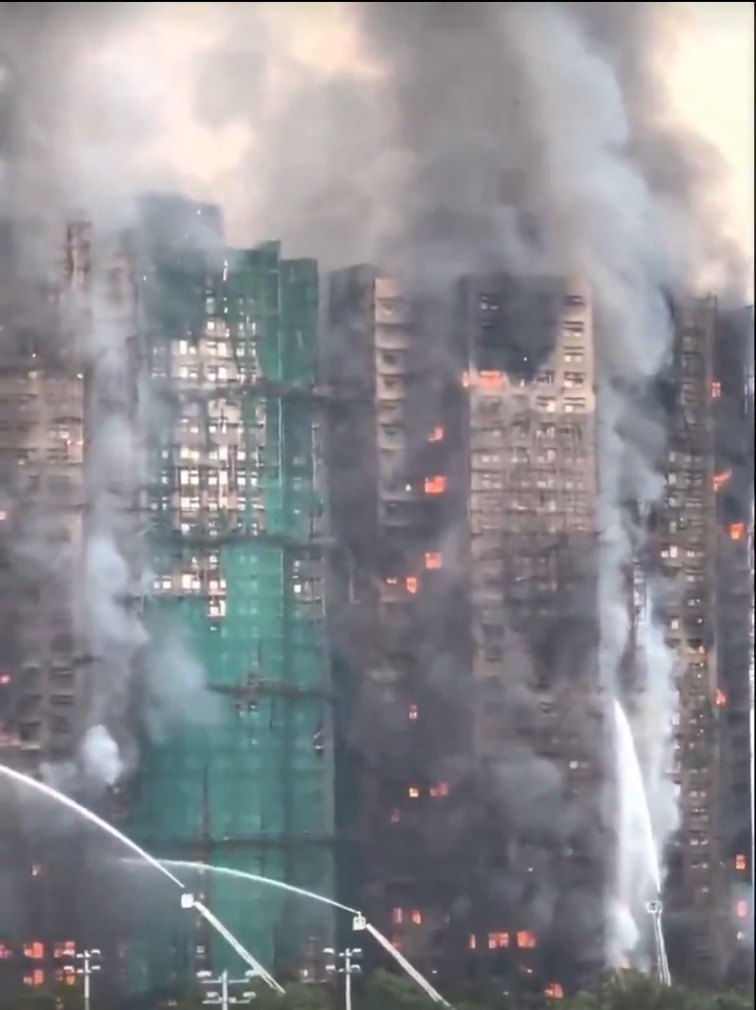
The fire in Hong Kong began on the afternoon of November 26 and was not fully extinguished until the morning of November 28. According to the Hong Kong police, inspections conducted by the Hong Kong Housing Authority on all buildings in the Hong Fu Court have initially determined that the structure poses no immediate danger, and the police anticipate completing the search of all buildings in Hong Fu Court by November 30.
Hong Fu Garden, located in the Tai Po District of Hong Kong's New Territories, was built in 1983 and comprises 8 high-rise buildings, each 31 stories tall. It houses nearly 2,000 apartment units and over 4,600 residents, including 1,701 elderly individuals aged 65 and above. The recent fire affected 7 of the buildings, with only Hong Zhi Pavilion remaining untouched. Many residents are currently being accommodated in temporary shelters or hotels in the city, while Hong Kong authorities are working to find long-term solutions.
Family members are grieving as they identify the deceased; Hong Kong citizens are lining up to pay their respects to the victims.
On November 27, Hong Kong officials opened the Tai Po Guangfu Community Activity Centre for families of the missing to identify their loved ones through photographs. Some citizens noted that approximately 50 body photos would be available on-site, with details recorded about the circumstances of the bodies' discovery, such as the floor unit and personal belongings found nearby.
On-site staff advised family members to prepare themselves psychologically, as some of the photos could be distressing. Some individuals recognised their deceased relatives from the photos and broke down in tears, while others required assistance to leave the area. The atmosphere was quite heartbreaking. However, there were also those who did not see photos of their relatives but still appeared tense and anxious. Reports indicate that at peak times, over a hundred people were waiting to enter, and even in the evening, more individuals arrived to identify the deceased.
After the fire was extinguished, thousands of Hong Kong citizens gathered to mourn outside the apartment complex over the weekend. At the Guangfu Recreation Area across from the fire scene, a large display of flowers expressing condolences emerged in front of the barricade. Many people placed white roses, carnations, lilies, and other flowers at a makeshift memorial, bowing their heads in silence or writing notes of remembrance.
One of the lamp posts was adorned with flowers and condolence cards, one of which read, 'May God bless Tai Po, may God bless Hong Kong, rest in peace to the deceased, and strength to the living.'
At 3 PM on November 30, a long line of citizens formed to pay their respects, with more people continuously joining. It took 15 minutes to walk from the front to the back of the line. After around 4:30 PM, another line extended 1.6 kilometres, requiring 22 minutes to traverse from start to finish.
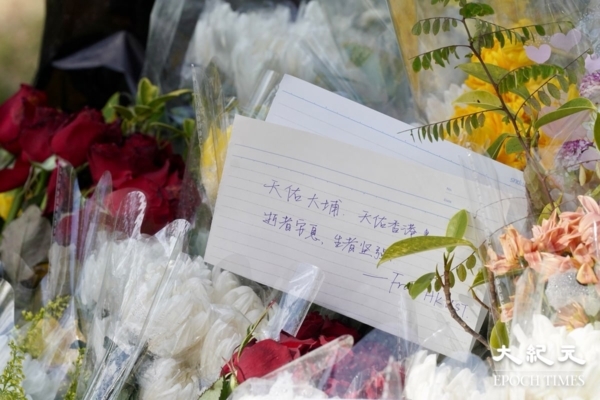
On November 29, 2025, citizens gathered near the fire scene to mourn. (Yu Gang / The Dajiyuan)
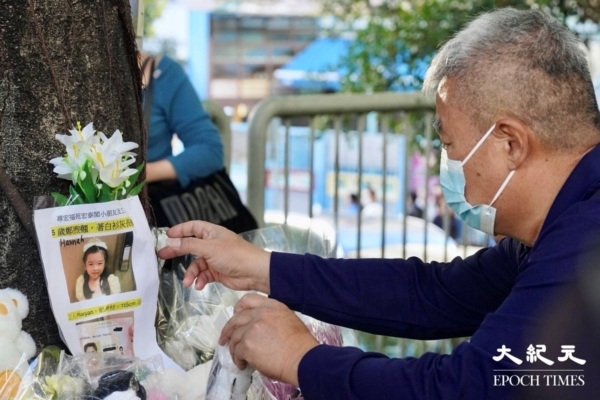
On November 29, 2025, citizens gathered near the fire scene to mourn. (Yu Gang / The Dajiyuan)
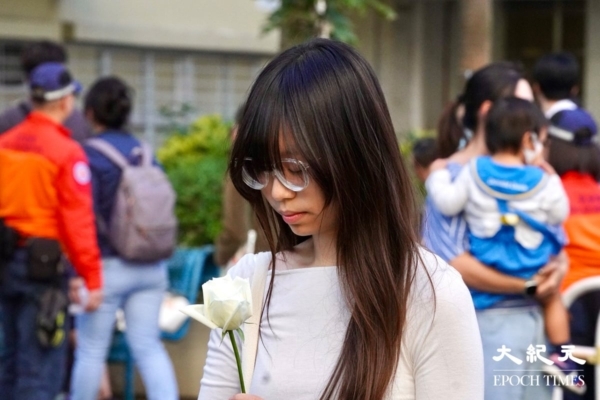
On November 29, 2025, citizens gathered near the fire scene to mourn. (Yu Gang / The Dajiyuan)
During the firefighting efforts at Hong Fu Court in Tai Po, 37-year-old firefighter He Weihao tragically lost his life. The Sha Tin Fire Station, where he was stationed, lowered its flag on November 29, and many citizens of Hong Kong came to the fire station to lay flowers and express their condolences. The Fire Services Department is currently raising funds for He Weihao's family and is accepting public donations.
The bamboo scaffolding has become a scapegoat, provoking public outrage.
This devastating fire in Hong Kong has resulted in significant casualties, and the cause of the incident is still under investigation. However, it is widely regarded as a man-made disaster rather than an accident. Public concern regarding how the fire escalated into a 'chain reaction fire' is primarily focused on the bamboo scaffolding, green mesh, and foam boards.
A preliminary investigation by the Hong Kong police revealed that the fire originated from the low-level scaffolding net of one of the buildings, spreading rapidly as foam boards contributed to the fire's acceleration, with windows covered by these boards. The wind further fueled the flames, allowing them to leap from one building to another, ultimately engulfing seven buildings. Firefighters worked for 40 hours to completely extinguish the blaze, finally bringing it under control on the morning of November 28.
In terms of the cause of the incident, Yang Enjian, the Director of the Fire Services Department, indicated that the fire alarm in Building 8 of Hongfu Court was not functioning properly.
On November 28, Hong Kong's Secretary for Security, Tang Ping-Keung, stated at a press conference that initial examinations showed the surrounding net used for the bamboo scaffolding had fire-retardant properties. The day after the fire, Chief Secretary for Administration Chan Kwok-kee announced that metal scaffolding would replace bamboo scaffolding in the future. These comments from Hong Kong officials have raised significant doubts among the public.
Bamboo scaffolding is a traditional construction method in Hong Kong, with a history spanning over a century. Former Observatory Director Lin Chao-ying expressed scepticism on social media, questioning, "The flammable surrounding net and foam are clearly the material culprits; why is the focus of scrutiny on the relatively less flammable bamboo?"
Many in Hong Kong society feel that the government's approach is akin to blaming bamboo scaffolding, treating it as a scapegoat for the fire. After the blaze was extinguished, numerous bamboo scaffolds at the scene were merely charred and had not turned to ash.
During firefighting efforts, firefighters found that some of the building materials on the exterior wall were more flammable and spread more easily than compliant materials, which is considered an 'unusual' phenomenon. Pan Zhuohong, a Hong Kong construction businessman and chairman of 'Zhongke Jiancha', previously raised concerns that the construction of Hongfu Garden did not utilise flame-retardant scaffolding nets, which contributed to the fire. He specifically called out the Director of the Fire Services Department, Yang Enjian, for consistently refusing to address the issue of flame-retardant scaffolding nets.
Residents of Biyou Bay in Hong Kong shared a video claiming that the fourth phase of their estate was also contracted for exterior wall repairs by the implicated company, Hongye. They took a sample of the scaffolding net for a burning test. The video shows residents cutting a piece of orange scaffolding net and igniting it, with flames quickly spreading and melted pieces falling off. The results of the test raised safety concerns among the residents regarding the construction work.
Furthermore, some netizens provided evidence indicating that the scaffolding protection nets used by Hong Kong Hongye Construction were tested and certified by a laboratory in Binzhou, Shandong, mainland China, replacing the traditional HOKLAS standards in Hong Kong. This has sparked questions about potential conflicts of interest, but the Hong Kong authorities have not yet responded to these rumours.
Self-media figure Zhai Shanying disclosed that he received a message from high-ranking officials of the Chinese Communist Party, stating that 'the fire at Hong Kong Hongfu Garden was a result of Xi Jinping's mismanagement of the real estate sector, leading to a surplus of steel scaffolding intended for dumping in Hong Kong. The Hong Kong government refused to accept it because bamboo scaffolding can support more workers. Consequently, the CCP sent national security agents to set the fire, but this group was unprofessional, resulting in a major fire disaster. Whoever benefits is the culprit.' This assertion has yet to be verified.
The initiator of public accountability has been apprehended by the authorities.
As the people of Hong Kong express doubts about the official investigation results, a grassroots movement advocating for government accountability has rapidly emerged, which has led to immediate arrests by the authorities.
On November 28, citizens spontaneously formed the 'Tai Po Hong Fuk Court Fire Concern Group' and presented four key demands for a comprehensive investigation into the incident. These demands include 'ensuring the resettlement of affected residents, establishing an independent investigation committee, reviewing the engineering supervision system, and holding government officials accountable for regulatory negligence.' The group aims to secure a more transparent and responsible investigation for the victims and survivors. By 4 PM on November 29, over ten thousand people had signed the petition.
One of the initiators, a university student named Miless, believes that the fire highlights underlying systemic issues. However, many netizens have cautioned him to be mindful of his personal safety.
Shortly thereafter, the South China Morning Post reported that informed sources indicated that on the evening of November 29, the Hong Kong police arrested the petition's initiator, accusing him of intending to 'incite.' On the same day, the Beijing Office for National Security in Hong Kong publicly stated that 'anti-China chaos in Hong Kong elements and those with ulterior motives are seeking to create chaos,' inciting social division and resentment against the Chief Executive and the SAR government, and warned that 'those who use disasters to create chaos in Hong Kong' will face severe consequences under the National Security Law.
The recent fire highlights how Hong Kong Chief Executive Li Jiachao (Li Jiachao) and his team of SAR officials have become typical Communist Party officials. Li Jiachao only made an appearance five hours after the fire broke out. In his speech, he repeatedly expressed gratitude to Xi Jinping and also acknowledged the Hong Kong and Macao Affairs Office and the Liaison Office of the Central People's Government in Hong Kong. However, he failed to mention the firefighters who risked their lives to combat the blaze or the various sectors in Hong Kong that actively contributed donations and resources. While government officials show such negligence regarding fire safety issues that directly affect the lives and property of citizens, they go to great lengths to suppress the pro-democracy movement in Hong Kong. This discrepancy arises because Li Jiachao's authority stems not from the citizens of Hong Kong but from Xi Jinping, who is situated far away in Beijing.
△



News magazine bootstrap themes!
I like this themes, fast loading and look profesional
Thank you Carlos!
You're welcome!
Please support me with give positive rating!
Yes Sure!