

Hong Kong Fire
[People News] The literati Zheng Xiaoxu, who lived through the late Qing and Republican era, summed up the “Three Gongs Theory” from prophetic charts left by his ancestors. He predicted: The Qing will fall to the Republic, the Republic will fall to Communism, and Communism will fall to Joint Governance. He pointed out that the reason for the CCP’s future demise would stem from a transition from dictatorship to joint governance. This prophecy seems closely tied to the emerging power blocs related to the major political families under Xi Jinping’s rule. Perhaps the force that will destroy the CCP is not foreign powers, not the masses, but these surviving red aristocratic clans themselves.
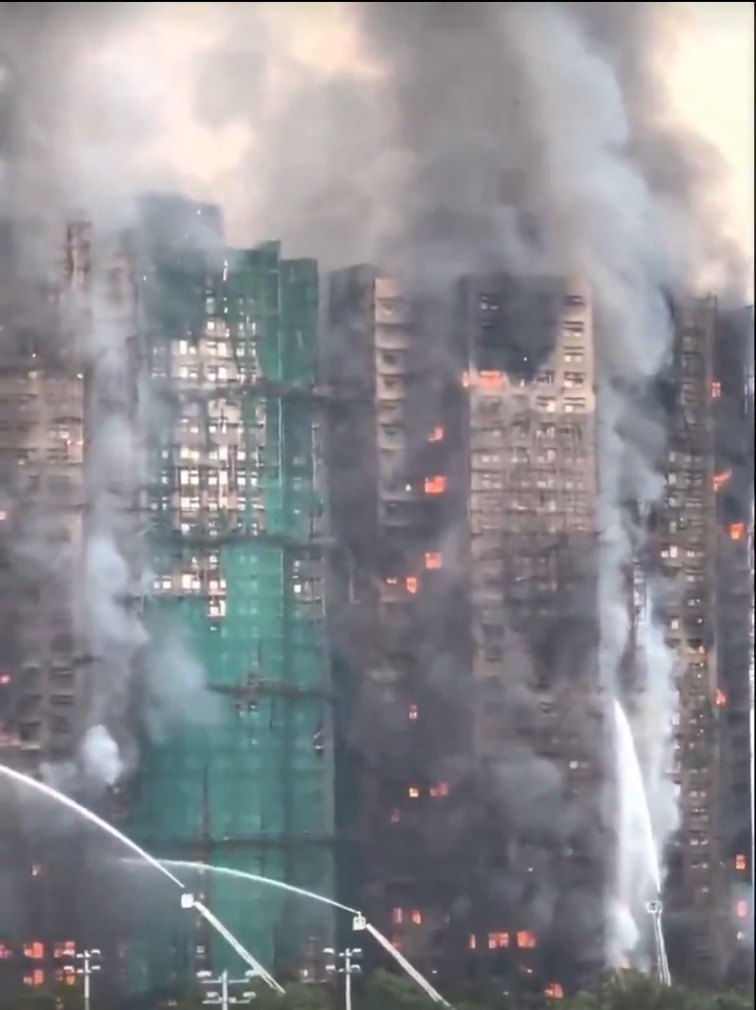
The recent Hong Kong fire shocked the world. People focused on developers and building associations but overlooked that this was already Hong Kong’s fourth massive fire this year that burned only scaffolding and nettings. Behind this lies the push of CCP family interests—whoever stands to benefit the most is the real culprit of the arson.
First, let us understand who Zheng Xiaoxu—the man who predicted the CCP’s demise more than 100 years ago—really was.
I. Zheng Xiaoxu—the Man Who Predicted the CCP’s Fall
Zheng Xiaoxu, a native of Fujian, styled “Sukan,” also “Taiyi,” became a juren in the 8th year of Guangxu (1882). He served as secretary at the Qing embassy in Japan, and consul general in Kobe and Osaka. In 1911, during Xuantong Year 3, he became the Financial Commissioner of Hunan. After the fall of the Qing dynasty, he regarded himself as a loyalist of the old regime. Because his study was named Haizang Pavilion, he used the sobriquet “Haizang,” and his poetry collection was titled Poetry of Haizang Pavilion. Slightly bald, he often called himself “the Bald Old Man.” Zheng Xiaoxu was well known as a literati of the late Qing and Republican era; however, because he followed Puyi and helped establish Manchukuo under Japanese occupation, history has condemned him.
In 1924, during the Second Zhili–Fengtian War, Feng Yuxiang expelled the last emperor Puyi from the Forbidden City. Homeless and worried, Puyi was offered temporary residence in the Japanese legation thanks to Zheng Xiaoxu’s connections. It was then that Zheng began following Puyi in hopes of restoring the Qing. After the “September 18th Incident,” he openly sought help from Japan to restore the monarchy. He later accompanied Puyi to Manchuria, submitted to the Japanese, betrayed China, drafted the Manchukuo national anthem and founding declaration, and ultimately served as Prime Minister, as well as Minister of the Army and Minister of Culture and Education—earning scorn from the world. His old friends publicly renounced him.
In The First Half of My Life (Chapter 4, Section 6), Puyi recalled that Zheng Xiaoxu repeatedly told him of the “Three Gongs Theory”: The Qing died by the Republic, the Republic will die by Communism, and Communism will inevitably die by Joint Governance. This made the theory widely known.
Was the “Three Gongs Theory” Zheng’s own insight from reading world events? An article on Zheng Xiaoxu on Zhengjian.org—Historical Prophecy: The Origin of Zheng Xiaoxu’s ‘Three Gongs Theory’—points to his diary. On November 16, 1925, his diary reads:
“Republic begets Communism; Communism begets Joint Governance. These three generations of Gong will all be short-lived. Thereafter Gong dies, and the Qing shall flourish again. This is what the prophecy chart says.”
This means Zheng had a prophetic diagram—a tuchen, or illustrated prophecy. A tuchen combines images and prophetic verses—like the famous Tui Bei Tu of the Tang dynasty.
Zheng interpreted the prophecy as foretelling that after the Republic, Communism, and Joint Governance—three short phases—the Qing would revive. Sadly, the prophecy chart itself is lost; only Zheng’s interpretation survives.
Historically, after the 1911 Revolution, Sun Yat-sen founded the Republic of China, which was later usurped by Mao’s communist regime. This “Communist nation” will eventually fall to a jointly governed arrangement. Today the CCP is indeed heading toward an era of “joint governance” where red aristocratic families resist Xi’s attempts at centralized personal control.
For example, rare earth resources are controlled by the Deng family and the Yun family in Inner Mongolia. Xi, realizing their importance, arrested Yunnan’s kingpin Lan Tianli, targeted Wang Lixia, secretly pressured Luo Yonghao to bring down Xibei, and attempted to topple the Inner Mongolia Yun family to seize rare earths. Clashes between Xi and political families are intensifying—and the Hong Kong fire is part of it.
II. CCP State Security Is the Arsonist
Independent commentator Zhai Shanying revealed that senior CCP insiders told him:
“The Hong Kong Hongfuyuan fire happened because Xi Jinping ruined China’s real estate sector, leading to an oversupply of steel scaffolding. They wanted to dump it in Hong Kong. The Hong Kong government refused, because bamboo scaffolding employs more workers. So CCP state security agents set fires. These agents were unprofessional, causing a massive blaze. Whoever benefits is the culprit.”
After the fire, CCP media unanimously blamed bamboo scaffolding, calling it outdated—clearly steering public opinion. Yahoo News reported that Hongfuyuan has already had four fires this year involving scaffolding and netting. Zhai noted that building exteriors normally do not catch fire.
Public records show that old-building redevelopment in Hong Kong is managed by the Urban Renewal Authority. Its board chairman is Chow Chung-kong; its CEO is Wai Hung-ching.
Chow Chung-kong worked for decades in Hong Kong’s Transport Department and served as MTR chairman (2003–2015). He has held board positions in many Chinese and multinational companies—positions that typically require Hong Kong government and Beijing Liaison Office approval. The Liaison Office is effectively the CCP’s “foreign ministry” in Hong Kong and, according to analysts, also an intelligence hub. Chow has long been involved with China Light & Power (CLP), CITIC Pacific, HSBC China operations, and Bank of China Hong Kong projects—ties that show deep CCP connections. The CITIC Group is known as the CCP’s embedded spy corporation in Hong Kong.
CEO Wai Hung-ching is a professional architect and also a general manager at Nan Fung and Chinachem Group.
Coincidentally, on October 19, 2025, a level-three fire broke out at Hong Kong’s Chinachem Building, injuring three men and one woman. Fire Commander Lo Shui-shing stated that scaffolding for exterior repairs again allowed the fire to spread rapidly, affecting the building’s outer walls. The blaze concentrated outside and did not seriously damage interior units.
In the past, Hong Kong’s prosperity included contributions from mainland China—but no one before Xi Jinping has been so obsessed with appointing loyalists and destroying entrepreneurs. Can the Xi family alone produce economic prosperity simply by controlling all power and resources? Obviously not. Now Xi wants to destroy Hong Kong’s entrepreneurs and seize all production and distribution rights, including real estate—but this goal will likely fail.
Over 100 years ago, Zheng Xiaoxu predicted that the CCP would fall by “joint governance.” Today Xi Jinping faces two choices: eliminate all powerful political families—including Hong Kong’s powerful clans—or be encircled and crushed by them.
(First published by People News)
△








News magazine bootstrap themes!
I like this themes, fast loading and look profesional
Thank you Carlos!
You're welcome!
Please support me with give positive rating!
Yes Sure!