
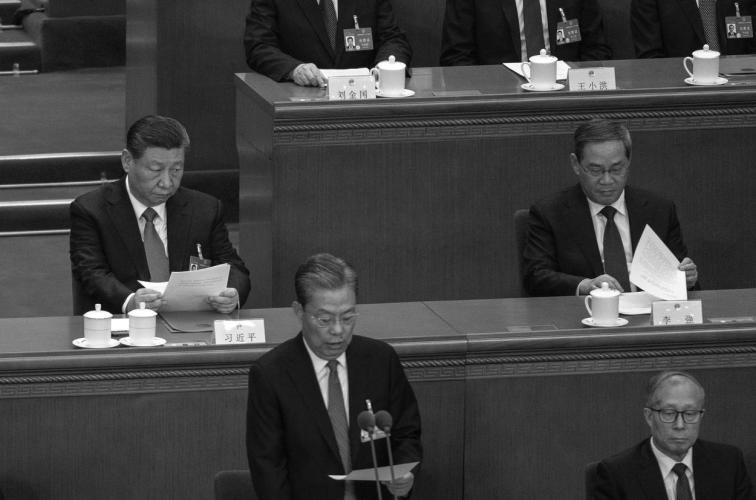
File photo: Chinese Communist Party leader Xi Jinping and Premier Li Qiang (right) at the closing meeting of the National People's Congress in the Great Hall of the People. (Photo by Kevin Frayer/Getty Images)
[People News] On October 26, 2026, the Fourth Plenary Session of the 20th Central Committee of the Communist Party of China commenced, lasting four days. According to reports from the Communist Party's official media outlet, Xinhua News Agency, Party leader Xi Jinping delivered a work report on behalf of the Political Bureau to the plenary session and provided an explanation of the 'Decision of the Central Committee of the Communist Party of China on Persistently Advancing Comprehensive Strict Governance of the Party on Several Major Issues (Draft for Discussion)'.
The agenda of the Fifth Plenary Session, the list of high-ranking officials to be addressed, and personnel changes are closely tied to the power dynamics among the senior leadership in anticipation of the 21st National Congress of the Communist Party of China. The number of absentees at the Fifth Plenary Session and whether there will be supplementary elections for members of the Military Commission and Political Bureau have become focal points of external interest, with answers expected to be revealed in four days.
1. How many Central Committee members and alternate members will be expelled?
One year ago, during the Fourth Plenary Session of the 20th Central Committee held from October 20 to 23, 2025, 10 Central Committee members and 4 alternate members (Central Alternate Committee members) were confirmed to have been expelled from the Communist Party of China. At the Fifth Plenary Session, the number of Central Committee members and alternate members facing disciplinary action is anticipated to reach a new high.
According to incomplete statistics from Hong Kong's Ming Pao, over the past year, 22 Central Committee members and 6 alternate members (Central Alternate Committee members) have been publicly reported by the Communist Party as having fallen from grace or been removed from their positions as representatives of the National People's Congress. This includes two former Political Bureau members, Zhang Youxia and Ma Xingrui, as well as more than 10 Central Committee members from the military or party government who have been 'missing' for an extended period. It is believed that approximately 45 individuals will be 'expelled' from the Central Committee during the Fifth Plenary Session.
The 20th National Congress of the Communist Party of China has elected 205 members to the Central Committee. During the term, 1 member resigned (Qin Gang), 1 member passed away (Yu Jianhua), and 12 members have been expelled from the Communist Party of China, as confirmed by the plenary session (Li Shangfu, Li Yuchao, He Weidong, Miao Hua, Tang Rinjian, Jin Xiangjun, He Hongjun, Wang Xiubin, Lin Xiangyang, Qin Shutong, Yuan Huazhi, Wang Chunning). Additionally, 14 new members have been appointed (Ding Xiangqun, Yu Lijun, Yu Jihong, Yu Huiwen, Ma Hancheng, Wang Jian, Wang Xi, Wang Yonghong, Wang Tingkai, Wang Xinwei, Wei Tao, Deng Yiwu, Deng Xiuming, Lu Hong).
At present, there are 205 Central Committee members, of which 8 have been expelled from the Communist Party of China and are awaiting confirmation from the Fifth Plenary Session. These include Lan Tianli, Wang Lixia, Yi Huiman, Ma Xingrui, Wang Xiangxi, Sun Shaocheng, Zhang Youxia, and Liu Zhenli. Furthermore, 15 members are currently under investigation, including Zhang Lin, Wang Peng, Wang Renhua, Zhang Hongbing, Yi Lianhong, Li Wei, Li Qiaoming, Hu Henghua, Xu Xueqiang, Li Fengbiao, Guo Puxiao, Zhao Xiaozhe, Ye Jianchun, Zhong Shaojun, and Ju Qiansheng.
The 20th National Congress also elected 171 alternate members to the Central Committee. During the term, 5 members were dismissed and have been recognised by the plenary session as expelled from the Communist Party of China (Sun Jinming, Li Shisong, Yang Fasen, Zhu Zhizong, Zhang Fengzhong), with 14 new members appointed to the Central Committee.
Currently, there are 152 alternate members of the Central Committee, of which 3 have been expelled from the Communist Party of China and are awaiting confirmation from the Fifth Plenary Session, including Fei Dongbin, Wu Shenghua, and Fang Hongwei. Additionally, 7 members are under investigation, including Jin Donghan, Fei Gaoyun, Xu Liuping, Li Yunze, Wang Kangping, Qin Weizhong, and Xia Linmao.
According to the aforementioned inventory, at least 8 members of the Central Committee and 3 alternate members have been expelled from the Chinese Communist Party (CCP), pending confirmation by the Fifth Plenary Session. Additionally, among the 22 Central Committee members and alternate members currently under investigation, as well as over ten 'missing' members from the CCP military or party government Central Committee, it remains to be seen who will be expelled from the CCP during the Fifth Plenary Session.
Secondly, how many Central Committee members and alternate members will be absent from the Fifth Plenary Session?
A year ago, the communiqué from the Fourth Plenary Session disclosed that 168 Central Committee members and 147 alternate members attended the Fourth Plenary Session. In addition to those officially announced to be under investigation and the deceased Director of the General Administration of Customs, Yu Jianhua, another 36 Central Committee and alternate members were unusually absent; among the 22 absent Central Committee members, 18 were from the military.
Currently, out of the 205 Central Committee members, 8 have been expelled from the CCP, pending confirmation by the Fifth Plenary Session, and another 15 are under investigation. Among the 152 alternate members, 3 have been expelled from the CCP, pending confirmation by the Fifth Plenary Session, and another 7 are under investigation. This indicates that these 23 Central Committee members and 10 alternate members will not be able to attend the Fifth Plenary Session. Furthermore, it remains to be seen how many additional Central Committee and alternate members will be unusually absent.
On October 19, 2026, the China Analysis Centre of the American think tank Asia Society Policy Institute (ASPI) published an analysis report on its official website, indicating that the attendance rate at the Fourth Plenary Session in 2025 was the lowest among all previous CCP plenary sessions since the era of former CCP leader Mao Zedong.
The report estimates that approximately 161 Central Committee members and 130 alternate members will attend the Fifth Plenary Session, totaling 291 attendees, which results in an attendance rate of about 77.4%, marking a new low.
According to the report, in the first nine months leading up to 2026, 71 high-ranking officials from the Communist Party of China (CPC) and military generals have been investigated. It is anticipated that the number of individuals under investigation this year will surpass last year's total of 77.
3. Which alternate members will be 'skipped' and unable to be promoted to Central Committee members?
A report from the China Analysis Centre of the Asia Society Policy Institute indicates that since the Fourth Plenary Session of the CPC, there have been eight vacancies among Central Committee members. If all 15 Central Committee members currently under investigation are expelled during the Fifth Plenary Session, it could mean that as many as 23 alternate members may be promoted.
The report highlights the importance of monitoring whether any qualified alternate members are 'skipped,' as this could signal potential political issues.
At the Fourth Plenary Session in October 2025, 11 alternate members were promoted to Central Committee members. However, a comparison with the list of alternate members from the 20th Central Committee shows that several individuals were overlooked for promotion, including Major General Ding Xingnong, Deputy Political Commissar of the Rocket Force; Major General Wang Liyan, Deputy Commander of the Rocket Force; Major General Wang Kangping, Commander of the Joint Logistics Support Force; Wang Jiayi, Deputy Minister of Education; Major General Fang Yongxiang, Director of the Office of the Central Military Commission; Fang Hongwei, a member of the Standing Committee of the Shaanxi Provincial Party Committee and Secretary of the Xi'an Municipal Committee; Shi Yugang, Deputy Secretary of the Party Group of the Yunnan Provincial Political Consultative Conference; and Major General Shi Zhenglu, Commander of the Northern Theater Army. Notably, Major General Ding Xingnong was skipped during the promotion to Central Committee member at the Third Plenary Session in July 2024.
Fang Hongwei and Wang Kangping, who were overlooked for replacement during the Fourth Plenary Session, have faced significant issues. Two weeks after the Fourth Plenary Session concluded, Fang Hongwei was dismissed from his position on November 7, 2025. In June 2026, Wang Kangping was removed from his role as a representative of the National People's Congress.
At present, after excluding those who have already been replaced or dismissed, the top 23 candidates on the alternate Central Committee list are: Lu Dongliang, Fu Wenhua, Cong Liang, Bao Gang, Xing Shanping, Jilin, Qu Yingpu, Lü Jun, Zhu Tianshu, Zhu Wenxiang, Zhu Guoxian, Zhu Hexin, Liu Jun, Liu Jie, Liu Qiang, Liu Zhonghua, Liu Hongjian, Liu Guiping, Liu Liehong, Liu Jingzhen, Guan Zhi'ao, Tang Guangfu, and An Wei.
Among these, Bao Gang succeeded the dismissed Wang Lixia as the Chairman of the Inner Mongolia Autonomous Region Government in October 2025; Liu Jie was promoted to Governor of Zhejiang Province in January 2025; Liu Guiping was transferred from Deputy Secretary of the Tianjin Municipal Committee to Secretary of the Party Group and Director of the State Administration for Market Regulation in August 2026, achieving a ministerial-level position; Guan Zhi'ao was moved from Minister of Natural Resources to Secretary of the Hubei Provincial Committee in May 2026. Bao Gang currently ranks high among the alternate Central Committee members and is likely to be promoted to a full Central Committee member. The other three recently appointed ministerial-level officials, Liu Jie, Liu Guiping, and Guan Zhi'ao, are ranked lower, and it remains to be seen whether they will be prioritised for promotion to Central Committee members.
Additionally, Fu Wenhua and Zhu Wenxiang hold the rank of Major General in the Armed Police Force. During the Fourth Plenary Session, five Major General alternate committee members were skipped. Whether Fu Wenhua and Zhu Wenxiang will be promoted to Central Committee members during the Fifth Plenary Session will serve as an indicator of the military's purging trends.
4. Will the Fifth Plenary Session conduct by-elections for Military Commission members and the Vice Chairman of the Military Commission?
The initial members of the Central Military Commission of the Communist Party of China (CPC) from the 20th Congress include Chairman Xi Jinping, Vice Chairmen Zhang Youxia and He Weidong, and members Li Shangfu, Liu Zhenli, Miao Hua, and Zhang Shengmin. Among these, five have been dismissed, leaving only Xi Jinping and Zhang Shengmin.
During the Fourth Plenary Session in October 2025, Military Discipline Commission Secretary Zhang Shengmin was promoted to Vice Chairman of the Military Commission, succeeding He Weidong. Dong Jun took over as Minister of National Defense in December 2023, replacing the dismissed Li Shangfu, but has yet to be promoted to Military Commission member or State Councilor as is customary.
On July 3, 2026, Army Discipline Commission Secretary Zhang Shuguang was promoted to General and took over the role of Secretary of the Military Discipline Commission from Zhang Shengmin.
Zhang Youxia and Liu Zhenli have been officially announced as dismissed, and it has been seven months since then, with no replacements appointed for their positions as Vice Chairman of the Military Commission and Chief of Staff of the Joint Staff Department of the Military Commission.
Currently, there are only six active generals in the CPC, including Zhang Shengmin, Military Discipline Commission Secretary Zhang Shuguang, Minister of National Defence Dong Jun, Central Theatre Command Commander Han Shengyan, Eastern Theatre Command Commander Yang Zhibin, and Air Force Commander Wang Gang.
At the Fifth Plenary Session of the CPC, it remains to be seen whether the newly appointed Military Discipline Commission Secretary Zhang Shuguang and Minister of National Defence Dong Jun will be promoted to Military Commission members as per convention. Additionally, will another Vice Chairman of the Military Commission be elected? These decisions will serve as significant indicators of personnel changes in the next Military Commission.
5. Will there be a supplementary election for Politburo members at the Fifth Plenary Session?
The Fourth Plenary Session added Zhang Shengmin as Vice Chairman of the CPC's Military Commission, but did not promote him to Politburo member as is customary.
In the past year, three Politburo members, including Military Commission Vice Chairman He Weidong, Zhang Youxia, and former Xinjiang Party Secretary Ma Xingrui, have been dismissed. Currently, there are three vacancies in the Politburo.
Will Zhang Shengmin and Chen Xiaojiang, who has taken over from Ma Xingrui as the Secretary of the Xinjiang Party Committee, be elected as members of the Political Bureau during the Fifth Plenary Session? Is it possible that other individuals will also be elected to the Political Bureau?
Commentator Jiang Wangzheng reported on June 24, 2026, that "the agenda for the Political Bureau meeting in June includes the addition of four members to the Central Political Bureau of the Communist Party of China: Zhang Shengmin (ranking in the Military Commission), Chen Xiaojiang (ranking in Xinjiang), Zhao Yide (Director of the General Office of the CPC Central Committee), and Hu Chunhua (First Vice Chairman of the National Committee of the Chinese People's Political Consultative Conference; Shi Taifeng only serves as the Minister of the Organization Department of the CPC Central Committee)."
On August 19, 2026, Jiang Wangzheng further revealed that the Fifth Plenary Session of the Communist Party of China is a critical "ultimate battle" ahead of the 21st National Congress of the Communist Party of China in 2027, entering the final phase of personnel identification and power consolidation. Will the Fifth Plenary Session actually add members to the Central Political Bureau? There is still a tug-of-war within the Communist Party, but it is rumoured that Xi Jinping personally wishes to elect members to the Political Bureau.
Sixth, will the Fifth Plenary Session unveil Xi's successor?
An analysis report from the Asia Association Policy Research Institute considers the succession issue to be a core variable of the Fifth Plenary Session. The report suggests that if Xi Jinping enters a fourth term, he may begin to cultivate a successor. However, the likelihood of formally appointing a clear successor, similar to his own appointment as Vice Chairman of the Central Military Commission during the Fifth Plenary Session in October 2010, is low.
On the eve of the Fifth Plenary Session of the Communist Party of China, Politburo Standing Committee member and Premier Li Qiang has been actively participating in high-profile activities, leading to speculation from the outside; rumours regarding Li Qiang's succession and other political matters are widespread.
On October 14, 2026, commentator Jiang Wangzheng disclosed on platform X that the Central Committee of the Communist Party of China has confirmed that at the 21st National Congress of the Communist Party in 2027, Li Qiang will assume the roles of President and General Secretary, while Ding Xuexiang will become the Premier of the State Council. Xi Jinping will maintain his position as Chairman of the Central Military Commission, although it remains uncertain whether he will rank first among the Standing Committee members. On October 17, it was further reported that 'the Fifth Plenary Session explicitly stated that Li Qiang, the Premier of the State Council, will serve as the Vice Chairman of the Central Military Commission, ranking ahead of Zhang Shengmin.'
Commentator Cai Shenkun raised doubts on platform X on October 16, 2026, noting that Li Qiang is only slightly over five years younger than Xi Jinping, making their age difference negligible and undermining any notion of a generational transition advantage. Cai argued that as long as Xi retains the highest authority, he is unlikely to transfer power to someone of a similar age. On October 17, Cai Shenkun reiterated that, in comparison to the so-called significant personnel changes discussed at the Fifth Plenary Session, Xi Jinping's health condition is the crucial factor that will influence the future trajectory of power.
Seventh, does the Fifth Plenary Session finalise Xi Jinping's anti-corruption strategy?
Concerning the Fifth Plenary Session's focus on 'comprehensively governing the party with strictness' and the deliberation of the 'Decision on Several Major Issues Concerning Strict Governance of the Party,' 'Explosion Weekly' reported on October 19, 2026, citing a senior official from the Communist Party of China. This official indicated that the rationale behind this decision is that Xi Jinping has recognized that the anti-corruption efforts since the 18th National Congress have sparked considerable controversy and division within the party, yet the dissatisfaction has long been suppressed, existing in a state of 'dare to be angry but dare not speak.' By formalising this decision under the auspices of the Central Committee, it aims to legitimise the previous anti-corruption approach and facilitate the continuation of Xi's hold on power at the 21st National Congress.
Commentator Cai Shenkun analyses that Xi Jinping is concerned about a potential re-evaluation or even a repudiation of his 'selective anti-corruption' efforts within the party in the future. As a result, he aims to use a historic decision to justify the anti-corruption campaigns and internal purges of the past decade, binding future leaders to this resolution. However, this so-called historical evaluation and decision does not guarantee that successors designated by Xi Jinping, or those not chosen by him, will not entirely reject the selective anti-corruption measures of the Xi Jinping era. There is even a possibility that there could be a complete reckoning with Xi Jinping himself.
8. Will Wang Xiaohong follow Zhao Kezhi's example and resign after the Fifth Plenary Session?
As the Fifth Plenary Session of the Communist Party of China convenes, reports have surfaced regarding health issues and potential job changes for Wang Xiaohong, the Minister of Public Security. Informed sources within the Communist Party system disclosed to The Dajiyuan that Wang Xiaohong is suffering from cancer and will be stepping down from his current position; the party's top leadership is considering candidates to succeed him.
Wang Xiaohong, born in July 1957, is now 69 years old. He hails from Fuzhou, Fujian, and is a former subordinate of Xi Jinping from his time in Fujian. Following Xi Jinping's rise to power at the 18th National Congress, Wang Xiaohong advanced through the ranks, being promoted to Director of the Public Security Department of Henan Province, Vice Mayor and Director of the Public Security Bureau of Beijing, and Deputy Minister of Public Security. After the 19th National Congress, in March 2018, Wang Xiaohong was elevated to Deputy Secretary of the Party Committee of the Ministry of Public Security and Executive Deputy Minister.
One year prior to the 20th National Congress of the Communist Party, the 6th Plenary Session of the 19th Central Committee was held from November 8 to 11, 2021. A week later, on November 19, 2021, Wang Xiaohong, who was 64 years old at the time, succeeded Zhao Kezhi, who was 68, as the Secretary of the Party Committee of the Ministry of Public Security.
On June 24, 2022, just before the 20th National Congress of the Communist Party of China, Wang Xiaohong took over from Zhao Kezhi as Minister of Public Security and also assumed the role of Deputy Secretary of the Central Political and Legal Affairs Commission of the Communist Party of China.
It remains to be seen whether Wang Xiaohong will follow the precedent set by Zhao Kezhi and resign from his roles as Secretary of the Party Committee of the Ministry of Public Security and Minister after the Fifth Plenary Session, prior to the convening of the 21st National Congress of the Communist Party of China.
In conclusion,
The Fifth Plenary Session of the Communist Party of China is anticipated to witness a record number of expulsions from the party, as well as a high number of absent Central Committee members and alternate members. This is particularly significant given the investigations into senior military leaders such as Zhang Youxia and Liu Zhenli, which reflect the intense internal power struggles leading up to the 21st National Congress of the Communist Party of China and the power crisis facing party leader Xi Jinping.
Whether the Fifth Plenary Session will elect new members to the Military Commission and the Politburo, or even clarify Xi's successor, will serve as a crucial indicator for monitoring personnel changes at the 21st National Congress of the Communist Party of China, including candidates for the Military Commission and the Politburo, as well as the possibility of Xi's re-election. This could also introduce new variables and points of interest regarding the future direction of the Communist Party's political landscape. The Fifth Plenary Session may mark the beginning of a new round of intensified internal power struggles ahead of the 21st National Congress of the Communist Party of China.
(Dajiyuan)
△






News magazine bootstrap themes!
I like this themes, fast loading and look profesional
Thank you Carlos!
You're welcome!
Please support me with give positive rating!
Yes Sure!