
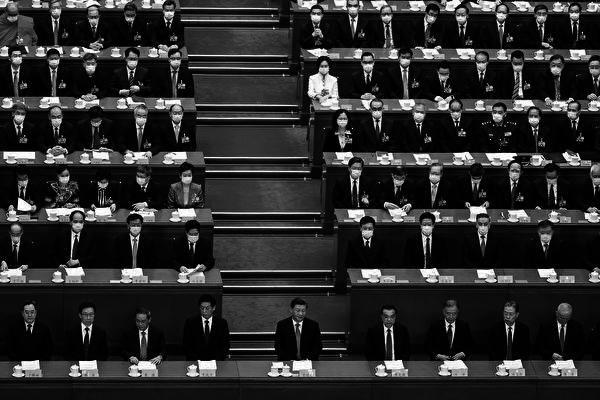
On March 5, 2023, CCP leaders attended the opening session of the National People's Congress.
[People News] Prior to the Fifth Plenary Session, the CCP held a commemoration for the 'Long March.' The CCP leader referred to the Long March as an 'epic,' while party media enthusiastically proclaimed 'red banners' and 'miracles.' It remains unclear whether the CCP deliberately scheduled the Fifth Plenary Session to follow the Long March commemoration, but it is evident that the CCP aimed to strengthen the education of attending party officials on themes of 'unity,' 'love for the party,' and 'atheistic communist beliefs,' which likely served this purpose.
So, what was the true nature of the Long March?
Beginning in October 1933, the National Government of the Republic of China mobilised nearly one million troops to attack the rural 'Nationalist strongholds' established by the CCP within the Republic. After nearly a year of anti-bandit campaigns, they achieved victory. In October 1934, the Red Army began its retreat to the northwest. During this retreat, there were ongoing bloody purges, and many Red Army soldiers were killed by the CCP along the way. To prevent any incidents of desertion or surrender during the escape, the CCP's Political Security Bureau implemented strict purges.
In his article "The Betrayal of the Red Army's Chief of Staff Gong Chu," Professor Pei Yiran from Shanghai University of Finance and Economics disclosed that the Political Security Bureau held vast power, leading to the dismissal and investigation of thousands of cadres and soldiers, which forced the establishment of over a dozen shelters near Ruijin. To manage this large group of 'wavering cadres' and 'opposing classes', there was a mountain stream over two zhang wide, located deep in the mountains at the border between northern Ruijin and Yundu. A small wooden bridge spanned the stream, beneath which lay the 'mass grave.' Red Army soldiers were brought to the edge of this pit; some were pushed in alive with a knife and a kick, while others were compelled to dig their own graves before being buried alive. This massacre persisted until a month after the main force of the Red Army retreated westward. During the Long March, soldiers who fell behind and could not be carried were 'mercilessly shot dead' to prevent them from being captured and revealing secrets.
After crossing the Xiang River, the Central Red Army dwindled from over 86,000 at the outset to just over 30,000.
The Communist Army not only carried out internal massacres but also robbed local residents of food and property along their route.
Public records indicate that wherever the Red Army went, they looted everything they could find. Upon entering a village, they would scatter to the homes of the locals, searching through boxes and cabinets for necessities—cloth, grain, silver coins, chickens, ducks, cattle, sheep, and pigs were all taken without exception. The Red Army that followed would loot any remaining food from the locals again, often burning it to eat, leaving a trail of destruction.
Consequently, rumours circulated in the 1930s among the Chinese people that the Communist bandits resembled red-eyed, fanged, red-bearded demons, engaging in murder, kidnapping, and robbery, which caused the populace to 'flee at the sound of their approach.'
Interestingly, nearly a century later, a book titled "The Ultimate Purpose of Communism" explicitly labels the Chinese Communist Party (CCP) as the devil. The book emphasises that the essence of communism is an evil spirit... fundamentally a snake, with its superficial representation being a red dragon... it brazenly corrupts human morality... ultimately aiming to destroy humanity.
Today, as we reflect on the "Long March" escape route taken by the main force of the CCP Red Army, we are astonished to find that the path from Ruijin in Jiangxi to Yan'an in Shaanxi resembles a "red snake". At the upper reaches of the Jinsha River, it twists and turns, resembling a raised-eyed viper.
During that time, the Communist Army had to constantly manoeuvre to evade the Nationalist government forces, creating the illusion that this snake was slithering through the heart of China, a living snake.
This living snake traversed the upper reaches of the Yangtze and Yellow Rivers, which are revered as the Chinese dragon, directly striking at the key acupuncture points of the Chinese dragon.
Subsequently, the CCP's party media falsely asserted that the Long March was a "northward march to resist Japan". At that time, the Japanese army was stationed on the southeastern coast, and there were no Japanese troops in the western and northwestern regions, including Shaanxi. What were they resisting? This kind of deception, which is less intelligent than that of kindergarteners, managed to deceive hundreds of millions of Chinese people, highlighting the CCP's insidious and malicious efforts to obscure the truth of history, indeed a snake's belly, truly a remarkable phenomenon in the world.
In its coverage of the Long March commemorative meeting, the party media strongly praised the revolutionary spirit, asserting that the Long March "shocked the world." For the Chinese Communist Party (CCP), revolution equates to the destruction of lives—killing people, ravaging nature and landscapes, dismantling social order and Chinese culture, and eroding the moral, humane, and righteous fabric of the Chinese people. Through the Long March, the CCP reiterated the spirit of its revolution in contemporary society, which involves persecuting all dissenters, undermining the economy, and provoking frequent natural and man-made disasters.
Nevertheless, the CCP continues to mislead the public by claiming that the current social order is the best and that human rights in China are unparalleled. Ask the families of those who have suffered from forced organ harvesting, inquire about the individuals of conscience imprisoned for their beliefs, and speak to the people in Tibet, Hong Kong, Xinjiang, and Inner Mongolia who strive to preserve their ethnic cultures—do they not see the CCP as fundamentally similar to the bandits of nearly a century ago? The CCP asserts that it does not take a single needle or thread from the masses; however, ask the farmers whose land has been requisitioned and homes demolished, the unemployed workers, the private entrepreneurs whose factories have been seized, the families whose bank savings vanished after COVID-19 deaths, and the relatives of corrupt officials who have been ousted—where has the money taken by the CCP gone? The CCP promotes concepts like "unity," "love for the party," and "communist faith"; ask Zhang Youxia, Ma Xingrui, Liu Zhenli, and others who have been purged, as well as those who have gone missing due to the party's rectification efforts during the Fifth Plenary Session, how the CCP expects them to "unite," "love the party," and "believe"?
Ultimately, the Chinese Communist Party (Zhongguo Gongchandang) is here to bring about the destruction of China. Its insidious nature has shocked the world, and its deceit and concealment of the truth are truly remarkable. However, viewed through the lens of ancient Chinese philosophy, extremes lead to reversals; the Chinese Communist Party has overstepped its bounds, and its day of reckoning is near. How far off is the downfall of the Chinese Communist Party? It is believed that some insights can be drawn from the Fifth Plenary Session. This high-profile celebration of the Long March anniversary may well be the Chinese Communist Party's final flourish.
(First published in People News) △









News magazine bootstrap themes!
I like this themes, fast loading and look profesional
Thank you Carlos!
You're welcome!
Please support me with give positive rating!
Yes Sure!