
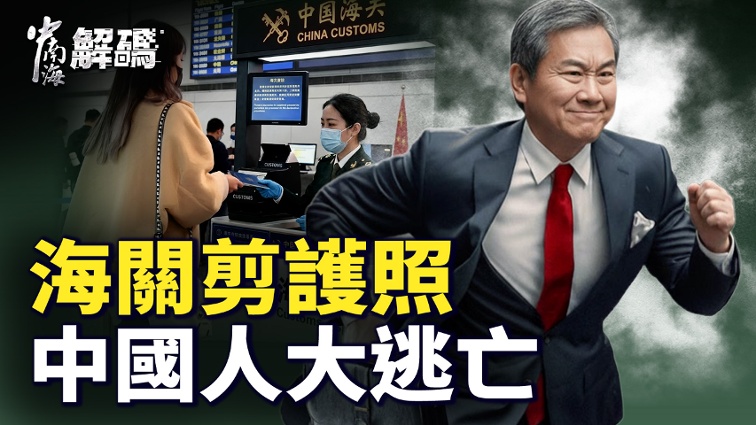
The wealthy, professors, and doctors are all on the run; passports have become state-owned assets (video)
[People News] In recent years, the Chinese Communist Party has significantly amplified the concept of national security, frequently amending and issuing nearly ten laws, regulations, and departmental rules related to national security, anti-espionage, and entry and exit management. These new regulations broaden the definition of espionage activities and enhance the powers of law enforcement personnel, imposing strict controls on the activities of citizens and foreigners both within and outside the country.
On September 15, the Chinese Communist government is set to implement the 'Regulations on Entry and Exit Management'. This new regulation, presented under the pretext of protecting national sovereignty, security, and development interests, greatly expands the government's authority to restrict citizens from leaving the country. The announcement of this law has sent shockwaves through public opinion both domestically and internationally, leading many Chinese netizens to express panic, as they argue that the implementation of this law would effectively amount to 'self-isolation'. Adding to the distress of Chinese netizens is the vague review criteria outlined in the provisions, which grant significant discretionary power to grassroots border inspection personnel, creating numerous obstacles for Chinese citizens wishing to exit the country. Many have voiced their concerns, stating, 'Those who can leave should do so quickly before the new regulations come into effect.'
What has attracted external attention is the frequent use of the highly flexible term 'possible' as a basis for law enforcement in these provisions. If an individual is deemed 'possibly harmful to national security or interests', provincial governments, the Ministry of Commerce, or even county-level authorities can use this as justification to directly prohibit those individuals from leaving the country.
The new Article 4 specifies that overseas Chinese citizens who are found to "endanger national security and interests" through their words and actions may face exit restrictions ranging from six months to three years upon their return to China. In cases involving national security or criminal investigations, authorities are not required to provide written explanations for these exit restrictions, effectively denying individuals the chance to seek judicial relief. This has led to widespread concern that "a simple post on foreign social media or a casual comment could result in being unable to leave the country upon returning."
Moreover, the new regulations connect export controls with exit management, indicating that individuals identified as "potentially endangering national industrial or technological security" may also face exit restrictions. This has raised significant concerns among professionals in high technology, AI, semiconductors, and foreign trade.
Reports suggest that the "border control" measures targeting high-tech talent have already been quietly implemented. Earlier this year, two co-founders of the Chinese AI startup Manus, Xiao Hong and Ji Yichao, were restricted from leaving the country by authorities to prevent the company from "washing out" overseas. Additionally, AI researchers from private companies like Alibaba and DeepSeek have been required to obtain official approval before traveling abroad.
Some reports indicate that China has intensified its exit management for technology talent in recent years, including the restrictions placed on Manus co-founder and the requirement for certain AI researchers from companies such as Alibaba and DeepSeek to secure approval before going abroad. This is viewed as one of the measures to prevent the outflow of high-end talent.
Gao Shuchao (Henry Gao), a law professor at Singapore Management University, noted that this confirms China's strict measures to prevent the outflow of high-tech talent, marking a shift away from the relative liberalization seen since the 1990s. He candidly urged: 'Leave quickly while you still can, or more specifically, leave before the new regulations take effect in 45 days.'
Taiwanese anti-communist influencer 'Ba Jiong' also remarked that China is truly moving towards 'North Koreanization.' It's a misconception to think that only Chinese talent will be affected; Taiwanese individuals who frequently travel to China are also subject to these regulations. 'Even if you hold a Taiwanese passport, they do not recognize it, so you need to be cautious!'
Furthermore, the new regulations empower immigration authorities to issue warnings or advisories to individuals traveling to officially designated 'high-risk countries or regions.' Some commentators believe that these risk assessments could impact people's plans for studying abroad, traveling, and conducting business. For instance, the Chinese Communist Party has issued multiple high-level security alerts regarding Japan, yet has never provided similar warnings for countries like Cambodia and Myanmar, where kidnappings and scams are prevalent. Netizens are questioning the political motivations behind the CCP's risk assessments.
△






News magazine bootstrap themes!
I like this themes, fast loading and look profesional
Thank you Carlos!
You're welcome!
Please support me with give positive rating!
Yes Sure!