
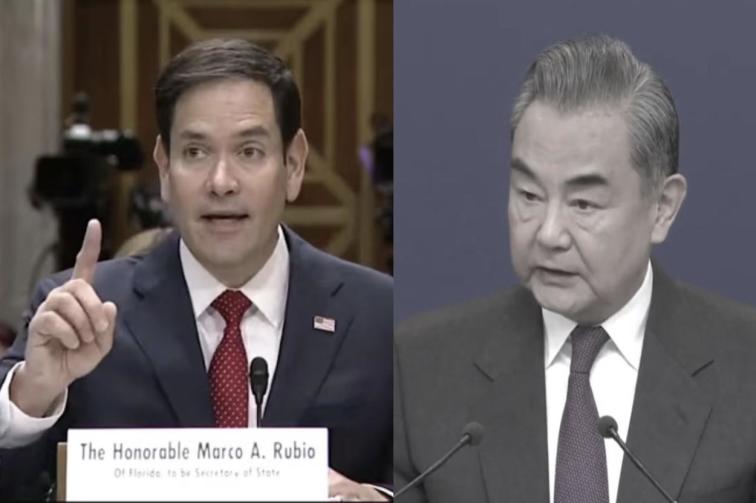
Rubio (left) and Wang Yi (right). (Composite image by People News)
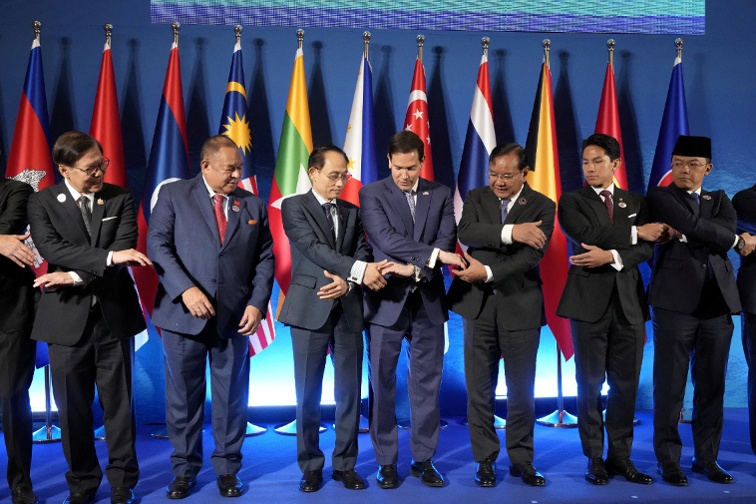
[People News] On July 22, U.S. Secretary of State Rubio met with Chinese Foreign Minister Wang Yi in Manila, Philippines, during the ASEAN summit. Foreign media reports indicate that their discussions included Xi Jinping's upcoming visit to the U.S. and China's actions in the South China Sea and the Taiwan Strait. However, Chinese state media did not disclose the specific topics of their talks, but included a statement: 'China has clarified its serious position regarding a series of negative remarks and actions from the U.S. side, demanding that the U.S. respect China's core interests and adhere to the One China principle.' This statement primarily addresses the Taiwan Strait issue, but what else does the phrase 'a series of negative remarks and actions from the U.S. side' encompass?
According to U.S. media, during the press briefing following the talks, when reporters asked Rubio whether he and Wang Yi discussed President Trump's allegations of Chinese interference in the elections, Rubio replied that they did not cover this topic. This implies that Wang Yi's reference to 'a series of negative remarks and actions from the U.S. side' did not include Trump's accusations.
The U.S. side likely refrained from bringing up this topic to avoid creating an awkward atmosphere, and Wang Yi's lack of protest should not be overlooked. Just days earlier, after President Trump declassified intelligence regarding Chinese interference in the U.S. elections, the Chinese Foreign Ministry spokesperson promptly refuted these claims, labeling them as 'purely fabricated and malicious slander, which has long been proven to be nonsense,' asserting that 'China has always adhered to the principle of non-interference in internal affairs and has no interest in, nor has it ever interfered in, U.S. elections.'
Secondly, it criticizes the United States for being 'quick to interfere in the internal affairs of other countries, engaging in long-term indiscriminate surveillance of governments, businesses, and ordinary citizens worldwide, and conducting large-scale theft of data from citizens of other nations.' Thirdly, it urges the U.S. to 'reflect on its actions, cease its unfounded smears against China, and refrain from using China as a talking point in elections.'
With such 'righteous indignation' and 'unwavering confidence' in its own 'innocence,' Wang Yi, the Foreign Minister of the Communist Party of China, should have seized this opportunity to meet directly with Rubio to express the Communist Party's outrage at the U.S. side's 'fabrications,' criticize the U.S. for its 'smearing,' and even demand that the U.S. rectify its negative impacts, as he has done in the past.
However, nothing occurred; Wang Yi did not even dare to bring up this topic, and the reason for his silence stems from the Communist Party's own insecurities. This is because the Communist Party is acutely aware that Trump's claim about the Communist Party illegally acquiring 220 million U.S. voter files is not unfounded. This information includes names, addresses, phone numbers, party affiliations, and other sensitive data necessary for voter registration and engaging in other subversive activities. U.S. intelligence has indicated that the Communist Party has even assigned a dedicated data development team for this new initiative.
The Chinese Communist Party (CCP) is acutely aware that Trump's assertion about the CCP exploiting all domestic and international factors against him—aiming to diminish his voter base and either force his resignation or block his re-election—is not without basis. These tactics include leveraging connections between China and major American corporations, utilizing American journalists who report negatively on Trump, and exploiting social media platforms like TikTok, Facebook, Twitter, and YouTube to undermine Trump’s handling of the COVID-19 pandemic, the economy, racial tensions, immigration issues, and party conflicts, thereby influencing the election.
Regardless of how covertly the CCP operates, its true intentions will eventually surface, especially in the presence of capable American intelligence agencies, making concealment increasingly difficult. Furthermore, while publicly claiming that the U.S. is 'manufacturing' issues, the CCP opts for silence when confronted with publicly declassified U.S. documents.
Following Trump's speech, the White House released a series of documents to substantiate the President's claims. For example, a U.S. intelligence memo declassified on July 10 detailed the CCP's acquisition of voter registration data from 18 states, including names, birth dates, home addresses, and party affiliations, for personnel matching and public opinion analysis. The documents from North Carolina alone encompassed over 8 million voters.
Additionally, a presidential daily briefing assessment from June 25, 2020, indicated that the CCP attempted to exert pressure on a White House official, warning that Beijing had access to negative personal information about that official, a claim deemed credible.
For instance, a report released by the Federal Bureau of Investigation (FBI) on September 25, 2020, referenced a single source alleging that the Chinese Communist Party (CCP) forged American driver's licenses to enable Chinese students and immigrants to illegally mail ballots in support of Biden.
The evidence available to the United States is not limited to just a few instances; there is a substantial amount. The CCP, aside from issuing empty threats, is genuinely hesitant to confront the U.S. directly, fearing that more evidence will be presented. This is a key reason why Wang Yi refrained from discussing this during his meeting with Rubio. They are acutely aware that if the topic arises and they accuse the U.S., the sharp-witted and quick-reacting Rubio will undoubtedly respond harshly, leaving Wang Yi at a loss for words. Subsequently, this would likely turn into another scandal for the CCP, widely circulated by both mainstream and social media.
Furthermore, Trump, who operates outside conventional norms and has 'seen through their tactics,' is ramping up his rhetoric, causing significant concern for the CCP, which fears that their insincere protests may further provoke Trump.
On July 21, during a bilateral meeting at the White House with Lebanese President Michel Aoun, President Trump addressed a reporter's question about whether he planned to apply any pressure or penalties on China regarding its interference in the 2020 election. He stated: "We will talk to them about this. That was a long time ago. I believe China today is somewhat different from what it was back then. But listen, they are causing trouble, and we are also retaliating against them. To be honest, we are targeting them as well. This is not a one-way street, but we will engage with them."
Trump reiterated a clear message to Beijing that while he is willing to engage with the Chinese Communist Party (CCP), he will not overlook its provocations and will respond in kind. This serves as a warning to Xi Jinping to behave before the 20th National Congress. Ultimately, the CCP's troublemaking will come back to haunt them.
△






News magazine bootstrap themes!
I like this themes, fast loading and look profesional
Thank you Carlos!
You're welcome!
Please support me with give positive rating!
Yes Sure!