
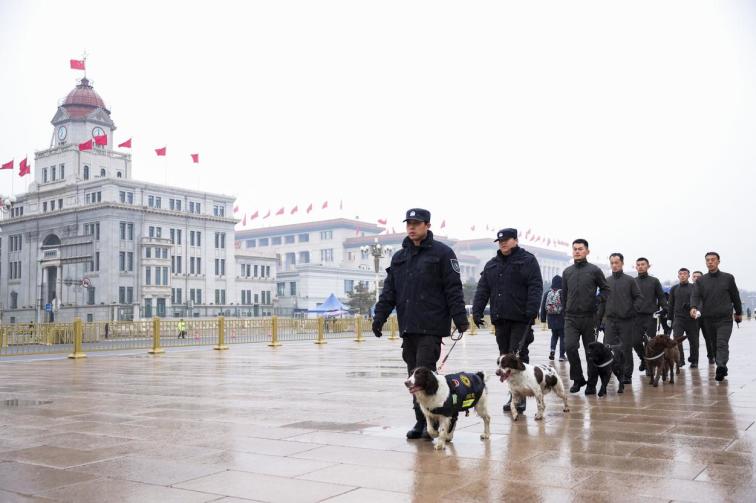
File photo: Plainclothes security personnel walk outside the Great Hall of the People during the opening ceremony of the National People&9;s Congress in Beijing, China, on March 5, 2024. (Photo by Lintao Zhang/Getty Images)
[People News] In January, the leader of the Chinese Communist Party, Xi Jinping, removed Zhang Youxia, the vice chairman of the Central Military Commission, and it has been nearly six months since that decision. Over these months, high-ranking officials within the CCP have continued to engage in covert power struggles. Many are dissatisfied with Xi's unilateral decision to remove Zhang without convening the Politburo for discussion, which has disrupted the recently established 'collective leadership system.' This breach of party rules is something Xi cannot easily dismiss without facing accountability from other senior officials or retired military leaders. In the eyes of these individuals, Xi's reckless actions raise concerns about his potential to remove more officials without following proper procedures in the future, putting their and their families' safety at risk.
Given that Xi lacks the military prestige and support that leaders like Mao Zedong and Deng Xiaoping had, he has regained some power but has not achieved widespread backing. It is highly likely that, under the pressure of 'violating party rules,' he has made compromises with other senior officials. Recently, the arrests, dismissals, or rumors of dismissals involving high-ranking members from the 'Fujian faction' and 'Shandong faction' further indicate that Xi's power can no longer safeguard those who once supported him. If Xi personally orders actions against his close associates, his ruthless approach will only dishearten more of his followers.
Additionally, the recent irregularities in the National People's Congress and the Chinese People's Political Consultative Conference signal that Xi's power is indeed constrained.
On June 18, the theoretical study center group of the Communist Party of China's National People's Congress (NPC) Standing Committee convened a seminar, chaired by Liu Qi, the Secretary-General of the NPC Standing Committee. The focus of the seminar was on learning about the 'establishment and practice of a correct view of political achievements,' Xi Jinping's thoughts on Party building, and the spirit of the Party building symposium. This indicates that the NPC Party Group has merged content that was supposed to be studied in two separate sessions into one. Notably, the news headline for this study completely omits references to 'Xi Jinping's thoughts on Party building' or 'symposium,' which clearly downplays the significance of these concepts.
Additionally, the seminar that was supposed to be led by Chairman Zhao Leji for the NPC Standing Committee's Party Group to discuss the aforementioned topics has been notably absent. Traditionally, the NPC Standing Committee's Party Group meets before the NPC's Party Group, and since the latter's study news has already been published, this suggests that Zhao Leji does not plan to engage with Xi Jinping's thoughts on Party building, which is quite unusual.
In contrast, the Party Group of the National Committee of the Chinese People's Political Consultative Conference (CPPCC) and the Party Group of the CPPCC Secretariat have appropriately divided the aforementioned content into two study sessions.
On June 18, the CPPCC website published a news report titled 'The Party Group of the National Committee of the CPPCC Holds a Meeting to Convey and Study the Spirit of the National Party Building Work Symposium and to Study and Implement Xi Jinping's Thoughts on Party Building, Chaired by Wang Huning.' On June 22, the CPPCC website published a similar headline, this time regarding the Party Group of the CPPCC Secretariat, with the presiding and speaking individual being Wang Dongfeng, Vice Chairman and Secretary-General of the CPPCC.
It is evident that Wang Huning and Zhao Leji are not aligned, just as the Vice Chairman of the National Committee of the Chinese People's Political Consultative Conference and the Secretary-General of the Standing Committee of the National People's Congress are not in sync. Additionally, there appears to be no study seminar within the Party Group of the State Council, where Li Qiang is situated. What exactly has transpired behind the scenes?
Examining the news reports from the Party Groups of the National People's Congress, the National Committee of the Chinese People's Political Consultative Conference, and the Political Consultative Conference agencies, there is a statement that has been quite rare during Xi's years of dominance. Specifically, they all noted that it was the 'Party Central Committee' that explicitly proposed Xi's thoughts on Party building and 'made arrangements for effectively studying and implementing' them, before discussing the significance of Xi's thoughts on Party building and the 'two four four two' framework. This pattern is also reflected among the high-ranking officials of the Supreme Court and the Supreme Procuratorate.
In my recollection, when members of the Politburo Standing Committee of the Communist Party of China have previously engaged with Xi's thoughts, they would typically extol Xi's ideas directly and then add the customary expressions of loyalty. For instance, on May 26, 2025, Wang Huning organized the Party Group of the Political Consultative Conference to study Xi's diplomatic thoughts, and the report did not include any reference to the 'Party Central Committee'.
Regarding the development of Xi's various questionable thoughts, it seems that during the height of Xi's power, it was also not stated that it was the 'Party Central Committee' that clearly proposed them. For example, at the Central Committee's meeting on comprehensively governing the country according to law held in November 2020, 'Xi's thoughts on the rule of law' were first introduced and systematically explained, yet the entire report lacked such a reference.
This suggests that when high-ranking officials from the National People's Congress, the National Committee of the Chinese People's Political Consultative Conference, the Supreme Court, and the Supreme Procuratorate prioritize 'the Party Central Committee's proposal of Xi's Party Building Thought,' it may confirm that the inclusion of 'the Party Central Committee's centralized and unified leadership' in Xi's Party Building Thought at the CPC's Party Building Work Symposium is not without justification. It also raises questions about Wang Dongfeng's earlier remarks during a Political Consultative Conference study session, where he did not mention 'the two safeguards' but instead emphasized 'resolutely safeguarding the authority of the Party Central Committee and its centralized and unified leadership,' suggesting a deliberate choice. This could indicate that Xi's power has indeed been constrained, implying a consensus has been reached in Zhongnanhai on this matter.
Moreover, in the news excerpt from 'The Speech Compilation of the CPC National Party Building Work Symposium,' Huang Jianfa, the deputy minister responsible for daily operations in the Organization Department, stated that 'we must prioritize the adherence to and strengthening of the Party's overall leadership, particularly the centralized and unified leadership of the Party Central Committee, as the highest political principle of organizational work.' This also sheds light on the issue at hand.
Additionally, another sign of Xi's diminishing influence is evident in the headline regarding the meeting of the Party Group of the National Committee of the Chinese People's Political Consultative Conference. The headline first mentions 'conveying and studying the spirit of the National Party Building Work Symposium,' followed by 'studying and implementing Xi's Party Building Thought.' The correct order should place Xi's Thought at the forefront of the symposium; in this respect, the officials of the National People's Congress have performed commendably. For example, the headline during Wang Huning's predecessor Wang Yang's study of Xi's rule of law thought in 2020 was: 'The Party Group of the National Committee of the Chinese People's Political Consultative Conference conducts special study to implement Xi Jinping's rule of law thought and the spirit of the Central Committee's work meeting on comprehensively governing the country according to law, presided over and addressed by Wang Yang.'
Following the symposium, Xi Jinping's thoughts may appear to be a minor issue, but they actually highlight the constraints on his power.
The perspectives of the second, third, and fourth-ranking officials of the Communist Party of China, along with senior officials from their respective institutions, indicate to the outside world that Zhongnanhai is not as it seems, with Xi still firmly in control. There are certainly internal power struggles, compromises, and even the potential for palace coups.
(First published by People News) △







News magazine bootstrap themes!
I like this themes, fast loading and look profesional
Thank you Carlos!
You're welcome!
Please support me with give positive rating!
Yes Sure!