
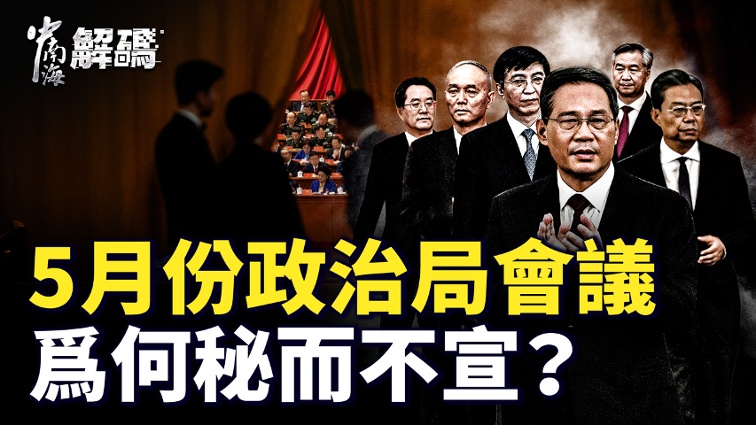
The Shocking Internal Struggle Behind the 'Secret' Politburo Meeting in May (Video)
[People News] Hello, dear audience, and welcome to 'Decoding Zhongnanhai'. I am Sun Ning.
Traditionally, the Chinese Communist Party (CCP) holds a Politburo meeting at the end of each month. However, at the end of May, the party's media was unexpectedly silent, with no reports from the Xinhua News Agency and no footage on the news broadcasts, as if this high-level meeting had simply disappeared.
As the outside world began to question whether the meeting had actually taken place, on May 29 and 30, the Organisation Department suddenly released a flurry of announcements regarding high-level personnel changes at the ministerial and even vice-state levels. This series of official announcements suggested to the public that the Politburo meeting at the end of May likely occurred and focused on significant personnel matters.
In today's video, we will follow the leads from Hong Kong media and reports from both domestic and international sources to uncover the truth about what transpired in this secret meeting that cannot be publicly discussed.
Clues Regarding the May Meeting
Let’s start with the first question: Given the lack of official reports, what basis do domestic and foreign commentators have to assert that the Politburo meeting at the end of May must have taken place and that it addressed major, impactful issues?
Within the CCP's political black box, personnel changes are always a key indicator of political dynamics. Just around May 29, a so-called 'saturation' personnel purge took place within Beijing's official circles.
First, there was a rapid handover between the vice-ministerial and ministerial levels. Chen Xi, a 72-year-old former classmate of Xi Jinping and a long-time powerful figure in the Organisation Department, has finally relinquished his last stronghold—the presidency of the Party School of the Central Committee of the Communist Party of China. His successor is none other than Cai Qi, the current top power broker in Zhongnanhai. The Central Party School is where the CCP trains senior officials, and the appointment and removal of its president must be formally voted on at a Politburo meeting.
Following this, there were simultaneous personnel changes in the financial system, defence technology, and among local officials. Ding Xiangqun, the former chairman of China People's Insurance Group, was swiftly appointed as the secretary of the Party Committee of the National Financial Regulatory Administration; Zhang Yuzhuo, the director of the State-owned Assets Supervision and Administration Commission, was unexpectedly reassigned as the secretary of the Party Group of the Chinese Academy of Engineering; and Guan Zhi'ao, the Minister of Natural Resources, was parachuted into Hubei to take over from Wang Zhonglin as the secretary of the Hubei Provincial Committee.
Consider this: with so many ministerial and vice-ministerial positions being changed in such quick succession, within the strictly hierarchical system of the CCP, would the Organisation Department have dared to announce such a concentrated series of dismissals and appointments on May 29 and 30 without the Politburo meeting having finalised it behind closed doors at the end of May?
Therefore, mainstream media such as Hong Kong's Ming Pao analyse that the meeting at the end of May not only took place but was a secret gathering for a 'special discussion on senior personnel and major projects.' Since the meeting did not include any macroeconomic policies that could be touted to the public, the CCP chose a 'do it but don’t say it' approach to avoid causing turmoil within the official ranks. However, this also reveals that the internal power reshuffle within the CCP has reached a precarious point where it cannot be publicly disclosed.
Is Cai Qi the biggest winner?
In this discreet major reshuffle, the clear winner is undoubtedly Cai Qi.
When CCTV's 'News Broadcast' confirmed the news of Cai Qi taking on the role of president of the Central Party School, the entire political landscape in Beijing was taken aback. Cai Qi now holds so many titles that it's difficult to count them all: member of the Politburo Standing Committee, first-ranked secretary of the Central Secretariat, director of the General Office of the Central Committee, director of the Office of the Central National Security Commission, and now he is set to add the position of president of the Central Party School, which oversees the ideological and personnel lifeblood of the party.
Historically within the Chinese Communist Party, it is considered a demotion for a Politburo Standing Committee member to also serve as the director of the General Office—acting as the 'big secretary' for the General Secretary and the de facto controller of the Central Guard Bureau. While this may seem like a downgrade on the surface, it actually represents a terrifying centralisation of power. Now, he has extended his influence to the Central Party School. What does this signify? It signifies that Cai Qi has already surpassed the nominally second-ranked Premier Li Qiang, becoming the 'number two figure' in the CCP, second only to Xi Jinping, wielding significant power over life and death, and even acting as a sort of 'regent' in a certain sense.
Both domestically and internationally, Cai Qi is often described with the term 'cruel official.' In the past, he was instrumental in the campaign to clear out the 'low-end population' in Beijing, forcing hundreds of thousands of workers onto the streets during the harsh winter; simultaneously, he loudly advocated for the need to study Xi's works to 'enter the brain, heart, and soul,' with his sycophantic and ruthless behaviour being shocking.
Why, as Xi Jinping nears the end of his rule and finds himself in a desperate situation, does he increasingly promote a cruel official like Cai Qi, who attracts everyone's attention?
In political science, there is a well-known principle: when a dictator finds himself surrounded by internal strife and external threats, losing trust in everyone around him, his standards for appointing and dismissing individuals will regress to the extreme—no longer considering ability, qualifications, or even the so-called factions; he will only focus on two things: first, your level of personal loyalty to him; second, how ruthless you are when carrying out his dirty work.
Cai Qi perfectly exemplifies Xi Jinping's (Xí Jìnpíng) distorted sense of security during his most desperate times. While Li Qiang may still be concerned about the disarray of the Chinese economy, Cai Qi is solely focused on Xi Jinping's 'political security.' Cai Qi's ascent to power is not indicative of the normal functioning of the CCP system; rather, it is a consequence of Xi Jinping's extensive purge of the party's senior leadership, compelling him to entrust all monitors, enforcers, and military power to his most trusted 'number one aide' for safekeeping. This situation is a classic sign of a dictatorial regime approaching its end, characterised by extreme contraction and insecurity of power.
Zhang Youxia and Liu Zhenli represent a hot potato that cannot be easily managed.
In addition to Cai Qi's rise, another key topic discussed at the secret meeting at the end of May was likely the cases involving Zhang Youxia and Liu Zhenli.
On January 24 of this year, when the Ministry of National Defence of the CCP officially announced the investigation into these two individuals, the PLA Daily published a vehement editorial, accusing these two military leaders of 'seriously trampling and undermining the accountability system of the Chairman of the Military Commission' and 'fostering and spreading political and corruption issues.' This suggests that the Zhang-Liu case is not a typical corruption case; in the CCP's terminology, 'trampling and undermining the accountability system of the Chairman of the Military Commission' translates to four words: conspiracy to rebel.
If the military coup case is indeed discussed at the Politburo meeting at the end of May, it will undoubtedly become a core issue that ignites intense debate. The reason for this is that, even today, the case remains ensnared in an extraordinarily peculiar legal deadlock.
Astute netizens may have observed that although these two individuals have been under investigation for several months, their qualifications as representatives of the National People's Congress (NPC) have not been revoked, and the Standing Committee of the NPC has yet to issue a dismissal announcement.
This situation is highly unusual in the context of case handling in Zhongnanhai. Historically, when addressing figures like Xu Caihou, Guo Boxiong, and more recently, Li Shangfu and Wei Fenghe, the standard procedure was to first strip them of their NPC representative status and then promptly transfer the case to the military procuratorate for prosecution. So why has the process taken so long in the cases of Zhang Youxia and Liu Zhenli?
The answer is straightforward: the internal resistance within the military is far greater than anticipated, and there are substantial disagreements within the Politburo regarding how to address the situation and when to reach a conclusion.
Who is Zhang Youxia? He is a genuine second-generation red, with his father Zhang Zongxun being a founding general and a close comrade of Xi Jinping's father, Xi Zhongxun, from their shared hometown in Shaanxi. Zhang Youxia has a strong foundation in the military, having led troops and fought in battles, earning military honours during the Laoshan campaign. In contrast, Liu Zhenli is one of the rare active military generals who has actually seen combat and possesses real battlefield experience as a commanding officer.
Xi Jinping's crackdown on these two key military figures effectively shatters the common ground shared by the 'red second generation', 'military second generation', and pragmatic commanders. Insider reports indicate that during a closed-door meeting at the end of May, senior officials engaged in heated debates over issues such as 'when to publicly disclose the details of the case', 'whether to classify the case as a serious act of treason', and 'when to formally transfer the case to military court for prosecution'.
If the measures are excessively severe, forcing Zhang Youxia's remaining supporters into a corner, it could potentially incite localised mutinies or confrontations within the military. On the other hand, if the situation is handled too leniently, Xi Jinping's authority as Chairman of the Central Military Commission would be completely eroded. This precarious situation, characterised by a lack of clear resolution, is another key reason why the meeting at the end of May had to remain 'confidential'.
What is the deep connection between Ma Xingrui and Li Xi?
In addition to potentially discussing the Zhang Youxia case, the Politburo meeting at the end of May may have also touched upon Secretary of the Central Commission for Discipline Inspection, Li Xi. Earlier rumours suggested that former Xinjiang Secretary Ma Xingrui had implicated Li Xi.
The most peculiar aspect of the Ma Xingrui case is not the amount of money he embezzled, but rather the individual responsible for investigating him and the extensive network of interests that has been uncovered.
Numerous authoritative media outlets and commentators, both domestically and internationally, have reported that the true mastermind behind the Ma Xingrui case is not Li Xi, the head of the Central Commission for Discipline Inspection, but Liu Jinguo, the first deputy secretary of the Central Commission for Discipline Inspection and the Director of the National Supervisory Commission!
In the disciplinary inspection system of the Chinese Communist Party, there is a term for this: 'the deputy undermining the leader.' The case involving Ma Xingrui was entirely led by Liu Jinguo, who conducted one-on-one secret briefings with Xi Jinping every night, bypassing Li Xi, the Secretary of the Central Commission for Discipline Inspection. To report on the case and receive top-level directives, Liu Jinguo, who is not a member of the Politburo, even attended a closed-door Politburo meeting at the end of April.
Why was it necessary to keep this from Li Xi? The reason lies in the deeply intertwined relationship between Ma Xingrui and Li Xi, which had become practically inseparable.
Let’s rewind to 2017. At that time, the political landscape in Guangdong was genuinely characterised by a 'Li-Ma Alliance.' Li Xi was the Secretary of the Guangdong Provincial Committee, the top leader, while Ma Xingrui served as the Governor of Guangdong Province, the second-in-command. The two worked together in Guangdong for four full years, with all significant land development, financial projects, and multi-billion investments in Qianhai, Shenzhen, being approved and signed by both.
Even more astonishing insider information follows. Overseas sources have revealed that during the period when Li Xi and Ma Xingrui were in power in Guangdong, their wives formed a remarkably close 'best friends alliance,' which was widely known among insiders in Zhongnanhai.
The wives of Ma Xingrui and Li Xi frequently moved between high-end private clubs in Shenzhen and Hong Kong, using their husbands' considerable influence in Guangdong, Shenzhen, and later Xinjiang to act as intermediaries for financial tycoons and military-industrial enterprises from Jiangsu, Zhejiang, and Guangdong. Allegations of money laundering, purchasing official positions, land acquisition, and embezzlement of state assets have surfaced, with the amounts involved reportedly reaching an astonishing figure that would leave many in disbelief.
Recent reports indicate that Ma Xingrui has suffered a complete mental breakdown under the intense interrogation and political pressure exerted by Liu Jinguo. He was seen crying out in the interrogation room, and in a state of near madness, he not only implicated his former 'good partner' Li Xi but also 'bitten' several current and former members of the Politburo Standing Committee.
Given the gravity of this confession, which could shake the very foundations of Zhongnanhai, it is inconceivable that Xi Jinping would allow Li Xi to be informed. Liu Jinguo's direct reports and covert investigations have effectively ensnared Li Xi in a vast net.
Before we delve deeper into Li Xi's fate, we would like to express our gratitude to the sponsor of this program—Puritan's Pride 'Xuanbao Black Ginseng'.
Currently, when you purchase products from Puritan's Pride, any single order over $500 will earn you a piece of Xuanbao Black Ginseng, crafted using the traditional method of nine steams and nine dries. The more you buy, the more you receive! Furthermore, any single order over $3000 will also include an additional premium original ginseng, enhancing the rewards.
For those interested, please click the link in the comment section below for more details. Use the discount code 'RMB888' at checkout to enjoy free shipping worldwide.
Now, let’s return to the main topic.
Li Xi has been notably absent, and the 'cutting of the skirt' drama has already begun.
Amidst this tumultuous situation, the recent odd behaviours of Li Xi, the Secretary of the Central Commission for Discipline Inspection, have signalled to the public that he may be the next target for a purge.
You can find reports about Li Xi on the Communist Party News website or the official site of the Central Commission for Discipline Inspection. His latest updates have been frozen since April 28, 2026.
From late April to early June, Li Xi, a member of the Politburo Standing Committee and the "party whip" overseeing the party's anti-corruption efforts, has unexpectedly "disappeared" from public view for over a month. Reports indicate that he missed the Politburo meeting at the end of April and is likely to be absent from the "secret" high-level meeting scheduled for the end of May.
Some might suggest that Li Xi is simply conducting research elsewhere or perhaps is unwell.
However, that would be naive. Consider his last public appearance on April 27. As a prominent national-level official, he was officially scheduled to meet with the head of the presidential office of Belarus, a position that is at most equivalent to a ministerial level in international diplomacy and the Chinese Communist Party system. For the head of discipline inspection and a member of the Politburo Standing Committee to engage in such a downgraded diplomatic activity sends a clear political signal of "deprivation of power and sidelining" to the public.
More critically, actions targeting Li Xi's "cutting of the skirt" have already been precisely initiated in his political stronghold—Liaoning Province.
In January of this year, Zhou Liyuan, who once served as Li Xi's "big steward" in Liaoning and was the former secretary-general of the Liaoning Provincial Government, was suddenly arrested after eight years of retirement.
In April, Xu Daqing, who was promoted by Li Xi and regarded as a trusted aide, was also officially announced to have fallen from grace as the former deputy secretary-general of the Liaoning Provincial Government.
Both Zhou Liyuan and Xu Daqing were key members of Li Xi's team during his tenure as the provincial party secretary in Liaoning. The Chinese Communist Party's method of investigating senior officials typically follows this pattern: first, arrest the secretary, then investigate the spouse, and finally freeze the official's power, leaving them in despair while awaiting the final official announcement.
Although Li Xi still holds the title of a member of the Standing Committee, he is effectively under Xi Jinping's scrutiny. His office at the Central Commission for Discipline Inspection has likely been compromised by Liu Jinguo's associates. By leveraging the Ma Xingrui case to dig deeper, they may send Li Xi, a former high-ranking official of the 'Shanbei Gang', to Qincheng Prison, thus completing a new wave of organisational purges following the 21st National Congress. Li Xi is in serious danger!
The Xi family faction is imploding, and the anti-corruption campaign has turned into a historical farce.
Having grasped the subtle implications from the Politburo meeting at the end of May, let us broaden our perspective to assess the overall decline of the current Chinese Communist regime.
Once, Xi Jinping, through a ruthless decade-long anti-corruption campaign, dismantled Jiang Zemin's 'Shanghai Gang' and Hu Jintao's 'Youth League'. By the time of the 20th National Congress, the entire leadership was filled with members of the 'Xi family faction'. At that moment, Xi Jinping wielded absolute power and enjoyed unparalleled prestige.
However, what has transpired? In less than four years, this so-called 'uniform team' has descended into one of the most absurd internal conflicts in the annals of political history.
Zhang Youxia and Liu Zhenli, both personally promoted by Xi and seen as stalwarts of the military, conspired to undermine the accountability system of the Chairman of the Military Commission; Ma Xingrui, another of Xi's appointees and a close ally of the military-industrial complex and the Shandong faction, embezzled hundreds of billions in Xinjiang and Guangdong, and upon entering the interrogation room, he frantically turned against his colleagues; Li Xi, the Secretary of the Central Commission for Discipline Inspection entrusted with significant responsibilities by Xi, found his own wife embroiled in bribery and corruption.
Isn't this the biggest political joke in the world? General Secretary Xi Jinping frequently speaks of 'self-revolution' and 'integrity,' yet the more he campaigns against corruption, the more it seems to proliferate. Ultimately, it was revealed that the most corrupt officials and the most disloyal traitors are all within his own inner circle, individuals he personally promoted.
This situation underscores that the corruption within the Chinese Communist Party (CCP) is not simply a moral failing of individual officials, but rather a systemic and incurable cancer that is intrinsic to the dictatorial regime itself. In a system devoid of public oversight, lacking transparency in property ownership, and where power is unchecked, the so-called anti-corruption measures serve merely as tools for the dictator to eliminate rivals and intimidate bureaucrats. Before assuming office, everyone professes loyalty, but once in power, they all seek to enrich themselves. In this unstable regime, every official is acutely aware that the CCP may not exist tomorrow; thus, selling one's life is futile, and the only sensible course of action is to amass wealth.
Currently, the CCP is grappling with external global containment and economic decoupling, while internally, the economy is in freefall and the populace is struggling to survive. Amidst these internal and external crises, the top decision-makers in Zhongnanhai show no concern for the lives of ordinary citizens. Instead, during a closed-door meeting at the end of May, they were preoccupied with infighting and backstabbing, all in a bid to safeguard their own positions and family interests.
This is a rotting giant beast, gnawing at its last remnants. The dramatic internal conflict in Zhongnanhai in May serves as a stark illustration of this regime, which is hastening towards its historical demise in a state of desperation.
If you have any thoughts on the ultimate fate of Zhang Youxia and Li Xi, feel free to share your comments in the comments section. We'll see you next time!
(‘Decoding Zhongnanhai’)
△





News magazine bootstrap themes!
I like this themes, fast loading and look profesional
Thank you Carlos!
You're welcome!
Please support me with give positive rating!
Yes Sure!