
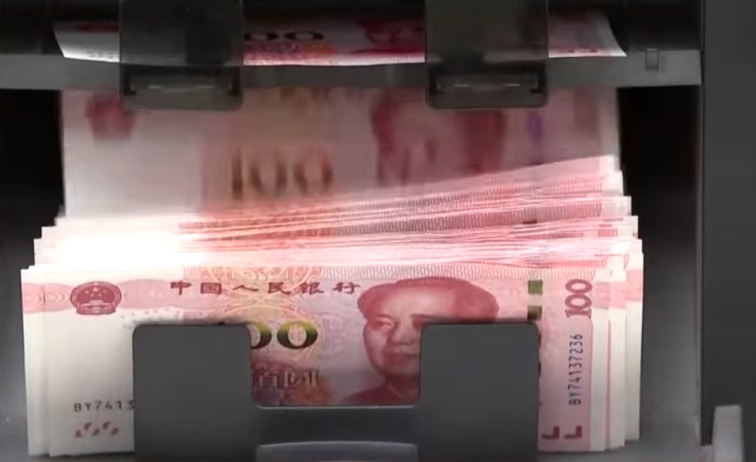
Renminbi Banknotes (Video Screenshot)
[People News] On March 20, 2026, the Ministry of Justice, the Central Bank, the Financial Regulatory Administration, the Securities Regulatory Commission, and the Foreign Exchange Bureau of the CCP jointly released the 'Draft Financial Law of the People's Republic of China', inviting public comments until April 19. This 'Draft Financial Law' claims to be the 'first foundational and overarching law' in China's financial sector, yet it judicializes and darkens administrative power. Notably, Chapter 7, Article 55, Section 6, stands out as the most alarming provision in the entire draft:
'The financial management department of the State Council shall perform its duties in accordance with the law and has the right to... inquire about the financial accounts, securities accounts, bank accounts, and other accounts with payment, custody, settlement, and other functions related to the units and individuals involved in the inspection and investigation matters... If there is evidence proving that illegal funds, securities, or other involved property have already been or may be transferred or concealed, or that important evidence has been concealed, forged, or destroyed, it may freeze or seal the assets.'
This clause effectively grants judicial powers to financial regulatory authorities, allowing them to bypass the courts and the procuratorate. If the regulatory authorities believe they have 'evidence proving' that something 'has already been or may be' amiss, they can directly access accounts, freeze assets, and seal properties. This is not merely a regulation; it is a new weapon in the CCP's arsenal that can strike at people's assets at any moment. The regulatory authorities are poised to directly 'seize people's assets'.
Judicialization of Administrative Power: From Regulation to Sudden Power Explosion
Historically, when administrative agencies sought to freeze the bank accounts or securities assets of individuals or businesses, they were required to follow the procedures set forth in the Administrative Coercion Law, which ultimately necessitated a ruling from the People's Court. This maintained a separation between judicial and administrative powers. However, the current draft legislation fundamentally undermines this separation by consolidating the judicial powers of inquiry, freezing, and sealing into a single package for the State Council's Financial Regulatory Administration, the China Securities Regulatory Commission, the State Administration of Foreign Exchange, and their local branches.
The phrase 'already or possibly' creates a loophole in the financial sector. While 'already' can be interpreted as having established illegal facts, 'possibly' reduces the threshold to nearly zero. If a regulatory official merely thinks, 'this account's fund flow seems unusual' or 'this money might be at risk of fleeing,' they are empowered to take action. The draft does not specify that a criminal case threshold must be met, nor does it require prior hearings or third-party reviews. Whether you are implicated in a case is left entirely to the discretion of the regulatory authorities, representing a complete takeover of judicial power by administrative power.
In fact, the Chinese Communist Party's Golden Tax Phase IV has already laid the groundwork for this form of 'judicialization.' In 2024, national tax inspection agencies are expected to address 21,000 cases of fraudulent tax invoicing through Golden Tax Phase IV, recovering over 380 billion yuan in taxes. The system can perform real-time comparisons of corporate declaration data with bank transactions and payment records, and if a discrepancy exceeding 300% is detected, it issues an immediate red alert. With the enactment of Article 55 of the Financial Law, these alerts are no longer mere 'reminders' but can lead to direct confiscation. The power has shifted from inquiry and monitoring to immediate freezing and confiscation, leaving individuals feeling helpless.
This raises the question: why do so many people perceive this as an unscrupulous bully clause?
The release of the draft has sparked widespread outrage among the public and the market. This is due to the fact that the regulation violates fundamental principles of procedural justice, property rights, and checks and balances.
To begin with, procedural justice has been completely undermined. The Constitution and the Civil Code clearly protect citizens' basic property rights. However, the draft allows administrative agencies to self-authorise such severe measures. Regulatory authorities can directly access various financial accounts of individuals and entities, including bank accounts, securities accounts, capital accounts, and new types of financial accounts such as those from payment institutions, custody, and settlement, encompassing digital payments, third-party custody, and cross-border settlements. This means that regulatory authorities can track the flow of funds comprehensively and without restriction, moving beyond the traditional banking system. Furthermore, these authorities can freeze or seal accounts at their discretion, leaving affected parties with no recourse but to apply for administrative reconsideration or litigation afterwards. Even if they win their case, what difference does it make? How do you account for the time cost, opportunity cost, and damage to reputation? Will the Communist Party support you through this? It is simply not feasible.
Moreover, property rights are being severely compromised. The term 'may be transferred' exemplifies the extreme presumption of guilt. Normal business operations and personal financial management naturally involve the movement of funds. Large transfers, cross-border investments, and adjustments to family trusts are all legal activities in any market economy. Now, if regulatory authorities suspect that 'you may have a problem,' your account could be reduced to zero in an instant. A private business owner might see tens of millions in their account before going to bed, only to wake up to find it has become 'frozen assets.' With such practices in place, who would still dare to conduct business domestically? Conversely, isn't this merely creating an opportunity for financial regulatory authorities to exploit their power for personal gain?
Ultimately, the system of checks and balances has completely broken down. The draft repeatedly emphasises 'following legal procedures,' yet the specific procedural details remain unclear. This means that regulatory authorities are acting both as players and referees. This is not about preventing risks; it is about turning regulatory bodies into a financial judicial institution that functions as both 'financial judges and financial police.'
Consequently, during the public consultation period, online discourse sharply criticised the 'unfair clauses' and the 'legalisation of money grabbing.' Netizens pointed out that this is not a 'Financial Law' at all, but rather a 'Money Grabbing Law.'
A Devastating Blow to Capital Outflow and Private Enterprises
The most immediate victims of this draft are private enterprises, the middle class and wealthy individuals who are trying to legally transfer their assets. The fourth phase of the Golden Tax has already demonstrated through real cases just how harsh this combination of monitoring and asset freezing can be.
In April 2025, internet anchor Le Chuanqu concealed his live-streaming sales income through personal accounts and fabricated the nature of the income from individual industrial and commercial households. He was precisely targeted by the big data of the fourth phase of the Golden Tax, resulting in a tax recovery and fines totalling 7.58 million yuan. In the same year, Shenyang blogger Li Chengxiang received sales commissions through his personal WeChat, hiding income for three years and underreporting taxes by 2.435 million yuan. The system automatically compared transaction flows with reported data, triggering a warning, and he was ultimately fined 4.02 million yuan. A fashion blogger was summoned by tax authorities within three months simply for failing to report 50,000 yuan in advertising fees. While these influencer cases may appear to be isolated, they have become emblematic of the harsh realities imposed by tax big data, and the chilling effect this has on others is unmistakable.
The situation for private enterprises is even more dire. Zhang Mou, the owner of a certain e-commerce company, diverted platform sales revenue into the accounts of 20 employees and friends, managing to conceal 8 million yuan over three years. The fourth phase of the Golden Tax System detected this through payment platform data, ultimately resulting in a tax payment of nearly 3 million yuan. In another chain restaurant, the store manager and finance staff collected payments through personal accounts without depositing them into the company account. The fourth phase of the Golden Tax System observed a long-term absence of incoming funds in the corporate account and frequent large transactions in personal accounts, with profit margins significantly below the industry average. This led to a direct identification of concealed income, resulting in the recovery of 150,000 yuan in taxes, along with fines and late fees totalling 80,000 yuan, and the freezing of related personal accounts. These cases follow a consistent pattern: the fourth phase of the Golden Tax System first identifies abnormal cash flows, after which tax or financial regulatory authorities take action to freeze the accounts.
With the enactment of Article 55 of the Financial Law, this crackdown will shift from tax recovery to direct account freezing by regulatory authorities. The capital management, overseas investments, and supply chain settlements of private enterprises during normal operations may all come under intense scrutiny. Once an entity is designated as an investigation target, account freezing and disruption of the capital chain become unavoidable. Previously, private enterprises could engage in wealth planning through trusts and offshore structures, but now regulatory authorities can trace directly to the underlying accounts, effectively closing off all avenues with the term 'possible.' The only outcomes are: either comply and remain in the country under supervision, or hasten the escape, but the act of fleeing itself will serve as evidence of 'possible transfer,' creating a vicious cycle.
On the other hand, Article 55 of the Financial Law has effectively created an invisible barrier to the outflow of private capital. According to Henley & Partners' '2025 Global Wealth Migration Report, China is projected to experience a net outflow of 7,800 millionaires by 2025, taking with them approximately $55.9 billion in investable assets. Wealthy individuals in China are looking to transfer their funds to overseas destinations such as Singapore, Dubai, and the United States, but they must first navigate the regulatory landscape. Private enterprises aiming to establish factories, make acquisitions, or go public abroad also require approval from regulatory authorities. In practice, however, state-owned enterprises are likely to receive exemptions. While the law ostensibly treats everyone equally, Article 55 of the Financial Law is essentially designed for individuals and private companies.
The Chinese Communist Party (CCP) is facing a severe financial shortfall, with hidden agendas at play.
The CCP is indeed running low on funds. In the first eight months of 2025, the national fiscal deficit has reached 6.4 trillion yuan, marking a year-on-year increase of 39.8%. Revenue from land sales has experienced negative growth for 40 consecutive months, and the total balance of local government debt and urban investment bonds has surpassed 100 trillion yuan. Although personal income tax revenue has surged by 11.5% due to tax collection efforts, traditional tax sources are depleting, while expenditures on stability maintenance, infrastructure, military spending, and debt interest are rigidly increasing. Both central and local governments are vocally urging citizens to 'tighten their belts', but where will the money come from? The answer is to seize it, though the CCP prefers to frame this as acting in accordance with the law.
Article 55 of the 'Financial Law (Draft)' represents a substantial power grab by regulatory authorities amid the dual challenges of fiscal pressure and capital outflow. This move has drastically diminished the sense of property security for private enterprises and ordinary citizens. When regulatory bodies can freeze the wealth accounts of 1.4 billion individuals without judicial oversight, we are not advancing towards common prosperity; instead, we are edging closer to common poverty.
(First published by People News) △








News magazine bootstrap themes!
I like this themes, fast loading and look profesional
Thank you Carlos!
You're welcome!
Please support me with give positive rating!
Yes Sure!