

According to the "Jiang Gong Jia Yan Lu" Facebook fan page, which has compiled notable quotes from Chiang Kai-shek, the former leader bluntly stated in 1953, "Negotiating peace with the Communist bandits is akin to seeking skin from a tiger." (Reprinted from Facebook)
[People News] Former President of the Republic of China and former Kuomintang Chairman Chiang Ching-kuo issued directives in 1979, advocating a "three no's policy" of "no contact, no negotiation, no compromise" in dealing with the Chinese Communist Party and the People's Republic of China. He even told a New York Times reporter, "Engaging (negotiating with) the Chinese Communist Party is a suicidal act. We are not that foolish."
However, Chiang Ching-kuo did not foresee that his straightforward warning would be ignored, as more than one Kuomintang chairman would foolishly travel to Beijing to "commit political suicide."
On April 10, Zheng Liwen, the chairperson of the opposition Kuomintang in Taiwan, recently led a delegation to Beijing to meet with Chinese Communist Party General Secretary Xi Jinping. Although the Kuomintang described this trip as a "peace journey," Xi Jinping's assertion that he would "not hesitate to use blood and life to prove that Taiwan is inseparable" sparked outrage among netizens. Furthermore, Xi Jinping did not consider that this statement would place the Kuomintang and Zheng Liwen in a position of betraying Taiwan.
During the meeting, Zheng Liwen echoed Xi Jinping's comments on "opposing foreign intervention" and reiterated the "1992 Consensus," which attracted severe criticism from various quarters. Many commentators and experts believe that this action not only undermines Taiwan's security defence but also places the Kuomintang in a "downgraded" position in Beijing's approach.
Loss of agency, becoming a pawn of the Chinese Communist Party.
The two parties in this meeting consist of Xi Jinping, labelled a 'dictator' by former U.S. President Biden, and Zheng Liwen, who holds no official position and is grappling with a party fund deficit, needing to raise over 20 million monthly for party rent and salaries. The stark contrast in their power and influence is evident; thus, even after being demoted by Xi Jinping, Zheng Liwen maintained a broad smile and lowered her stance, shaking hands with Xi for 13 seconds.
In reaction, senior media commentator Akio Yaita expressed on Facebook that this so-called 'ice-breaking' meeting, occurring after a decade, is essentially a blatant political surrender. The brief 13-second handshake at the Great Hall of the People starkly illustrated the harsh power imbalance. One side is cold and in control, while the other deliberately adopts a submissive posture, publicly showcasing a subordinate relationship. The Kuomintang has not only forfeited its political dignity but is also attempting to place the fate of Taiwan's 23 million people on the negotiation table. Currently, leadership within the Kuomintang is shifting to Zheng Liwen, who previously advocated for Taiwan independence, allowing her to modify her rhetoric at any moment for personal interests and political manoeuvring. When the party's stance is supplanted by 'opportunistic tactics,' the risks for Taiwan escalate, as Zheng Liwen operates with 'no bottom line.'
Akio Yaita candidly remarked that Zheng Liwen's notion of 'institutional solutions' is a manifestation of this limitless logic. In the realm of international politics, peace is never achieved through appeasement of power. When she aligns with the sentiment of 'opposing foreign intervention' in Beijing, she is fundamentally weakening Taiwan's security framework, attempting to frame the Taiwan Strait issue as an internal matter for China. This is not a strategy to avoid conflict, but rather a move to 'remove protective measures.'
Akio Shibata has warned that Zheng Liwen has forsaken the Kuomintang's previous strategy of using 'individual statements' to maintain a flexible interpretative space, opting instead for language that closely aligns with Beijing. This shift signifies the complete erosion of the Kuomintang's subjectivity. As scholar Ogasawara Yoshiyuki has noted, the Chinese Communist Party does not seek a true negotiating partner, but rather a manipulable entity. Amidst global instability, this arrangement serves to project a 'peaceful posture' internationally while simultaneously probing Taiwan's internal political fractures. Although Zheng Liwen may perceive herself as the focal point, in the strategic calculations of Beijing, she is merely a replaceable pawn.
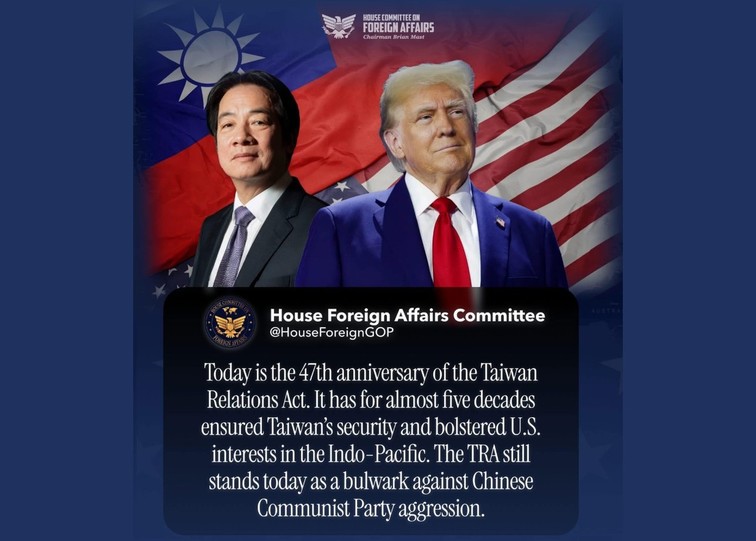
The United States has created a poster featuring Trump alongside Lai Ching-te. Economist Wu Jialong interprets this as an implicit confirmation that the U.S. will intervene in Taiwan, as such action aligns with American interests. (Reproduced from Wu Jialong's Facebook)
Xi Jinping finds himself without leverage and is struggling to secure his position.
On the 11th, economist Wu Jialong expressed on Facebook that the meeting between Xi Jinping and Zheng Liwen is intended to demonstrate to the world that the chairman of Taiwan's largest opposition party is engaging with the Chinese Communist Party, which is preparing to use military force against Taiwan, in a bid for peace. Consequently, for the CCP, the management of the Taiwan issue has become an internal affair of China, free from interference by other nations. In essence, the true significance of the Zheng-Xi meeting lies not in the technical details such as reception protocols, speech content, or media coverage, but in signalling to the international community that the CCP seeks to internalise the Taiwan issue. However, Xi Jinping's efforts in this regard are likely to be futile, as the fundamental nature of the Taiwan issue cannot be unilaterally internalised by the CCP.
Wu Jialong further noted that from the U.S. perspective, as long as the 'Taiwan Relations Act' and Reagan's 'Six Assurances' are in place, the Taiwan issue is firmly embedded in the international political landscape and cannot simply be regarded as an internal matter for China. Taiwan is a critical geopolitical hotspot in the Western Pacific and occupies a key position in the first island chain; this is the crux of the matter. Thus, Taiwan is intertwined with Japan's national security, the United States' own national security, and the credibility of U.S. security commitments. Therefore, inherently, Taiwan cannot be viewed solely as an internal issue for China, nor is it merely a historical remnant of the Chinese Civil War; it is a vital geopolitical battleground. From a geopolitical perspective alone, Taiwan has already been internationalised, and no matter how hard Xi Jinping attempts to alter this reality, he cannot change the established framework!
Wu Jialong pointed out that to counter the self-serving calculations and propaganda of the Chinese Communist Party (CCP), the United States has produced a poster featuring Trump and Lai Ching-te together, presented by the House Foreign Affairs Committee to commemorate the 47th anniversary of the Taiwan Relations Act. This effectively serves as an official declaration that the United States will intervene in Taiwan, as this aligns with American interests.
Wu Jialong urged the people of Taiwan not to frighten themselves, noting that Taiwan not only possesses a semiconductor industry chain but is also part of the geopolitical first island chain. Therefore, there is no need to pay attention to the CCP's minor provocations, as the CCP has reached a point of having no leverage. Furthermore, the economic issues facing the CCP are severe; in addition to the unemployment crisis, there is a debt crisis and a structural overcapacity crisis. They lack the capacity to escape from American influence, as China relies on the American market, technology, and orders... The current substantial trade surplus indicates an increased dependence on foreign markets, making it even more difficult to withstand the risk of being blockaded by sea and air. For a China that is struggling to maintain its stability, Taiwan should focus on enhancing its own capabilities rather than seeking peace from a declining China. △




News magazine bootstrap themes!
I like this themes, fast loading and look profesional
Thank you Carlos!
You're welcome!
Please support me with give positive rating!
Yes Sure!