
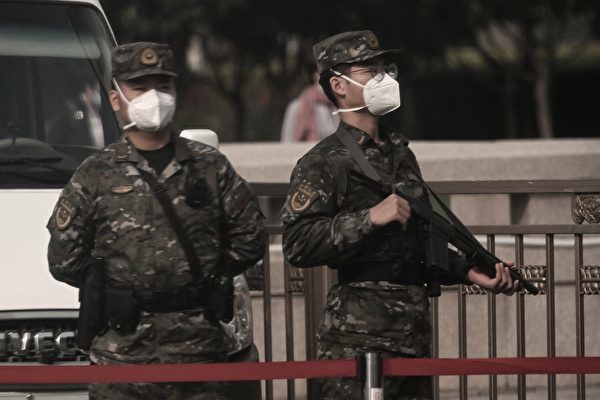
Caption: On October 13, 2022, ahead of the 20th National Congress of the Chinese Communist Party, security personnel were stationed along the road leading to Tiananmen Square. (NOEL CELIS/AFP via Getty Images)
[People News] On April 11, 2026, overseas X platforms were abuzz with rumours that Li Ganjie, a current member of the Central Political Bureau of the Communist Party of China, Secretary of the Central Secretariat, and Minister of the United Front Work Department, had been taken away for investigation by the Central Commission for Discipline Inspection. This news quickly gained traction. Although the Communist Party of China has not officially confirmed this information, the emergence of such rumours has already ignited public opinion both domestically and internationally. Just over ten days ago, on April 3, Political Bureau member Ma Xingrui was officially announced to have fallen from grace. If the rumours about Li Ganjie being taken away are true, it would indeed signify another victory for the Political Bureau, suggesting an imminent collapse of the Political Bureau, as Xi's approach of 'self-revolution' has effectively dismantled the Xi-led Party Central.
Publicly available information indicates that Li Ganjie participated in the deliberation of the government work report during the National Two Sessions on March 5; from March 18 to 21, he conducted research in Yunnan, visiting Xishuangbanna, Yuxi, and Kunming; on March 24, he attended the opening ceremony of the fifth training class for young and middle-aged cadres in the United Front system and delivered a speech; his most recent public activity was on March 31, when he attended the thematic education launch meeting for various democratic parties and non-party figures and gave a speech. This means that as of April, Li Ganjie has not made a public appearance for 12 days.
Li Ganjie's resume positions him as a quintessential official of the 'technocrat + Xi Jinping's trusted aide' archetype in the Xi Jinping era. Born in November 1964 in Changsha, Hunan, Li joined the Communist Party in December 1984. He holds a master's degree in engineering with a specialisation in nuclear reactor engineering and safety from Tsinghua University and is a senior engineer. Early in his career, he spent a significant amount of time working within the nuclear safety and environmental protection sectors, having held positions such as the director of the National Nuclear Safety Administration, deputy minister of the Ministry of Environmental Protection, and the inaugural minister of the Ministry of Ecology and Environment. Since 2016, he has been a key protégé of Tsinghua alumnus Chen Xi, gaining local experience first as the deputy secretary of the Hebei Provincial Committee, then moving to Shandong, where he served as the deputy secretary of the Provincial Committee and governor, and from 2020 to 2022, he was the secretary of the Shandong Provincial Committee. At the 20th National Congress of the Communist Party of China in 2022, he entered the Central Political Bureau at the age of 58, succeeding Chen Xi as the minister of the Central Organisation Department, and was once viewed as a central figure in charge of personnel matters across the party.
Li Ganjie is associated with multiple factional labels. He is part of the Tsinghua faction, having graduated from Tsinghua University, where he was a roommate of Chen Xi, indicating a close relationship; the Shandong faction, having governed Shandong and having ties to Peng Liyuan's hometown, with many former subordinates; and the military-industrial technocrat faction, with a professional background in nuclear reactors, which has strong connections with military, aerospace, and environmental protection sectors. Due to these three layers of affiliations, Li Ganjie is considered Xi Jinping's most reliable personnel strategist and one of the core members of the Xi family army with the highest loyalty. Observers have regarded him as a significant organisational and personnel chess piece in Xi's strategy for the 21st National Congress.
Unexpectedly, this dynamic protégé of Xi Jinping faced a rare job swap in April 2025, exchanging positions with Shi Taifeng, the then Minister of the United Front Work Department. Such a personnel arrangement is extremely uncommon in the history of the Communist Party of China, as it involves a direct exchange of top leaders at the Politburo member level between two major departments, which has almost no precedent. Analysts interpret this as Xi Jinping encountering personnel attacks from anti-Xi factions, with Shi Taifeng, who has ties to the anti-Xi camp, successfully replacing Xi Jinping's key personnel figure, Li Ganjie.
Adding to the intrigue, after Li Ganjie was reassigned to the United Front Work Department, he was not elected as the Vice Chairman of the National Committee of the Chinese People's Political Consultative Conference (CPPCC) as is customary, nor was he even appointed as a member of the CPPCC. Meanwhile, Shi Taifeng, after moving to the Organisation Department, continued to serve concurrently as Vice Chairman of the CPPCC, while Li Ganjie completely lost this standard concurrent position. This unusual arrangement is widely seen as a clear signal of a reduction in power and a demotion. At 61 years old, Li Ganjie may face significant risks in his political career.
Following this, a series of alarming signals emerged for Li Ganjie. First, several of his former subordinates from Shandong, including a former Secretary and officials from Hunan, were investigated in rapid succession. On January 4, 2026, Lu Jie, Deputy Secretary-General of the Shandong Provincial Government and a member of the Party Group of the Office, was investigated while in office. Lu Jie had served as the Director of the Shandong Provincial Bureau of Institutional Affairs during Li Ganjie's tenure as governor in 2021. Lu Jie is regarded as a typical secretary aide, and his downfall often signals trouble for higher-level officials. Additionally, another former Secretary of Li Ganjie, Hui Xin'an, was also investigated around the end of 2025. A wave of investigations also affected senior officials from Hunan, Li Ganjie's home province. These purges, reminiscent of trimming the edges, reasonably suggest that Li Ganjie is undergoing a systematic dismantling ahead of a potential downfall.
Secondly, there is a notable irregularity in the reports from the party media. On August 23-24, 2025, during the central delegation's activities in Tibet, the front page of the "People's Daily" on the 23rd reported that Li Ganjie, serving as the deputy leader, led a team to the Ali region. However, in the press release issued upon their return to Beijing on the 24th, the activities of deputy leaders Wang Huning and Zhang Guoqing were included, while all references to Li Ganjie were completely removed and taken down separately. This significant anomaly has heightened concerns regarding his potential troubles.
More critically, Li Ganjie has become embroiled in the case of Jin Xiangjun, the former governor of Shanxi. Jin Xiangjun was officially announced to have been dismissed on April 12, 2025, making him the first sitting provincial governor to be investigated following the 20th National Congress. There are overseas rumours suggesting that Jin Xiangjun attempted to leverage Li Ganjie to secure a higher position, but was unsuccessful. Additionally, both their wives are suspected of colluding in the sale of official positions. Reports also indicate that Li Ganjie's daughter, who works at China Resources Land, has been implicated in the related case. If these rumours are substantiated, they would directly indicate a possible power-money transaction chain involving Li Ganjie during his time at the Organisation Department, which could serve as a critical piece of evidence against him.
Reports indicate that the Central Commission for Discipline Inspection (CCDI) special investigation team had already conducted a thorough secret investigation into Li Ganjie last year. It was later revealed that the case involving Ma Xingrui was more significant than that of Li Ganjie, implicating more senior officials from the central government, which led to the decision to initially target Ma Xingrui. A Fujian entrepreneur who supports Wen Jiabao disclosed that Ma Xingrui, in a bid to save himself, clung tightly to Peng Liyuan and Li Xi. Between 2017 and 2022, Li Xi served as the Secretary of the Guangdong Provincial Committee, while Ma Xingrui was the Governor of Guangdong Province, making them partners in corruption. Ma Xingrui's wife, Rong Li, adopted a first lady approach, frequently passing on substantial corruption proceeds to Peng Liyuan. Ma Xingrui hoped that this connection with Peng Liyuan would help him preserve his life, but it ultimately led Xi Jinping to take action against him. Xi Jinping had initially planned to have Liu Jinguo from the CCDI arrange for individuals connected to the Ma Xingrui case to implicate Hu Chunhua. However, Hu Chunhua is considered untouchable, with no evidence of corruption against him, and remains safe for now.
On April 3, it was officially announced that Ma Xingrui had fallen from grace. Both Li Ganjie and Ma Xingrui are regarded as trusted allies of Xi Jinping, representatives of the era's technocratic bureaucrats, and key figures in the military-industrial sector, as well as members of the Politburo. If both were to fall, it would be a significant irony for Xi Jinping. Whether Xi Jinping is sacrificing his trusted aides due to their waning loyalty or if anti-Xi forces are manoeuvring behind the scenes, his confidants are falling one after another, akin to dumplings being tossed into the boiling pot of anti-corruption at the CCDI. This situation underscores that Xi Jinping's anti-corruption campaign is beginning to spiral out of control. The walls of the Politburo are crumbling, and the Xi family faction is collectively collapsing, creating an increasingly absurd and ridiculous spectacle.
What is even more alarming is that this indiscriminate model of self-revolution has thrown the entire political landscape into a cycle of fear and distrust. Officials have shifted their focus from pursuing practical work to lying low, self-preservation, reporting on others, and aligning with factions. The anti-corruption campaign has failed to genuinely cleanse the governance; instead, it has led to increased political instability. As trusted aides continue to fall, who can the highest echelons still safeguard? When even the most trusted individuals become the 'next to fall,' the notion of absolute loyalty turns into a self-deceptive farce.
Should the rumours surrounding Li Ganjie be confirmed, it would further illustrate that in Xi Jinping's new era, there are no permanent confidants, only enduring interests and fears. The question of when this power struggle will conclude is one that even Xi Jinping may no longer be able to answer.
(First published in People News)△




News magazine bootstrap themes!
I like this themes, fast loading and look profesional
Thank you Carlos!
You're welcome!
Please support me with give positive rating!
Yes Sure!