
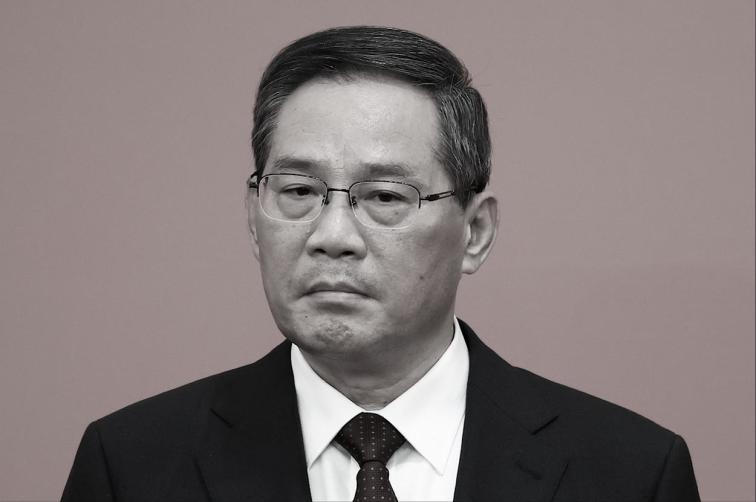
Chinese Premier Li Qiang&9;s Profile Photo. (Photo by Lintao Zhang/Getty Images)
[People News] On March 12, the closing ceremony in Beijing, which was expected to be a well-rehearsed event, unexpectedly revealed a highly discordant signal. A dissenting vote appeared on the big screen, disrupting the long-standing calm of the venue. This was not merely a vote; it felt more like a public confrontation. Who, in such a high-pressure moment, dared to embarrass the second-in-command on stage?
With Zhao Leji's shout of "curtain down," the Chairman of the National People's Congress, the 2026 Two Sessions of the Communist Party finally concluded. This meeting, perceived by outsiders as a "political drama," was remarkably dull. Inside the venue, representatives exhibited a noticeable sense of relaxation, even rubbing their eyes and yawning during the proceedings. However, when it came time to vote on Premier Li Qiang's government work report, the big screen surprisingly displayed "one opposing vote" and "two abstentions." In that venue filled with "raise your hand machines," who had the audacity to openly cast a dissenting vote against the second-in-command, Li Qiang?
To be frank, under the current high-pressure atmosphere in China, ordinary representatives would not dare to cast an opposing vote, as the Communist Party has the means to trace voters through technical methods. Senior political commentator Chen Pokong analysed that this opposing vote most likely originated from the "big boss" sitting on the podium himself.
Why would this top leader be dissatisfied with the second-in-command?
This can be traced back to a mistake made by Li Qiang while reading the report. Observers noted that Li Qiang, during his reading of the report, actually omitted a very crucial phrase: "resolutely oppose hegemonism and power politics."
This phrase is specifically used to criticise the United States within the context of the Chinese Communist Party. Li Qiang intentionally overlooked this statement, which is interpreted as a signal to the U.S. and foreign investors that 'I am pro-American, I am a reformist,' in an attempt to leave himself an escape route.
For a leader who demands absolute loyalty, this is essentially a spiritual alignment with the U.S., which constitutes an act of betrayal. Analyst Chen Pokong suggests that this opposing vote serves as a warning from the top leader to the second-in-command, reminding him: don't assume that just because you are the Premier, you can have your own opinions; your power is granted by me, and I can make you look bad at any moment.
Since Li Qiang assumed office, the top leader has taken several actions to undermine his position, including cancelling the Premier's press conference, downgrading Li Qiang's official visit from a 'special plane' to a 'chartered flight,' and even leaking damaging information about Li Qiang's family wealth to intimidate him. Thus, it is not surprising that he cast an opposing vote.
There is also a possibility that the Chinese Communist Party is staging a performance, with the opposing and abstaining votes being prearranged to create an illusion of false democracy.
Beyond this vote, let's examine the financial situation of the populace. This time, the government work report has set the economic growth target between 4.5% and 5%, marking the first time in over thirty years that it has fallen below 5%, which indicates a complete loss of confidence in the economy by the authorities.
Particularly in the real estate sector, the government's attitude can be described as 'letting it go.' The emphasis on 'stabilising the housing market' in the report has been significantly deprioritised, and it no longer even mentions 'stopping the decline and stabilising.'
Experts believe that Xi Jinping fundamentally perceives private real estate companies as 'undermining socialism,' and he would prefer to let the real estate sector deteriorate rather than redirect resources to what he refers to as 'new productive forces.' For a Chinese society that is already 'ageing before becoming wealthy' and has a severely distorted demographic structure, this situation is like adding insult to injury.
Moreover, we cannot overlook the influence of the international landscape on this year's Two Sessions. The recent demonstration of formidable strike capabilities by the U.S. military in Iran has clearly alarmed Beijing. In light of the new Supreme Leader of Iran taking office, Xi Jinping even unusually refrained from sending a congratulatory message, fearing it might offend Trump and worrying that the U.S. military's 'divine troops' could turn their focus on him next.
Amid this internal and external crisis, Wang Huning introduced a new strategy at the Two Sessions, which aims to 'precisely target Taiwanese youth' for brainwashing and infiltration, attempting to destabilise Taiwan from within. This indicates that the CCP is shifting towards a more insidious form of soft united front tactics after the failure of military deterrence.
Although the Two Sessions of 2026 have concluded, what remains for the outside world is a regime rife with suspicion and economic collapse. That enigmatic 'opposition vote' was not only cast against Li Qiang but also against a system that has only garbage time left.
(First published by the People News)
△








News magazine bootstrap themes!
I like this themes, fast loading and look profesional
Thank you Carlos!
You're welcome!
Please support me with give positive rating!
Yes Sure!