
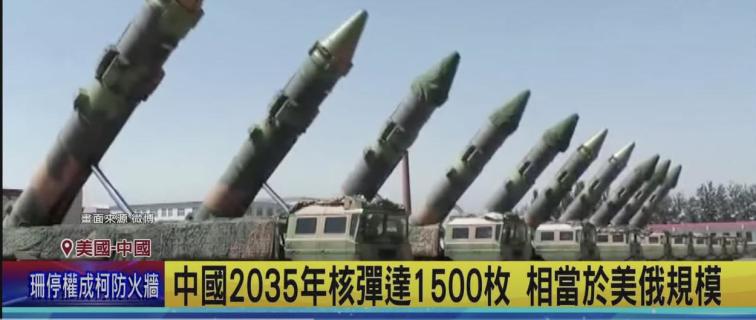
The Chinese Communist Party (CCP) is aggressively expanding its military, with its nuclear arsenal expected to reach 1,500 warheads by 2035, approaching the scale of the U.S. and Russia. The United States is increasingly concerned about China's nuclear expansion. (Video screenshot)
[People News] As the U.S. ramps up its strategic efforts against Iran and the meeting between Presidents Trump and Xi approaches, the U.S.-China rivalry has once again delivered a stunning blow.
The U.S. military has publicly disclosed classified information regarding the CCP's nuclear warheads.
On March 9, the U.S. Air Force's China Aerospace Studies Institute (CASI) published a report titled "Dancers at the Knife's Edge: PLA Rocket Force Nuclear Warhead Management." This report systematically details the organisational structure, operational processes, storage and transportation mechanisms, and potential vulnerabilities of the CCP's Rocket Force nuclear warhead management system. It reveals a little-known model of nuclear warhead management within the CCP military, indicating that warheads are not always loaded onto missiles but are instead stored centrally and need to be distributed during a crisis, akin to the separation of bullets. The report highlights that this arrangement exposes potential single points of failure in the logistics and security chain.
The CASI report asserts that it is based on open-source intelligence, combining Chinese military publications, satellite imagery, and public documents. It identifies Base 67, located in Baoji, Shaanxi, as the central unit of China's nuclear weapons management system, primarily tasked with the storage, security, testing, and transportation of nuclear warheads. The facilities of this base are situated in the deep mountains of the Qinling range, codenamed 'Hongchuan'. The entire nuclear weapons storage area comprises multiple ground and underground structures, maintained under strict environmental control systems to ensure optimal storage conditions for the warheads.
Base 67 originated from Base 22, a deputy military-level unit established in 1958, which was directly under the Central Military Commission and was renamed following military reforms in 2017. It oversees at least three brigade-level units, including a technical service brigade (responsible for storage and transportation) and an emergency management battalion (focused on nuclear and biochemical crisis response), along with eight regiment-level units, spread across Baoji and the surrounding Qinling mountain area. Base 67 also features a multi-layered defence system, which includes anti-aircraft missiles, electronic warfare units, and ground security forces. Some high-altitude outposts are positioned at elevations exceeding 3,600 meters, tasked with patrolling the expansive mountainous terrain.
The 'Hongchuan' complex is situated 35 miles from the headquarters in Baoji, accessible only via a narrow road. Due to its remote location, there was still no mobile phone signal as of 2019. During the upgrade of the technical service brigade in 2017, the Chinese Communist Party urgently relocated over 300 personnel from research institutes, including 46 senior engineers, to Hongchuan, with only short notice. This sudden move caused dissatisfaction among the families of the troops, who had to quickly arrange for their children and families, underscoring the harsh and inhumane management practices within the Chinese Communist military.
The 67th base distributes nuclear warheads to six operational bases and missile brigades using rail and road transport. Typically, the convoy consists of over 40 vehicles, and every 1-2 hours, strict checks on the warheads' temperature and humidity are required. Police escorts are also necessary during the transport, making this process inefficient, time-consuming, and significantly exposing the targets, which can be easily monitored by satellite imagery. The Chinese Communist Party (CCP) claims that separating the warheads from the missile bodies is intended to prevent accidental launches and to lower the alert level of its nuclear arsenal.
The report points out the vulnerabilities in the management of nuclear warheads by the CCP's Rocket Force: storing them at a single location increases the risk of failure, while the chances of transportation accidents and interception rise sharply. Furthermore, the closed nature of the base complicates personnel retention and poses significant health risks. The report notes that the Equipment Inspection Research Institute is responsible for quality control, remote sensing, and extending the lifespan of nuclear warheads. One soldier has been exposed to radioactive dust for 22 years, resulting in various health issues, including acute dermatitis, low white blood cell count, arrhythmia, vision and digestive problems, and arthritis.
Currently, the CCP has 600 nuclear warheads, and with the rapid expansion of its nuclear arsenal, this number could exceed 1,000 by 2030. The 67th base is facing increasing pressure, revealing a systemic crisis in centralised management.
The release of this report has sparked significant international discourse. While the United States asserts that the information is derived from open sources, the 30-page document provides an intricate overview of the Rocket Force's 67 bases. It is hard to believe that such detailed information could be gathered without espionage, as it includes specifics on base locations, internal functions, transportation methods, health issues, military family conflicts, and various historical events, which appear to go well beyond what can be gathered from satellites and public intelligence sources.
In 2023, the U.S. also revealed classified details about the locations, unit numbers, internal organisational structures, and personnel assignments of all units within the Chinese Rocket Force. This disclosure was labelled as an internal leak, with claims that the Rocket Force, fearing that they would be targeted by the U.S. military as live targets during a potential invasion of Taiwan by Xi Jinping, sold intelligence to the U.S., resulting in Xi Jinping later purging the entire senior leadership of the Rocket Force.
In January 2026, The Wall Street Journal reported that Zhang Youxia, Vice Chairman of the Central Military Commission, was accused of selling nuclear technology to the United States, including missile guidance parameters and secrets related to warhead miniaturisation. Although this allegation is heavily tinged with the internal power struggles of the Chinese Communist Party (CCP) and lacks credibility, it is a fact that many military leaders oppose Xi Jinping's plans for an invasion of Taiwan and do not follow his leadership. The Chinese military is currently facing disorganisation, low morale, and a desire for change, with widespread dissatisfaction towards Xi Jinping and hopes for his removal. Furthermore, the CIA has made multiple attempts over the past year to engage with members of the Chinese military and the party, openly recruiting spies. Given the interplay of international and domestic factors, the likelihood and feasibility of further intelligence leaks from the Rocket Force have significantly increased.
The Fivefold Mysteries of Nuclear Absolute Secret Bombs
Why did this "nuclear absolute secret" erupt like thunder in March 2026? There are five key factors that must not be overlooked.
Firstly, the United States is currently engaged in the deep strike phase of the Iran War. On February 28, the U.S. and Israel launched the "Epic Fury" operation, which resulted in the assassination of Iran's Supreme Leader Ali Khamenei and the destruction of nuclear facilities. Even when cornered, Iran continues to resist, using its leverage in the Strait of Hormuz to drive oil prices up and threaten Trump. As Iran's behind-the-scenes master, the Chinese Communist Party (CCP) is feeling the loss of its allies and is secretly supporting Iran. Reports from U.S. media indicate that the CCP has been covertly supplying Iran with CM-302 supersonic anti-ship missiles and assisting in gathering military intelligence. Trump's release of this report serves as a powerful deterrent, warning Xi Jinping not to act recklessly or provide covert support to Iran, essentially telling him: "I am fully aware of your nuclear trump card."
Secondly, Xi Jinping is wielding the sword of anti-corruption, conducting a bloody purge within the military. The significant absence of military representatives at the Two Sessions signals turmoil within the armed forces. The U.S. exposure of nuclear secrets acts like a knife in the dark, likely igniting Xi Jinping's suspicions and further escalating violence within the military. The report highlights several vulnerabilities at Base 67, directly targeting Xi Jinping's tendency for grandiosity, akin to publicly slapping him in the face. This could lead to more purges, and Xi Jinping may even intensify the crackdown, further undermining the structure of the CCP's military.
Third, the U.S. has issued a potential warning to the Chinese Communist Party (CCP): do not even think about taking aggressive action against Taiwan. Taiwan is a crucial concern and a core strategic interest for both the U.S. and China. In 2026, the situation in the Taiwan Strait is expected to be turbulent; if the conclusion of the U.S.-Iran war is delayed, there is a possibility that the CCP might take risks and attempt to invade Taiwan. At this critical moment, Trump has unveiled a powerful card, indicating that the CCP's nuclear weapons could be precisely targeted, suggesting that the U.S. military could dismantle the CCP's military capabilities with surgical precision. This will undoubtedly instil fear in Xi Jinping, and his ambitions for a Taiwan invasion will likely be thwarted.
Fourth, the Xi-Trump summit is on the horizon. Trump is set to visit China from March 31 to April 2, marking the first direct confrontation between the leaders of the U.S. and China following the 2024 election. The report serves as a formidable bargaining chip, significantly enhancing the U.S.'s negotiating position. The lingering effects of the trade war persist, and U.S.-China relations are as precarious as thin ice. The U.S. can leverage this situation to pressure the CCP into making concessions on critical issues, including trade, rare earths, fentanyl, the Taiwan Strait, and Iran.
Fifth, the response to nuclear expansion and the political manoeuvring within the country. The U.S. Department of Defence's "2025 China Military Power Report" estimates that the number of CCP nuclear warheads is rapidly increasing. The CASI report provides a detailed analysis of the weaknesses in the CCP's nuclear management, aiming to undermine the CCP's nuclear deterrence and provocations, and to curb its nuclear expansion.
This revelation is just the tip of the iceberg in the great power rivalry between the U.S. and China. Xi Jinping has been exposed and has lost another round; the game of U.S.-China competition has only just begun, and the grand drama of the Year of the Red Horse is sure to unfold continuously.
(People News first published) △





News magazine bootstrap themes!
I like this themes, fast loading and look profesional
Thank you Carlos!
You're welcome!
Please support me with give positive rating!
Yes Sure!