
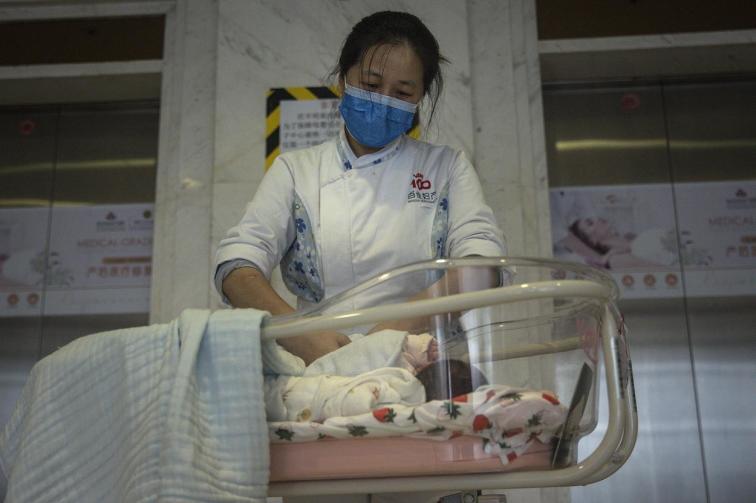
Image: On March 12, 2020, at a private maternity hospital in Wuhan, Hubei Province, China, an obstetrics nurse wearing a mask cares for a newborn. (Photo by Getty Images)
[People News] On January 19, the Chinese Communist Party announced that in 2025, China's population will decrease for the fourth consecutive year, with a reduction of 3.4 million people, surpassing the decline recorded in 2024. Additionally, the total number of newborns in China is expected to drop to 7.92 million in 2025, marking the lowest level since 1949. The number of deaths is projected to rise from 10.93 million in 2024 to 11.31 million in 2025. These statistics underscore the significant demographic challenges that Beijing is facing.
Demographer Yi Fuxian from the University of Wisconsin-Madison noted on the X platform that the number of births in China last year, 7.92 million, is comparable to the figures from the early years of the Qianlong Emperor in 1738, when China's total population was only 150 million. Moreover, China's share of global births is expected to decline from 17.4% in 1990 to 6.0% in 2025, which is similar to the current situation in Nigeria.
Since 2022, China's population has been in continuous decline, and the accelerating ageing of the population is complicating Beijing's efforts to stimulate domestic consumption and manage debt.
The shrinking labour force and the ageing population pose significant threats to China's economy. With the elderly population on the rise, hundreds of millions are set to leave the labour market, while the pension budget has long been under strain.
Since Xi Jinping took office, the 'one-child' policy was relaxed to a 'two-child' policy in 2016, but the results were underwhelming. In 2021, an even more lenient 'three-child' policy was introduced, yet these measures failed to address China's declining birth rates. By the end of 2022, the country recorded its first population decline in 61 years.
The low birth rate is linked to a trend among young people of avoiding dating, marriage, childbearing, and home buying. The root causes include an economic downturn, persistently high youth unemployment, and the soaring costs of raising children, all of which are critical factors contributing to the drop in marriage and birth rates.
A mainland resident, Yang Jian (pseudonym), shared with The Dajiyuan that young people born in the 1990s and 2000s in his neighbourhood generally opt not to marry. Many parents have also come to accept this reality, realising that if their children remain unmarried, they won't have to care for grandchildren.
25-year-old Zhuang Yi (pseudonym) remarked that under the Chinese Communist Party's governance, society in mainland China is highly competitive, making it extremely difficult to secure employment. Even when one finds a job, they often face excessive overtime, and salaries are frequently delayed. 'There’s no interest in starting a family; it feels unattainable, and there seems to be no way forward.'
During the lockdown in Shanghai in 2022, a man who refused mandatory quarantine faced police threats that it would 'affect your three generations.' He responded, 'This is our last generation, thank you!' This remark quickly became a trending topic, dubbed 'the voice of the era,' highlighting a generation's despair, grievances, and resistance against the tyranny of the Communist Party.
A video continues to circulate online, depicting Tan Sitong (Tan Sitong) from the late Qing Dynasty saying goodbye to his wife before his execution. His wife remarks, 'We still do not have any children.' In a moment of deep despair, Tan Sitong replies, 'In such a China, isn't having one more child just creating one more slave?'
Many internet users have taken this video to 'use the past to critique the present,' expressing agreement that this statement is relevant to contemporary mainland China. △





News magazine bootstrap themes!
I like this themes, fast loading and look profesional
Thank you Carlos!
You're welcome!
Please support me with give positive rating!
Yes Sure!