

Among Taiwan's various outlying islands, Kinmen, Matsu, and Dongsha hold important positions in defence. (Google Maps/Dajiyuan illustration)
[People News] On December 29, 2025, Shi Yi, spokesperson for the Eastern Theater Command of the People's Liberation Army, announced without prior warning that starting today, the Eastern Theater Command would conduct live-fire exercises in five designated areas: the Taiwan Strait, northern Taiwan, southwestern Taiwan, southeastern Taiwan, and east of Taiwan, under the code name 'Mission of Justice-2025'. The exercises will focus on maritime and aerial combat readiness patrols, seizing comprehensive control, blocking key ports and areas, and implementing external three-dimensional deterrence. Naval and air forces will approach Taiwan from multiple directions, with joint assaults from various military branches aimed at testing the operational capabilities of the theatre forces.
In response to Beijing's sudden military exercises encircling Taiwan, the island remains calm and composed.
This military exercise by the Chinese Communist Party has several notable features: it was conducted without prior notice; it includes a comprehensive maritime and aerial blockade that breaches Taiwan's 12 nautical mile territorial sea line; live-fire exercises are scheduled for the 30th; the Chinese Foreign Ministry has explicitly stated that the exercises target 'external forces' and 'Taiwan independence forces'; the drills involve land, sea, air, rocket forces, and the coast guard, simulating the blockade of key ports and striking high-value targets, with a scale and intensity that have quickly caused international concern.
On the afternoon of the 29th, Taiwan's Ministry of National Defence held an emergency press conference. Major General Xie Risheng, Deputy Director of the Intelligence Planning Office, explained that the five exercise areas designated by the Chinese Communist Party include Taiwan's 12 nautical mile territorial sea baseline, making the implications clear. The Ministry of National Defence stated that the military will authorise the Navy's 62nd Task Force, Air Operations Department, and frontline combat units to respond according to the level of threat posed by the enemy, following the Rules of Engagement (ROE) and authorisation matrix.
Major General Sun Lifang, spokesperson for Taiwan's Ministry of National Defence, indicated that the gap between the Chinese Communist Party's (CCP) transition from training to military exercises and from exercises to actual combat is becoming increasingly shorter, resulting in greater pressure on Taiwan. In response, the national military has adjusted its readiness and training methods to effectively counter these threats.
The CCP is grappling with both internal and external challenges, and the military exercises have exposed various strategic anxieties within Xi Jinping's administration.
As the military exercises approach, the international landscape is at a sensitive point that is unfavourable to the CCP. The U.S. Congress has recently passed the Fiscal Year 2026 National Defense Authorization Act, reaffirming the U.S. political commitment to re-engage in Asia and its geopolitical objective of maintaining peace in the Indo-Pacific region. This legislation also includes approval for an $11 billion arms sale to Taiwan, featuring offensive weapons such as the HIMARS multiple rocket system. This move is viewed as a strong endorsement from Washington for Taiwan. Trump's approach towards Taiwan emphasises doing more with fewer resources, which may seem to continue the U.S.'s longstanding ambiguous strategy towards Taiwan, but in fact, it strengthens U.S.-Taiwan strategic relations. The signing of the Taiwan Assurance Implementation Act in August provides institutional support for U.S.-Taiwan relations and lays the groundwork for normalisation, while this arms sale further provokes Beijing's sensitivities.
Recently, former Japanese Prime Minister Gao Shi Zaomei made a bold statement, asserting that 'If Taiwan faces a crisis, Japan will too.' In retaliation, the Chinese Communist Party (CCP) resorted to both verbal and military threats against Japan. CCP diplomat Xue Jian even took to social media to issue a chilling threat to behead Gao Shi Zaomei. Undeterred, she led her cabinet in a strong confrontation with the CCP and accelerated Japan's constitutional revisions aimed at re-establishing militarism, resulting in her public support rating soaring to nearly 80%. Japan's firm stance has reinforced the Japan-U.S. alliance's position on the Taiwan Strait issue. This situation not only represents a significant public humiliation for the CCP but also raises the potential costs of war for Beijing, heightening the CCP's strategic anxiety regarding military unification with Taiwan.
Domestically, Xi Jinping's power struggles have become increasingly apparent, with his close associate Ma Xingrui frequently absent from CCP Politburo meetings and other significant events. His absence from the CCP Politburo's democratic life meeting on December 25-26 has been interpreted by observers as a clear signal of his political downfall. Additionally, there are rumours that Zhong Shaojun, a military insider close to Xi Jinping, has been arrested in connection with the Miao Hua case.
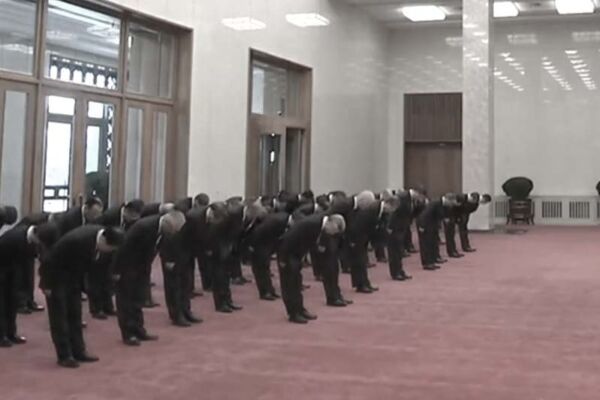
On December 22, the CCP military promoted Eastern Theatre Command Commander Yang Zhibin and Central Theatre Command Commander Han Shengyan to the rank of general. Observers were surprised to see that only four generals—Zhang Youxia, Zhang Shengmin, Liu Zhenli, and Dong Jun—attended the promotion ceremony, as seen in a CCTV broadcast. The previous promotion ceremony, held a year ago on December 23, 2024, had 20 generals in attendance. In just one year, 16 generals have been lost, resulting in an alarming 80% loss rate among generals, with combat losses surpassing any previous conflict in CCP history.
Recently, the Chinese Communist Party's National Defence Procurement Network publicly called for evidence of corruption within the Air Force. Reports suggest that Air Force Commander Chang Dingqiu has died, and Air Force Political Commissar Guo Pu is under investigation. The Air Force is expected to undergo a significant purge, following the example set by the Rocket Force. The military's anti-corruption campaign has revealed the harsh realities of power struggles within the armed forces and has considerably weakened the combat effectiveness of the Chinese Communist Party's military. The U.S. Department of Defence recently published a report on China's military capabilities for 2025, highlighting that since the latter half of 2023, the high-pressure anti-corruption environment within the People's Liberation Army (PLA) has intensified, with the Rocket Force and the Equipment Department identified as 'hard-hit areas.' This anti-corruption drive is highly likely to trigger shocks within China's nuclear forces and may raise concerns among the leadership about the troops' combat readiness.' Investigations and dismissals of senior generals are likely to lead to short-term impairments in the operational effectiveness of the PLA.'
These developments suggest that the recent decision to conduct military exercises in Beijing is not solely motivated by military factors but is also influenced by complex and significant international and domestic political considerations.
The goals of Beijing's military exercises are likely to be unmet.
While the Chinese Communist Party publicly asserts that these military drills serve as a deterrent against 'Taiwan independence' and foreign interference, a thorough analysis of Beijing's strategic anxieties indicates that the true objectives are multifaceted, reflecting a dual logic of confronting external challenges while ensuring internal stability.
First, the military exercises clearly aim to target Japan's encirclement and support strategy. As a crucial node in the first island chain of the U.S. military's forward base in the Asia-Pacific, Japan's Prime Minister Kishi Nobuo has stated that 'if Taiwan faces a crisis, Japan faces a crisis,' which has become a significant strategic concern for Beijing. The exercises are designed to emphasise a 'full-dimensional blockade', intending to test the Japanese authorities' response by surrounding Taiwan, which could provoke a counterattack from those coming to Taiwan's aid. However, this tactic by the Chinese Communist Party (CCP) seems somewhat self-indulgent; the international community has recognised that the CCP has the intent of a thief but lacks the courage to act. They are merely posturing for the domestic 'little pinks', constantly boasting about retaliating against Japan, but in the end, how will they justify their actions?
Secondly, the military exercises also serve as a challenge to the United States. The timing of these exercises closely follows the approval of U.S. arms sales, revealing an intention to confront Washington. This can be seen as a strong response to the U.S. Indo-Pacific strategy. However, this approach is unlikely to deceive Trump, who is not easily fooled. If Washington applies pressure through tariffs and technology restrictions, Xi Jinping will have to relent, especially since he is looking forward to Trump visiting Beijing next year to enhance his own standing.
Thirdly, the military exercises continue the intimidation of Taiwan. The unpredictability of the exercises and the full-scale blockade directly target the psychology of the Taipei authorities and the public, creating a sense of oppression from being 'surrounded', which undermines Taiwan's defence resolve. However, this tactic is also proving ineffective; Taiwanese media report that fishermen are continuing their fishing activities as usual, completely disregarding the military exercises, and are instead playing along with the CCP's 'fishing with bombs' game.
Ironically, shortly after the conclusion of the Taipei-Shanghai Twin City Forum and Jiang Wan'an's departure from Shanghai, the Chinese Communist Party (CCP) conducted military exercises. Just as the CCP had promised to promote peace and prosperity across the Taiwan Strait, it quickly resorted to military threats with its formidable naval forces. This contradictory behaviour has shocked the international community, and it seems that the Kuomintang (KMT) should take a moment to reflect on this situation.
Ultimately, these military exercises serve as a facade to mask the internal turmoil within the CCP's military. Anti-corruption measures have created a vacuum and decay at the upper echelons of the military, leading to a general decline in troop morale. The Rocket Force, Air Force, and Navy have all faced significant setbacks, particularly the key units tasked with operations against Taiwan. What resources does Xi Jinping have to confront Taiwan? This military exercise may be intended to distract from the internal power struggles within the military by showcasing a high-profile display of 'joint operational capabilities.' Moreover, as the CCP's economy falters and the public struggles to survive, an increasing number of netizens are expressing anti-communist sentiments. The CCP is under tremendous pressure to maintain stability, even going so far as to cancel New Year's celebrations, and these military exercises also aim to shift domestic focus and alleviate pressure.
The CCP has framed the exercises as a 'just mission,' attempting to incite nationalist feelings. However, this year, the Chinese public has completely lost faith in the government due to ongoing deflation, rising unemployment, and supply chain disruptions. Many netizens have expressed a desire for U.S. military intervention to help overthrow the oppressive regime. Additionally, some mainland netizens have boldly stated that, as one family across the strait, anyone who dares to invade Taiwan will find them standing in solidarity with the Taiwanese people in resistance.
(First published by People News) △





News magazine bootstrap themes!
I like this themes, fast loading and look profesional
Thank you Carlos!
You're welcome!
Please support me with give positive rating!
Yes Sure!