

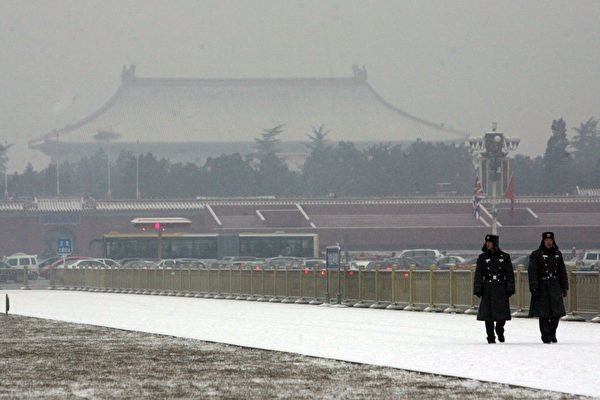
March 10, 2025, Beijing Great Hall of the People—A security guard stands at the entrance before the closing ceremony of the Chinese People&9;s Political Consultative Conference. (WANG ZHAO/AFP via Getty Images)
[People News] In accordance with tradition, the democratic life meeting of the Political Bureau of the Communist Party of China, scheduled for the end of 2025, was finally held from December 25 to 26. As the name suggests, a democratic life meeting should be a casual gathering for Political Bureau members to freely share their opinions and suggestions. However, the annual democratic life meeting of the Communist Party has turned into a showcase of dictatorial authority, where members take turns reporting their work to the party leader, competing to highlight their achievements and gain favour. This is followed by the party leader's evaluations and summaries, which often include criticism and admonitions. This year, however, the calls for intensified anti-corruption measures, stricter standards for party governance, and heightened political loyalty carry a clear sense of intimidation, presenting a performance of increased dictatorship and centralisation of power.
Initially, this year's democratic life meeting was seen as an opportunity to assess Li Xi's situation. Recently, there have been rampant rumours suggesting that he was implicated in the Ma Xingrui disloyalty case and was summoned for questioning or 'sent to the cold palace.' However, this meeting seems to have confirmed the rumours that Ma Xingrui is indeed in trouble, as he was absent once again, having missed four important meetings since July. Meanwhile, Li Xi's name has not appeared in any Communist Party news reports, and there are no written accounts about him. Among the seven members of the Standing Committee, it is noted that during the meeting, Zhao Leji, Cai Qi, and Ding Xuexiang left to attend the funeral of the vice-state-level official Peng Peiyun.
Nevertheless, it is clear that Li Xi is under significant pressure. The main focus of this meeting is to resolutely advance the anti-corruption campaign by doubling efforts in 2026, with a firm stance of 'not taking half a step back.' The stern anti-corruption messages delivered during the meeting seem to suggest something deeper. According to reports from party media, 'relevant parties made serious preparations' before the meeting; they 'persistently implement the spirit of the eight regulations... conduct self-examination, party character analysis, and engage in criticism and self-criticism'... Members of the Central Political Bureau spoke one by one, 'taking the lead in strengthening political loyalty'... and 'seriously identify and deeply analyse according to the Central Eight Regulations'...
Where is the atmosphere of democratic life in all of this? It feels more like a scene filled with tension: leaders must comply honestly in the coming year and must eliminate any disloyal thoughts from the depths of their souls; otherwise, Ma Xingrui serves as a cautionary example.
The specific content of the speeches made by the Political Bureau members remains unclear, but the emphasis of their remarks, as reported by Radio France Internationale based on party media, revolves around the concepts of 'loyalty' and 'awe.' Each member, while reporting to Xi Jinping, is expected to stress how they incorporate loyalty to the leader and respect for the leader into all aspects of their work.
Reports from party media outlets like Xinhua News Agency regarding the speeches of the so-called 'Political Bureau comrades' highlight the importance of leading the way in strengthening political loyalty, enhancing party character, and taking the lead in party governance... It is evident that the atmosphere is steeped in a sense of 'sternness.'
It is noteworthy that in recent years, the announcements made by the Communist Party of China (CPC) regarding officials at the deputy ministerial level and above who have been ousted often include charges of disloyalty to the Party. According to the CPC's established principles of 'two establishments' and 'two safeguards', disloyalty to the Party translates to disloyalty to Xi Jinping, which is considered the most serious accusation. Members of the Politburo are well aware of this.
What raises questions is why Xi Jinping, who holds the highest authority within the Party and possesses consolidated power, frequently emphasises the 'two establishments' and 'two safeguards' during various meetings. In the CPC's cultural narrative, there is often a tendency to vocalise what is lacking. Xi Jinping's insistence on loyalty in every meeting suggests that he is acutely aware of the insufficient loyalty from the entire Party towards him. His sense of security is lacking; despite having arrested numerous associates, his insecurity only deepens. The call to 'let Chairman Xi rest assured' has led to the question, 'How can he truly feel at ease?'
Reports indicate that during this session of the Politburo's democratic life meeting, a special Politburo meeting was also convened, primarily to 'study and deploy the Party's work on integrity and anti-corruption'. 'We must maintain a high-pressure stance against corruption... and must not allow corrupt individuals any place to hide; no one should entertain any illusions or hopes.' The meeting further reiterated, 'Put power in the cage of the system.'
In summary, it appears that the anti-corruption campaign is still being wielded as a tool to intimidate those present. In simpler terms, it is about confining disloyal individuals. The Politburo's democratic life meeting has effectively transformed into a stark display of dictatorial intimidation.
(People News first published)
△






News magazine bootstrap themes!
I like this themes, fast loading and look profesional
Thank you Carlos!
You're welcome!
Please support me with give positive rating!
Yes Sure!