
China
Popular news

The Fifth Plenary Session of the Communist Party of China Focuses on 'Party Governance' as Absolute Loyalty Faces a Dilemma
The Fifth Plenary Session of the 20th Central Committee of the Communist Party of China commenced today (26th) in Beijing.




Chinese Communist Party Petitioners on October 1: Without a Home, How Can There Be a Country?
October 1 marks the anniversary of the Chinese Communist Party's seizure of power. Despite the grand official celebrations, many people in mainland China feel their rights have been violated, stating, 'With no home, how can there be a country?' 'I am in despair and helplessness; what is there to celebrate?'

Chinese Communist Hackers Impersonate American AI Experts to Commit Fraud; Former White House Officials Nearly Fall Victim
The United States has recently discovered that the Chinese Communist Party is trying to sustain its competitiveness in the global AI race by stealing software, algorithms, and strategic intelligence, particularly under the constraints imposed by the United States on hardware (chips).

The Secret Telegram from the Grassland (Part 1): Mao Zedong's 'Darkest Hour'
Editor's Note: This article is an excerpt from 'Historical Notes', an unpublished work by renowned Chinese journalist Dai Qing, and is published exclusively by this station, with the title suggested by the editor. The text delves into the mystery surrounding the 'Secret Telegram from the Grassland' in the history of the Chinese Communist Party.
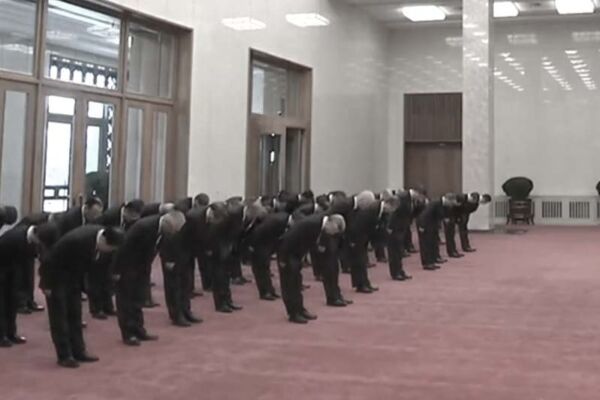
The Monument That Xi Jinping and Others Pay Tribute to Is Destined to Be Toppled.
On the morning of September 30, Xi Jinping, the leader of the Chinese Communist Party, led senior officials including Li Qiang and Zhao Leji to Tiananmen Square in Beijing to participate in the "Martyrs' Memorial Day" event and to pay respects at the "Monument to the People's Heroes."

Military Editorial Signals Move from Xi’s Leadership to Party Central Control
October 1 marks the founding day of the Communist Party of China (CPC) and is also a day of national mourning for the Chinese people. Regardless of how much the CPC celebrates and promotes its so-called achievements, it cannot conceal the harm it has inflicted on the Chinese populace over the decades, nor can it hide the substantial issues facing China's politics, economy, and society amid internal and external challenges.
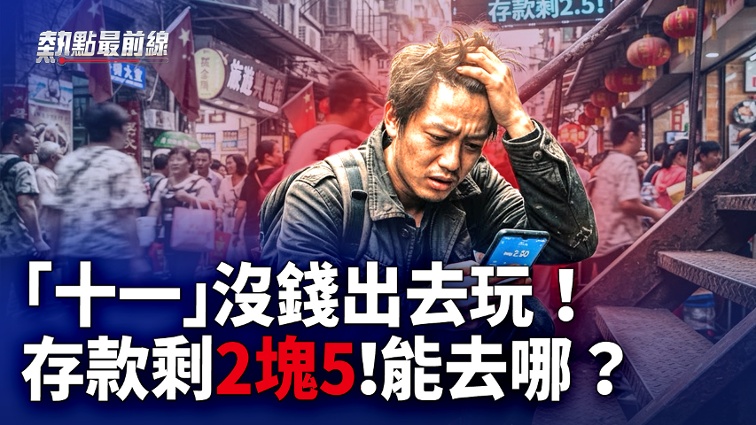
"Eleventh" Chinese People Collectively Cry Poor, Everyone Online Shouts About Lack of Money!
Today is September 30th in mainland China, and in just one day, the "Eleventh" long holiday will officially begin. With the holiday approaching, are you feeling the urge to go out and have some fun? Wait a moment. Before you head out, there’s one very important thing to do—open your banking app and check your balance.
When Will a Mother Smile? -- The Song That Made Liu Huan Famous, 'Youth......'
On September 25, 2026, at 9:52 AM, Liu Huan passed away in Shanghai at the age of 63. Coincidentally, this day fell on the Mid-Autumn Festival, the 15th day of the eighth month. The following day, the University of International Business and Economics, where he had taught for over thirty years, released an obituary stating that in accordance with his wishes, the funeral would be kept simple, without forming a funeral committee, and there would be no body farewell ceremony or memorial service.

From Xi's Visit to the U.S. and the Coma of Jie Lijian, Chairman of the International Democratic Alliance
Jie Lijian, the chairman of the International Democratic Alliance of China, protested following Chinese Communist Party leader Xi Jinping's visit to the U.S. On the afternoon of the 27th, he was out of contact for over 24 hours. When he was located, he was found to be in a coma and was urgently taken to the hospital for treatment.

Should Women Join the Standing Committee? 985 Professors on Xi’s Power
On September 29, the Beijing Institute of Technology released a 'Situation Report' indicating that the school had received information regarding issues related to teacher Pei Yi and had formed a special working group to investigate.

Pan Shiyi's Old Video Resurfaces Online, Igniting Debate Over His Political Stance After Returning to China
A video featuring Pan Shiyi speaking at a dinner has recently gone viral on social media platforms both in China and abroad. Pan Shiyi, the founder of SOHO China, has been residing in the United States for several years.

20 Students from Harbin Engineering University Punished for 'Climbing the Wall'
A recent disciplinary notice from the School of Mathematics and Science at Harbin Engineering University announced that 20 undergraduate and graduate students received warnings for accessing foreign networks using VPNs and other methods.

Pre–National Day Outrage: Public Demands Vacation Freedom
What you just heard were the grievances of Chinese netizens regarding the "adjusted holiday" just before this year's Mid-Autumn Festival and National Day. Even before National Day, the adjusted holiday had already sparked widespread criticism. However, this time is different; after voicing their complaints, the public has directly called for a boycott of consumption and urged the freedom to take vacations and travel. Freedom is precisely what the Chinese people are lacking.
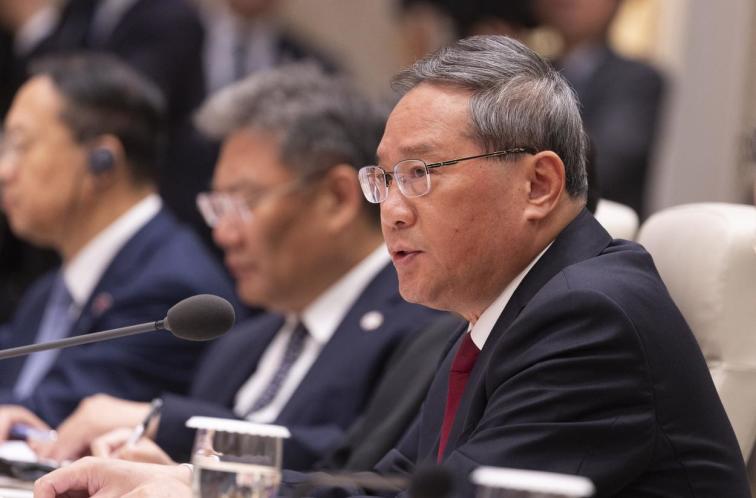
Zhao Yide Set to Lead CPC General Office, Fueling Speculation on Li Qiang’s Ambitions
Overseas commentator Jiang Wangzheng has disclosed that during the upcoming Fifth Plenary Session of the CPC in October, Chen Xiaojian, Zhang Shengmin, and Zhao Yide are expected to be added as members of the Politburo, with Zhao Yide taking on the role of Director of the General Office.

Chinese Communist Party Wealth Task Force Draws Criticism Over Officials’ Public Phone Numbers
Recently, the Chinese Communist Party in Changning, Hunan, and Habahe, Xinjiang, publicly released the personal mobile numbers of hundreds of party and government officials and department leaders.

Trump Proves the “Thucydides Trap” Is a False Proposition Through Strength
On September 24, Xi Jinping, in his speech at the welcoming ceremony held in the White House hall, stated: “When China and the United States cooperate, both benefit; when they fight, both suffer… Both sides must uphold the bottom line of no conflict and no confrontation, and are certainly capable of finding a correct way for two major powers on this planet to get along… The Thucydides Trap can be avoided.”

Xi Jinping Instructs to Speak with Chen Wenqing to Further Weaken His Power
Xi Jinping, who has just returned to Beijing from the distant United States, has issued new directives. On September 28, the Chinese Communist Party's Safe China Construction Work Conference convened in Beijing, where Xi's important instructions were conveyed, although it was not specified who delivered them.

What a Pity! While "Xi Jinping" Faces Vandalism Overseas, "Trump" is Seen as a Symbol of Wealth?
Xi Jinping, the General Secretary of the Communist Party of China, had just wrapped up his visit to the United States and returned to Beijing when South Korean media highlighted a significant incident: At around 2 a.m. on September 24, a Chinese restaurant named after "Xi Jinping" in Bundang, Gyeonggi Province, was broken into and vandalized with spray paint.
How Absurd It Is! A Day in the Life of a Small County-Level Official During the Xi Era
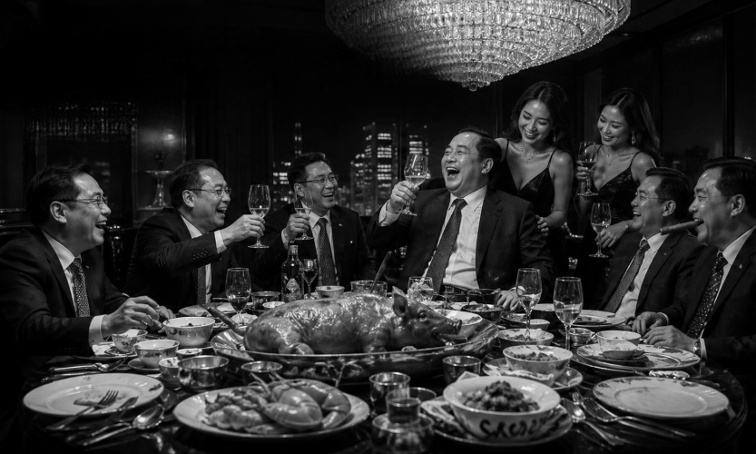
Since Xi Jinping took office, a so-called 'anti-corruption' campaign has been vigorously promoted. In the first decade of this campaign (from 2012 to just before the 20th National Congress of the CCP in 2022), nearly 5 million party members and officials at all levels were reported to have been investigated.

The CCP's Strategy for "Big Country External Propaganda" Has Backfired; Even With a Red Carpet, Xi Cannot Find a Reason to Smile.
One of the key objectives for Chinese Communist Party leader Xi during his visit to the United States was to utilize the coverage of mainstream American media to generate global support for the CCP and himself.

U.S. and China Issue Similar Summit Statements with Different Emphases
Following the summit this week at the White House between U.S. President Donald Trump and Chinese Communist Party leader Xi Jinping, there has been significant interest in whether any concrete results were achieved.