

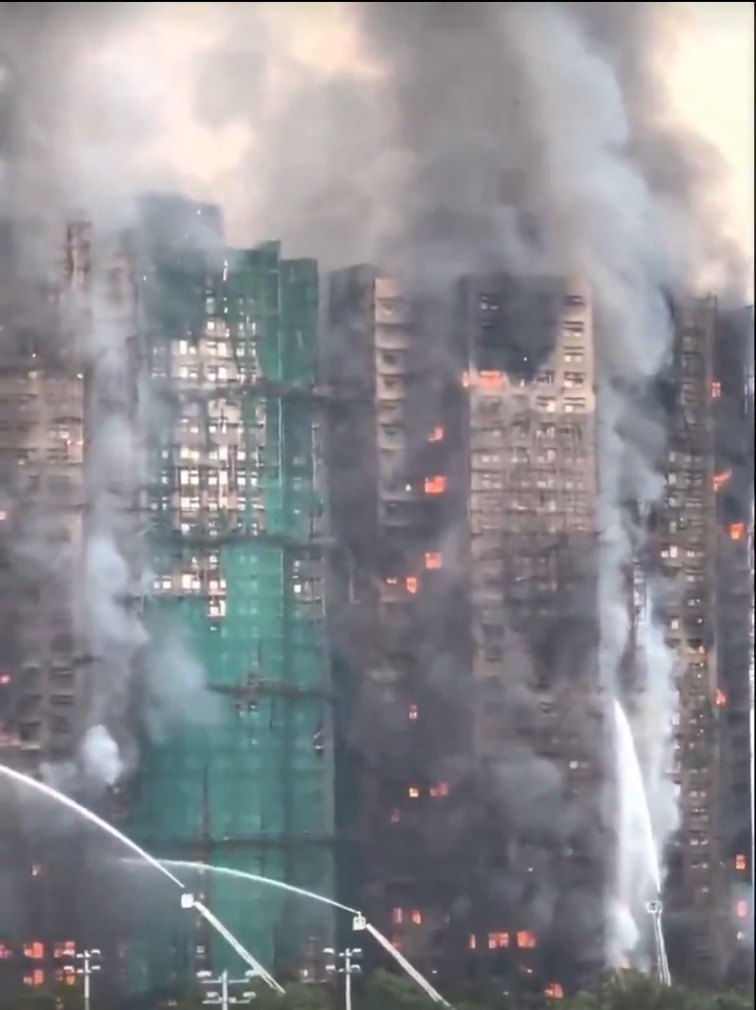
Hong Kong fire (Video screenshot)
[People News] The fire at Hong Fu Court in Hong Kong has drawn global attention, and now even more netizens are digging deeper. Independent media personality “01 Archives” located the initial ignition point: on the triangular, enclosed platform between the first and second floors of the “Hong Cheung House” building in the Hong Fu Court complex, across from Yuanzhouzi Park. Using March 2024 Google Maps images for comparison, 01 Archives found that at that time the building had not yet undergone repairs, and the images show the area clean and free of stored materials. Because of the fencing and the enclosed structure, ordinary people could not access it. After renovations began, the contractor sealed all corridor windows with foam panels, making it even harder for residents to access—and, as shown in the images, workers also had difficulty entering the area.

Ignition point. (Video screenshot)

Video screenshot
The triangular enclosed platform between the first and second floors of Hong Cheung House is the ignition point. The platform is walled on both sides, covered above by bamboo and wooden planks, and the central platform originally had nothing on it. So what exactly was burning before the fire?
Netizen “Heavenbeing Services” wrote on Facebook: What most confuses and terrifies everyone about the Hong Fu Court fire is how fast and how far the fire spread—far beyond imagination. From the moment the platform fire was discovered to the point the flames reached the top floors, it took only about ten minutes.
According to the video posted on Threads by user @striking_biking, one of the earliest callers to report the fire: he called the fire department at 2:51 a.m., when only the platform was burning. By 3:02 a.m., when firefighters arrived, the fire had already spread to the fourth floor.
Ordinarily, bamboo scaffolding—being solid wood-like material—burns in a gradual process. Many netizens have personally tested burning bamboo scaffolding and confirmed that the observed rapid spread in this incident does not match what citizens witnessed in videos.
During the fire, it became evident that the protective mesh fencing played a role in accelerating the flames. The foam sealant used by Hong Yip Construction to block the windows also contributed to the fire's spread. The chimney effect created by the building’s structure and the northeast wind further prevented the fire from being contained.
Another netizen, Jia Zhanghao of the “Chinese Film Discussion Society,” summarized the major fires in Hong Kong over the last three years on Facebook and discovered that since January 2025, there has been a major fire every month—almost all related to bamboo scaffolding used in building renovations. Listing bamboo scaffolding fire incidents from 2023 to 2025, he noted a significant increase in 2025.
2023:
-
Jan 13: San Po Kong industrial building exterior wall scaffolding, 3-alarm fire
-
Jun 11: Choi Hung Temple bamboo scaffolding fire
-
Jul 24: Hung Shui Kiu construction site scaffolding fire
-
Nov 2: Fortress Hill building exterior wall scaffolding fire
-
Nov 7: Kai Tak Yung King construction site scaffolding fire
-
Nov 7: Mongkok construction site scaffolding fire
2024:
-
Feb 3: Yau Ma Tei Maolin Street construction site scaffolding fire
-
Dec 25: North Point Kong Tao Hin exterior wall scaffolding fire
2025:
-
Jan 15: Kwun Tong industrial building scaffolding fire
-
Feb 3: Yau Ma Tei Maolin Street construction site scaffolding fire
-
Mar 25: Kai Tak Coordination Road construction site scaffolding fire
-
Apr 15: Tuen Mun Castle Peak Road bamboo scaffolding fire
-
Jul 26: Wan Chai King Sing Building exterior wall scaffolding fires at multiple spots
-
Oct 18: Central Winco Tower scaffolding fire
-
Oct 29: Kai Tak construction site scaffolding fire
-
Oct 30: HKU West Campus dormitory construction site scaffolding fire
-
Nov 26: Tai Po Hong Fu Court 5-alarm fire
From the records: 6 fires in 2023, 2 in 2024, and 9 in 2025—clearly more in 2025.
Jia Zhanghao said that to improve scaffolding fire safety, the Development Bureau had earlier met with industry representatives to discuss transitioning from bamboo scaffolding to metal scaffolding. The Buildings Department and others have required registered construction professionals and contractors to review documentation on scaffolding protection net materials and submit reports. Departments will conduct sample tests. They will also conduct batch inspections of existing buildings undergoing exterior wall repairs with scaffolding protection nets to test flame resistance or review related documents, again with sampling.
So was Hong Fu Court inspected? If the non flame-resistant and substandard materials had been discovered earlier, would such a major fire have occurred?
On the 27th, mainland WeChat public account “Niutanqin” published an article stating that Hong Kong has a “good record” in building safety but that this fire “was disappointing.” The author wrote that the mainland has basically replaced bamboo scaffolding with metal, while “Hong Kong is still using bamboo,” directly calling bamboo the reason the fire spread so fast. “Niutanqin” is the personal media account of Liu Hong, deputy editor-in-chief of Xinhua News. The article received over 100,000 reads on WeChat and was later reposted on multiple platforms such as NetEase. Now any commentary labeling bamboo scaffolding as backward is heavily amplified on the mainland.
In fact, the Hong Kong government has not stated that bamboo scaffolding caused the fire. It only emphasized that the foam panels sealing the windows were highly flammable and caused the mesh, the bamboo, and other materials to ignite. But on the 27th, the government did announce it would work with the industry to plan a roadmap for switching to metal scaffolding.
Worth noting: amidst online arguments, Hong Kong pro-establishment newspaper Ta Kung Pao published an investigative report on the 28th revealing “layers of hidden problems behind building repair scaffolding,” covering repair fees, bid-rigging collusion, and benefits transfers. But the article was taken down within a day without explanation.
Hong Kong netizens believe the removal shows that Hong Yip Construction and the Hong Fu Court owners’ corporation are unscrupulous profit-seekers, but the Buildings Department, which failed in oversight, is also a group of “bad actors.” And behind them is an even worse group cracking down on public discussion, preventing citizens from speaking up.
After the fire, 24-year-old student Miles Kwan distributed leaflets at a train station calling for accountability regarding the Hong Fu Court fire. However, according to local media, he was quickly arrested by Hong Kong national security police, and the petition he initiated was soon deleted. Since China imposed its strict National Security Law in 2020, Hong Kong has intensified its crackdown on political activity. The law was originally intended to address pro-democracy protests, but now Kwan is accused of being part of “anti-China forces,” and he and his friends are accused of “fueling social division and inciting hatred.”
Kwan and several fellow activists raised four main demands at the scene: government accountability, an independent investigation into possible corruption, appropriate resettlement for affected residents, and a review of construction supervision standards.
Kwan firmly believes the fire “was not an accident” but a man-made disaster.
Netizen Cc wrote on Facebook: According to Chinese law, an accident causing more than 100 deaths is defined as a “particularly serious accident,” and responsible officials must face severe punishment. Chief Executive John Lee and Security Secretary Chris Tang value Chinese national security and are very patriotic, so they should strictly abide by the “Production Safety Law of the PRC” and severely punish the relevant “main leaders” and “government department heads,” meaning the “Chief Executive” and “Security Secretary.” If Lee and Tang refuse to punish the “Chief Executive” and “Security Secretary,” then they are not patriotic! That would violate the principle of “patriots governing Hong Kong”!
Following the fire, former owners’ corporation member Wong Pik-kiu filed reports with the police and ICAC against current corporation members. She said the Hong Fu Court fire was a man-made disaster and that the current management body had been negligent.
It is easy to see that no matter how the CCP tries to silence the public, people from all walks of life in Hong Kong still want to speak out and seek justice for themselves and the victims.
AFP commented that the fire and the subsequent calls for accountability reveal deep dissatisfaction in Hong Kong society with government inaction. Although the current legal and political environment suppresses such demands, public protests and anger at injustice have not subsided.△




News magazine bootstrap themes!
I like this themes, fast loading and look profesional
Thank you Carlos!
You're welcome!
Please support me with give positive rating!
Yes Sure!