
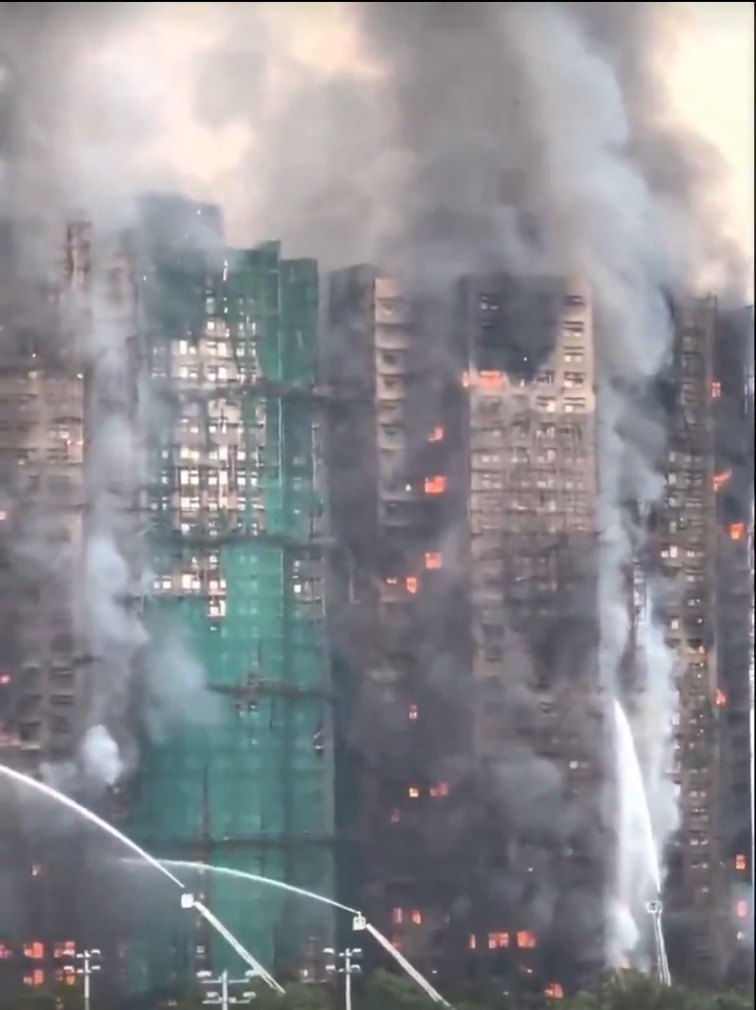
As of the evening of November 27, the fire at Hong Fuk Court in Tai Po, New Territories, Hong Kong, has resulted in 44 fatalities and 58 injuries. (Video screenshot)
[People News] In November 2025, under CCP rule both Hong Kong and the Chinese mainland played out two “physical elimination” scripts in succession.
One was a residential fire. In the early hours of November 26, 2025, a sudden, raging inferno at Hongfuyuan in Tai Po, Hong Kong, engulfed seven 31-storey residential towers. As of now, the level-5 fire has killed 128 people, left 200 missing, and reduced thousands of families to nothing overnight — the deadliest fire in Hong Kong in 77 years.
The other occurred on the evening of November 28 at the Bandai Namco Carnival 2025 event in Shanghai, when Japanese singer Maki Otsuki (Ōtsuki Maki) was suddenly cut off in mid-performance of the “One Piece” ending song and forced to leave the stage. Earlier that day, several Japanese artists, including Ayumi Hamasaki, had their concerts abruptly and roughly halted by Shanghai officials.
The first — the Hong Kong blaze — was a rare open-flame disaster that caused enormous social and ecological devastation. The second — the Shanghai “big fire” — was political cannon fire the CCP aimed at the international cultural community. Not only did it cause economic loss and psychological trauma to performers and fans, it also severely damaged cultural exchange between China and other countries and harmed the nation’s reputation.
Both fires are man-made disasters, and both point to the CCP as the perpetrator. They arise from the needs of totalitarian politics and the blunt force of power. These two successive “physical elimination” scripts burned the same kinds of things: the restraints on power, universal social values, the spirit of contract, and the public’s remaining trust in the CCP and its government.
Hong Kong government steers narrative, mainland-style emergency response model
Hongfuyuan is government-subsidized housing completed in 1983, located in Tai Po, comprising 1,984 units and housing thousands of low- and middle-income families; about 40% of residents are over 65.
Throughout the Hong Kong fire incident, many “CCP-style” formulas familiar to mainlanders appeared: the company involved had multiple violations in the past three years yet still won an overpriced construction contract; the owners’ corporation — advised by a pro-Beijing DAB councillor surnamed Wong — proceeded with work despite residents’ opposition; after the fire, building fire alarms failed to sound; within an hour the fire spread across five blocks, firefighters arrived 11 minutes after the fire was discovered, yet the blaze burned for 43 hours; the Hong Kong government immediately directed public opinion to blame bamboo scaffolding, but after the fire many bamboo scaffolds were merely blackened rather than reduced to ash.
Civic volunteers organized rescue and donated supplies, but a government-backed “care team,” escorted by police, drove away volunteers and seized civilian donations — taking photos for social media but doing no real work. Netizens posted photos of workers smoking at the site despite residents repeatedly warning against smoking. Residents had warned authorities multiple times since July 2024 that the protective nets on the scaffolding used allegedly flammable materials. Online evidence showed that one of the culprits, the scaffolding protection net used by the contractor Hong Kong Hung Yip Construction, had been tested and certified by a laboratory in Binzhou, Shandong, mainland China. The Hong Kong government arrested three contractors; official narrative emphasized “accident,” “rapid response,” and humanitarian aid, directly copying the CCP’s upbeat, “positive energy” funeral-style spin...
Because the Hong Kong fire was so horrific it drew global attention. Videos of buildings being consumed, of victims losing loved ones and becoming homeless, circulated wildly online. People worldwide felt deep sorrow; many offered assistance. Western media covered the event. Beijing seemed to sense something unsettling: when asked whether the garrison in Hong Kong planned to provide help, PLA Hong Kong garrison spokesman Jiang Bin publicly said the troops would act on orders — a statement heavy with the taste of stability maintenance.
Hong Kong after the National Security Law: political, economic, and livelihood triple collapse
In 2019 the CCP forcibly pushed the National Security Law into effect in Hong Kong, marking the city’s most tragic turning point. Hong Kong’s democratic and free institutions became hollow; Xi Jinping altered Deng Xiaoping’s “Hong Kong people governing Hong Kong” into “patriots governing Hong Kong.” Since then, the CCP’s party-over-everything governance model has seeped like a virus into Hong Kong’s social fabric. Not only are democratic elections a sham — one person, one vote amounts to a façade — Hong Kong’s economy and finance have rapidly declined: foreign capital fled, talent left in droves, with a net loss of 100,000 professionals by 2024.
In 2020, political decline plus the pandemic produced a GDP contraction of −6.54%; the economy has remained in contractionary or weak growth since. GDP growth in 2024 was 2.5%, still below pre-National-Security-Law levels. Hong Kong’s Hang Seng index fell from a 2021 peak of about 31,000 points to a 2022 trough of 15,000 points, then slowly recovered from 2023–2025 but has yet to return to its peak. As an international financial center once famed for efficient, clean public services, Hong Kong has seen rapid degradation in livelihoods under the combined pressures of the National Security Law, economic downturn, and uneven resource allocation. Housing, healthcare, social welfare, food safety, and public transport have all slid toward mainland-style conditions.
One key driver of this degradation is Hong Kong’s structural copying of mainland CCP methods. For example, in June 2025 Hong Kong’s government bottled-water procurement scandal erupted. In March 2025 the Government Logistics Department re-tendered contracts for bottled water supply to government departments. In June the contracts were awarded to “Xin Ding Xin Trading Co., Ltd.” (Hong Kong Island and some outlying islands), Watsons Group (Kowloon), and “Shi Mao International Co., Ltd.” (New Territories and some Lantau areas). The “Xin Le” brand bottled water supplied for Hong Kong Island by Xin Ding Xin’s manufacturer, Vitasoy (Lepur?), had been repeatedly exposed by mainland media in 2017 for microbiological exceedances. The incident raised concerns about Hong Kong food safety and eroded public trust in the government.
The Hongfuyuan fire burned people’s last hope and trust in the Hong Kong government — a collective trauma to the city’s spirit of freedom. Hong Kong, once an “Eastern Pearl” upheld by democracy, freedom, rule of law, and clean governance, now under the iron curtain of the National Security Law has become black grit in the ashes. Victims weep, collect water, search for relatives outside the ruins — scenes of pain that indict the city’s decline. People’s faces show unprecedented despair.
When hatred can’t be provoked, they cut the power — CCP’s “urban management” style foreign affairs shocks the whole internet
The CCP, adept at finding confidence in censorship, completely lost face in the face of Japan’s assertive Prime Minister Sanae Takaichi. External saber-rattling and whining to Trump didn’t work; domestic anti-Japan rhetoric also failed to stoke sufficient fervor. The CCP became stupid and enraged, producing an even more outlandish international scandal.
On the evening of November 28, Japanese veteran singer Maki Otsuki was performing the anime “One Piece” ending song “Memory” in Shanghai when the music abruptly stopped. Otsuki seemed stunned; two staff members rushed onstage, she stood with her mouth agape in shock, and was hurried off. The host announced the show was over. The organizers later said the performances scheduled for the 29th and 30th were canceled due to “force majeure.”
The incident exploded online. Netizens on bullet chats and Weibo said: “So disrespectful,” “So surreal,” “Either cancel beforehand or let the song finish — what are they thinking?” “They preach a good business environment but pull this,” “No contractual spirit,” “Maki was forcibly cut off mid-song — politics over everything, sigh.” That same day, famous Japanese singer Ayumi Hamasaki announced on Instagram that her Shanghai concert on the 29th would be canceled. She posted that the Shanghai production had involved some 200 staff from Japan and China and five days of stage setup, but that morning they were suddenly ordered to stop. A widely shared photo showed Hamasaki singing alone on an unfinished stage that night in what was said to be “an explanation to everyone”; some netizens said her voice could be heard outside the venue.
In normal interpersonal dealings, breaking a promise at the last minute is condemned as untrustworthy. For a great nation and an international metropolis to cancel two already approved, ticketed, and rehearsed performances at the last moment and cut power while performers are on stage — that international joke could only be pulled off by the CCP.
The CCP has extended its characteristic “chengguan-style” (urban management) governance into foreign affairs and international exchanges: failing to provoke hatred, it simply cuts power. Losing diplomatic face abroad, it turns to “political domestic violence” — taking out frustration on domestic fans and ordinary citizens. Hamasaki’s moonlit solo and Maki Otsuki’s onstage blackout — this anti-civilization, anti-universal-values totalitarian logic, this foolish hatred narrative — like the Hong Kong fire, infiltrates modern civilized society and completely crushes the public’s last sliver of trust in government. Such barbaric, almost absurd acts are declared the nation’s will, labeled “force majeure.” Netizens’ reactions expose the CCP’s “positive energy” packaging as completely busted.
The two fires trace a portrait of the CCP’s regime crisis
The Hong Kong fire and the concert power cuts together form a complete image: in Hong Kong, the CCP burned away the façade of “patriots governing Hong Kong” — mainland corrupt collusion between government, business, and construction seamlessly connects to Hong Kong, where patriotism is less important than the Hong Kong dollar; externally, the CCP tore up its civilized-nation image and demolished the last dignity of its domestic supporters — you no longer even have the freedom to attend a concert; if they decide to seize it, it is seized.
This is not a retreat of civilization but thugs wielding political clubs, firing the hatred engine to test obedience and dumb obedience into the humiliated. The world is not only aghast but fully awakened: this is not the mistake of a normal state — this is a national system working against civilization, contract, human commonsense, and universal values. Beneath a twenty-first-century civilizational veneer, it frantically resurrects the most primitive law of the jungle. That is precisely why the CCP has cut itself off from its people and isolated itself from the world; the regime crisis is intensifying in history’s destiny.
(First published by People News)
△





News magazine bootstrap themes!
I like this themes, fast loading and look profesional
Thank you Carlos!
You're welcome!
Please support me with give positive rating!
Yes Sure!