
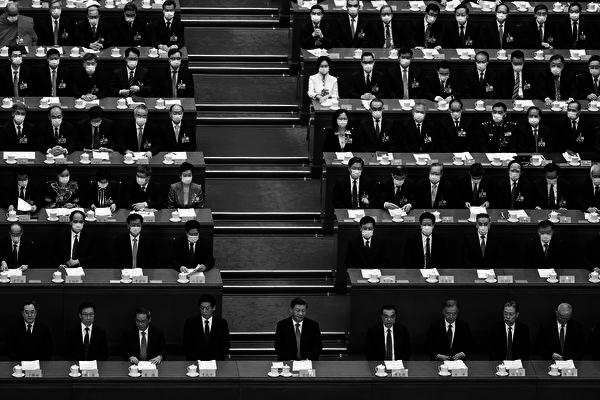
On March 5, 2023, CCP leaders attended the opening session of the National People's Congress.
[People News] On September 21, 2026, the Communist Party of China held a Political Bureau meeting chaired by Xi Jinping. The meeting announced that the Fifth Plenary Session will take place in Beijing from October 26 to 29, during which it will review the "Decision of the Central Committee of the Communist Party of China on Persistently Advancing Comprehensive Strict Governance of the Party on Several Major Issues."
The communiqué from Xinhua News Agency is highly structured, stressing the need to "maintain an unwavering strict tone," "enhance the comprehensive strict governance system of the Party," and "prioritize political construction." It calls on the entire Party to recognize the importance and urgency of consolidating its ruling position and achieving the great rejuvenation of the Chinese nation from a strategic perspective.
The Political Bureau meeting prior to the Fifth Plenary Session serves as a prelude and sets the tone; this is not a routine Party-building initiative but a political signal indicating a new round of high-level purges and power restructuring. The Political Bureau is sharpening its knives, laying the groundwork for the tumultuous events expected at the Fifth Plenary Session.
The aim of the Communist Party's "comprehensive strict governance of the Party" is not merely anti-corruption; it represents the latest manifestation of the brutal logic behind power struggles among the Party's elite. An analysis by the Taiwan Liberty Times indicates that approximately 19 members at the Central Committee level have already been removed or stripped of their qualifications as representatives of the National People's Congress, with military personnel making up more than half. Considering unusual dismissals and those who have been absent for an extended period, it is highly likely that nearly 30 individuals will be addressed at the Fifth Plenary Session. Key observation points for this session will include the vacancies in the Military Commission, the lack of military representation in the Political Bureau, and the replacement and disciplinary actions regarding Central Committee members.
Zhang Youxia, He Weidong, Li Shangfu, Miao Hua, Liu Zhenli, and other former high-ranking military officials have all been removed from their positions. Zhong Shaojun has been disqualified as a representative of the National People's Congress, and Zhou Hongxu, the director of the Central Guard Bureau, made a rare appearance at the BRICS meeting. The recent Politburo meeting has once again emphasized strict party governance as a key strategy from the Fifth Plenary Session, indicating that October in Beijing will likely showcase a bizarre and comprehensive purge surrounding the question of whether Xi Jinping can secure re-election at the 21st National Congress.
The anti-corruption campaign within the Chinese Communist Party's military has been exceptionally severe. Since the beginning of 2023, 57 generals have been implicated in scandals in just over three years. Those under investigation include Politburo members, Vice Chairman of the Military Commission Zhang Youxia and He Weidong, Military Commission members Li Shangfu, Miao Hua, Liu Zhenli, as well as commanders, political commissars, theater commanders, and senior officials from the Armed Police and National Defense University. Additionally, those who have 'disappeared' include personnel from the Joint Staff Department, Navy, Air Force, Rocket Force, Strategic Support Force, and various major theaters. Such a concentrated purge is unprecedented in the history of the Chinese Communist Party's military and is also extreme by global military standards.
The reasons behind this phenomenon are complex and multifaceted. During Jiang Zemin's tenure, there was rampant corruption within the military, characterized by the intertwining of power and personal interests. Jiang Zemin's influence within the military was deeply entrenched. After Hu Jintao's departure, Xi Jinping did not effectively inherit military power. In the early stages of Xi's leadership, his campaign against high-ranking officials, often referred to as 'tigers,' aimed at cleaning up Jiang's faction was primarily a strategy to solidify his own position, purge the previous regime, and consolidate power.
Miao Hua, despite being a direct subordinate of Xi Jinping's 31st Army, has leveraged his position as the director of the political department to select and appoint personnel within the military, thereby creating a significant sphere of influence for himself. Notably, He Weidong was also recommended by Miao Hua. When Zhang Youxia was targeted for purging by Xi Jinping, he made a daring move by acquiring evidence of disloyalty from both Miao Hua and He Weidong, which compelled Xi Jinping to eliminate his own trusted allies whom he had personally elevated.
The power struggles at the top of the Chinese Communist Party (CCP), whether stemming from the rivalry between Xi Jinping and Jiang Zemin or the internal conflicts within Xi's faction, are rooted in the party's combative nature and Xi Jinping's political regression. Xi's fixation on preserving the party has led him to place an excessive emphasis on political security and loyalty. This, combined with rampant political suspicion and governance failures, has compelled him to rely on political purges to assert his authority and maintain his grip on power. Following his third term, Xi has escalated these actions. In late January 2026, the sudden arrests of Zhang Youxia and Liu Zhenli were officially characterized as 'seriously violating the responsibility system of the Chairman of the Central Military Commission,' resembling an internal coup.
Xi Jinping's sense of crisis is constant; the belief that someone is plotting against him has never waned. His close aide, Zhong Shaojun, has been by his side for 22 years, having long held significant positions within the Military Commission's office and in reforming organizational structures, with personnel authority highly centralized. It is rumored that his power was ultimately reclaimed by Xi due to overlapping interests with Miao Hua.
As Xi's trusted allies continue to fall from grace, senior military leaders are left feeling vulnerable, uncertain if they will be the next target. The downfall of a high-ranking military official signifies the collapse of a faction, potentially implicating hundreds or even thousands of military cadres who may face purges. Currently, only Xi Jinping and Zhang Shengmin remain in the Military Commission. The potential entry of Zhang Shuguang, who was promoted to general in July and appointed Secretary of the Military Commission's Discipline Inspection Commission, into the Military Commission, as well as Zhang Shengmin's possible inclusion in the Politburo, will be critical points for external observers assessing Xi Jinping's military and administrative personnel strategies ahead of the 21st National Congress.
The harsh realities of power struggles are evident not only in the fall of military leaders but also in the security and personnel networks at the highest levels of authority. During the 'Mo-Xi Meeting' in New Delhi on September 12, 2026, Zhou Hongxu, the Director of the Central Security Bureau, made a rare appearance at the negotiation table dressed in a suit, positioned between the Deputy Minister and the Assistant Minister of Foreign Affairs. This is quite unusual in terms of diplomatic protocol, leading external analysts to speculate that Zhou may have been secretly promoted to Deputy Director of the Central Office while also retaining his role as Director of the Security Bureau. This action appears to be driven not only by the need to address unexpected situations in sensitive contexts but also by Xi Jinping's intention to demonstrate 'internal control and military leverage' to both domestic and international audiences.
Zhou Hongxu has a background in the 14th Group Army, which has historical connections to Zhang Youxia. He later joined the Central Security Bureau. Media commentator Du Zheng suggests that Zhou may have played a role in managing the unusual circumstances surrounding the death of his predecessor, Wang Shaojun, as well as the control operations against Zhang Youxia and Liu Zhenli in January 2026. In a one-man dictatorship, anyone can become a political tool, serving as an instrument for monitoring and executing power struggles.
Beyond the military, the organizational personnel system and local political circles are experiencing significant tension. Between late August and September 2026, Qin Weizhong, the former mayor of Shenzhen and an alternate member of the 20th Central Committee, unexpectedly resigned from his mayoral position to join the Standing Committee of the Guangdong Provincial People's Congress. He was later reported by independent commentator Cai Shenkun to have been taken away by the Central Commission for Discipline Inspection (CCDI). At just 55 years old, Qin Weizhong, a graduate of Tsinghua University's Department of Chemical Engineering, has had a long career in the energy sector and Guangdong's political landscape. He is considered to have connections to Chen Xi, the former Minister of the Organization Department and President of the Central Party School, who is associated with the so-called 'Tsinghua faction.' Following Chen Xi's departure from his roles at the Central Party School and the National Academy of Administration in June, rumors about him have proliferated. On August 17, during a commemorative event for Jiang Zemin's birthday, his expression was described as blank, which was interpreted as a sign of sensing danger, reminiscent of Ma Xingrui's visible tension and frustration during last year's September 3 military parade at Tiananmen.
Around September 1, even more shocking rumors emerged regarding Chen Xi. Reports circulating online suggested that he was being escorted for detention by the newly appointed deputy secretary of the CCDI, linked to the case of Jiangxi Province Governor Ye Jianchun, who was arrested and provided incriminating information. Ye Jianchun has been accused of 'nepotism corruption,' 'bureaucratic corruption,' and 'family-style corruption,' and his wife was also taken into custody. Ganzhou, a key rare earth hub, has been alleged to be under the influence of officials from the Fujian faction at Chen Xi's direction, with their power extending into critical enterprises. While these claims have not been officially confirmed, when considering Qin Weizhong's unusual personnel changes, the prior investigations into senior officials at Shenzhen Metro and Vanke, and the long-term scrutiny of Chen Xi's personnel arrangements related to the 'Fujian faction,' it appears that signs of a cleanup in the organizational system are beginning to surface ahead of the Fifth Plenary Session.
The intense pace of the anti-corruption campaign reflects a self-cleansing process within the power structure of the Chinese Communist Party (CCP). The political purges and power struggles within the CCP's organizational framework are systemic. He Weidong, Miao Hua, Zhong Shaojun, Ma Xingrui, and Chen Xi are all trusted allies who were either personally promoted or exceptionally elevated by Xi Jinping, yet they ultimately fell from grace due to disloyalty or possessing too much knowledge. This is a never-ending devil's game. The Politburo meetings are preparing for conflict, and the upcoming Fifth Plenary Session is sure to be tumultuous. When the slogans of 'self-purification, self-improvement, self-reform, and self-enhancement' are repeatedly emphasized by the authorities, it signals that the regime itself is nearing its end, unable to engage in any meaningful governance, simply waiting for its downfall.
(First published by People News) △





News magazine bootstrap themes!
I like this themes, fast loading and look profesional
Thank you Carlos!
You're welcome!
Please support me with give positive rating!
Yes Sure!