
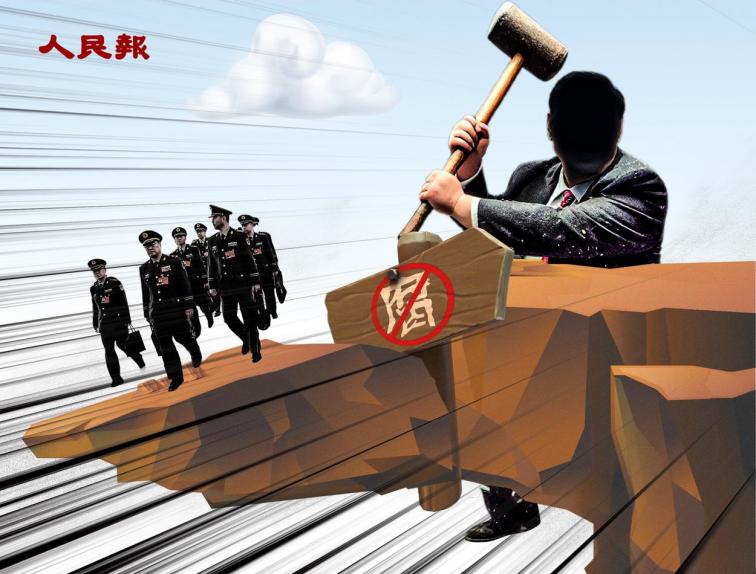
Xi Jinping’s Central Committee and the Military in Fierce Infighting (Graphic by People News)
[People News] The Chinese Communist Party (CCP) is set to convene its 21st National Congress next year. Despite having a year and a half until the event, the political landscape is already marked by turmoil and unpredictability. Xi Jinping, as the instigator and chief strategist of the internal power struggles within the CCP, has frequently called for self-revolution during major meetings to safeguard his position for a fourth term. This has resulted in a continuous wave of officials being ousted from the party's bureaucratic ranks.
Interestingly, there has been a recent surge in the deaths of high-ranking officials within the CCP, which has coincided with the ongoing wave of officials being removed, creating a disturbing tableau of chaos and bloodshed.
On July 17, Shen Desheng, the Secretary of the Liao Yuan Municipal Committee in Jilin Province, unexpectedly passed away due to illness in the early morning at the age of 56. According to the WeChat public account 'Liao Yuan Release', the mourning work team for Comrade Shen Desheng announced on July 17 that he suddenly fell ill on the morning of July 17, 2026, and died in Liao Yuan after unsuccessful rescue efforts. The announcement stated that, in accordance with the family's wishes, the funeral would be kept simple.
The official announcement was concise and did not provide details on the cause of death, medical condition, or history, nor did it elaborate on the rescue efforts. However, the timeline is clear: he fell ill suddenly in the early morning and died after unsuccessful attempts to save him. Domestic media reported the news after eleven o'clock in the morning, suggesting that his condition was extremely critical and without hope. Furthermore, the official mourning process was remarkably swift, with the announcement being made almost immediately, and the family expressed their desire for a simple funeral right away. Notably, the official used the term 'passed away' instead of the more commonly used 'departed'.
Shen Desheng had a long career in the tax system and party and government departments of Jilin Province, where he held various positions, including deputy director of the Jilin Provincial Local Taxation Bureau, a member of the Standing Committee of the Jilin Municipal Committee, and vice mayor. Since January 2023, he has served as the secretary of the Liaoyuan Municipal Committee. His last public appearance was on July 13, when Liaoyuan issued a red alert for mountain floods, and he led an overnight video conference on flood prevention for the city.
Analyzing the limited information reported by mainland media, the official obituary mentions 'deceased,' which may suggest deeper implications. It is possible that Shen Desheng died from overwork. However, someone who reaches the level of municipal committee secretary in the Chinese Communist Party (CCP) typically wields considerable influence and power in their region and should have support from both the provincial government and central authorities. If he was successful in life, he would be expected to receive posthumous honors. Yet, the rapid and definitive announcement of his death raises questions, indicating a hasty conclusion that may conceal hidden circumstances and political secrets. Shen Desheng's career in the bureaucratic landscape is likely intertwined with the common narratives of corruption, bribery, and transactions involving power and money that are prevalent in the CCP. Further developments will need to be monitored.
On July 15, 2026, just two days ago, Huang Ruixue, the Vice Governor of Sichuan Province, Secretary of the Party Committee of the Provincial Public Security Department, and Director of the Department, tragically passed away at the age of 54 after suddenly falling ill, despite rescue efforts. However, an alternative narrative has gained significant traction overseas, suggesting that Huang Ruixue committed suicide in her office after attending a national meeting of public security bureau directors organized by Wang Xiaohong. This line of reasoning implies that Huang's death is closely tied to political power struggles. Some commentators abroad have pointed out that Huang Ruixue was associated with Zhao Kezhi, the former Minister of Public Security of the Communist Party of China. Originally from Jiangxi, Huang had a long tenure in the Ministry of Public Security. From 2020 to 2022, she served as the Director of the General Office of the Ministry, during which Zhao Kezhi was the Minister. Zhao has a strong connection with Wang Qishan. In June 2022, Huang was reassigned to Gansu as the Director of the Public Security Department. Following the investigation of Ye Hanbing, Huang was transferred to Sichuan in July 2025 to take on the role of Director of the Public Security Department. This outcome has occurred merely a year later. Recently, rumors have circulated that Wang Qishan has been implicated due to his involvement in Zhang Youxia's failed anti-Xi actions and has since been placed under house arrest by Xi Jinping.
The various systems within the Chinese Communist Party's (CCP) ruling apparatus function like different-sized meat grinders. Once caught up in them, whether you are a mere cog or a key component, the inevitable outcome is to become expendable. For officials who find themselves deeply embroiled in the CCP's internal power struggles, death may emerge as the most readily accepted and beneficial solution for all parties involved at critical junctures. In recent years, there have been numerous instances of officials in the CCP 'suddenly passing away,' including Ren Xuefeng, the Deputy Secretary of the Chongqing Municipal Committee, Liao Guoxun, the Mayor of Tianjin, Yu Jianhua, the Director of the General Administration of Customs, and Zhang Anjiang, the Deputy Mayor of Chongqing and Director of the Public Security Bureau. Official announcements have consistently described these incidents as 'unfortunate passings,' a phrase that invites reflection. These officials have been accused of being entangled in factional struggles within the party, leading to forced suicides, such as jumping from buildings, or actively or passively choosing to end their own lives to resolve the complex political interests at play. The death of Huang Ruixue highlights the increasing frequency of profound tremors within the bureaucratic system, driven by Xi Jinping's ongoing political purge.
Accompanying the wave of deaths is an unending tide of officials being ousted. Since Xi Jinping took office in 2012, anti-corruption has been established as the most crucial means of governance. According to incomplete statistics, over the past decade, the number of officials at the ministerial level and above who have been dismissed has reached as high as five to six hundred, while the number of local officials at the departmental level and above under investigation may have reached millions. No one has been spared, from members of the Politburo Standing Committee at the national level to vice-ministerial Politburo members, vice-chairmen of the Central Military Commission, and military commission members, down to officials at the bureau and division levels. On January 24, 2026, the news that Zhang Youxia, vice-chairman of the Central Military Commission, and Liu Zhenli, chief of the joint staff of the military commission, were under investigation for serious violations of discipline and law sent shockwaves both domestically and internationally.
Zhang Youxia, a member of the 'red second generation' and a close confidant of the Xi Jinping family, was once seen as one of Xi Jinping's most trusted military allies. He worked to eliminate obstacles within the military to support Xi Jinping's re-election. However, Zhang Youxia broke the age limit by remaining in his roles as a member of the Politburo and vice chairman of the Central Military Commission, which Xi Jinping perceived as a significant threat to his lifelong rule. Motivated by his ambition for lifelong power, Xi Jinping began to orchestrate a political attack against Zhang Youxia, dismantling the senior leadership of Zhang's faction in the Rocket Force and capturing Li Shangfu and Wei Fenghe. In a natural counteraction, Zhang Youxia retaliated by eliminating Xi Jinping's direct military affiliates, including He Weidong and Miao Hua. Subsequently, with strong support from Cai Qi and Wang Xiaohong, Xi Jinping unexpectedly arrested both Zhang Youxia and Liu Zhenli. At this juncture, the power struggle surrounding Xi Jinping's personal authoritarianism escalated uncontrollably. In June 2026, the Standing Committee of the National People's Congress announced the disqualification of 15 national representatives, including former Xinjiang Party Secretary Ma Xingrui, high-ranking Politburo officials, and six military generals: Air Force General Xu Xueqiang, Colonel Guo Pu, Army General Li Fengbiao, and Lieutenant Generals Wang Kangping, Zhang Minghua, and Yin Hongxing. On July 15, former Deputy Minister of the Propaganda Department Cai Fuchao was officially reported to have fallen from grace. Commentator Cai Shenkun revealed that the reason for Cai Fuchao's downfall was his son's involvement in anti-Xi activities, as he had previously acted as a messenger between Wang Qishan and Zhang Youxia. While the authenticity of this information remains unverified, the opaque politics of the Chinese Communist Party and the brutal power struggles are undeniable realities.
Xi Jinping's anti-corruption campaign has never been aimed at addressing the rampant corruption within the decaying officialdom, curbing the abuse of power for personal gain, combating misconduct, or restoring the sharply declining credibility of the government. Instead, it is entirely motivated by the political necessity of consolidating personal authoritarian power. The political mobilization logic that has been in place since Deng Xiaoping's reform and opening up, which focuses on 'economic development' and the sharing of power and interests among elites, has been completely overturned and discarded by Xi Jinping. Under his leadership, loyalty has become the only standard for evaluation, and any potential dissenters are within the effective range, becoming precise targets for attack. Regardless of how trusted or close they once were, once they trigger Xi Jinping's suspicions or enter the leader's field of distrust, they can quickly shift from honored guests to prisoners.
This brutal governance is deeply undermining the operational order and developmental ecology of the entire Communist Party's officialdom. Officials are generally adopting a 'lying flat' approach and passively resisting. The execution capability at the grassroots level has collapsed, middle management is hesitating and observing, and the upper echelons are caught in endless infighting. During Xi Jinping's visit to Shanghai for the World Artificial Intelligence Conference in 2026, the entire city was on high alert: drones were banned from flying, roads were closed, traffic was controlled, windows facing elevated structures had to be closed and locked, and public gatherings and photography were prohibited. Even the delivery of kitchen scissors was suspended. This heightened state of security, where every tree and bush seems like a potential threat, reveals the profound sense of insecurity under authoritarian rule.
The recent wave of deaths reflects the extreme survival instincts of officials under intense pressure. For some, choosing to die to preserve their reputation and protect their family's assets has become the best option. As we look forward to next year's 21st National Congress of the Communist Party of China, a more severe storm of bloodshed and chaos has quietly begun. On the eve of the Beidaihe meeting, rumors surrounding the Zhang Youxia case, which implicates the 'red second generation' including Wang Qishan and Zeng Qinghong, have been rampant, with military officers above the rank of colonel undergoing thorough scrutiny. The entire bureaucratic system is gripped by anxiety and fear. The domino effect of Xi Jinping's campaign to 'cripple tigers and scare flies' is swiftly dismantling the bureaucratic order and governance structure that the Communist Party has built over the past century. This relentless pursuit may lead to an irreversible and profound crisis of power for the Communist Party.
Historically, power maintained through fear and purges has proven difficult to sustain over time. While Xi Jinping has centralized power under the pretext of anti-corruption, he has simultaneously dismantled the bureaucratic system, undermining the foundational support for the Communist Party's rule. The ultimate outcome of this political drama will not only involve high-level power struggles but will also significantly influence China's future political trajectory and social stability.
(First published by People News)△






News magazine bootstrap themes!
I like this themes, fast loading and look profesional
Thank you Carlos!
You're welcome!
Please support me with give positive rating!
Yes Sure!