
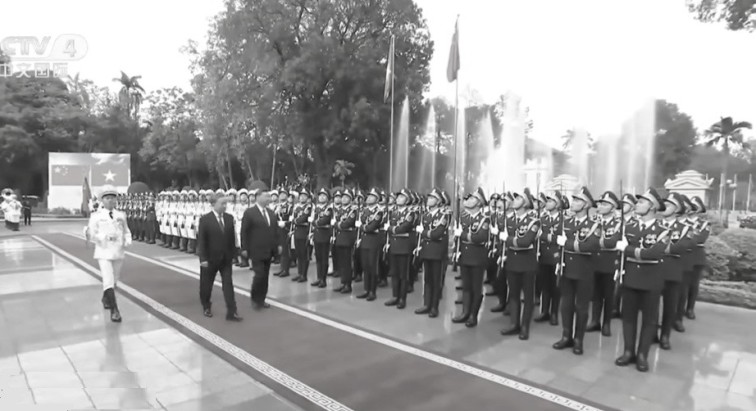
On April 14, 2025, CCP leader Xi Jinping paid a state visit to Vietnam. In a video still, he can be seen walking with stiff legs and short, shuffling steps while inspecting the Vietnamese honour guard at the airport. (video screenshot)
[People News] On March 16, the inaugural ministerial meeting of the China-Vietnam diplomatic, defence, and public security '3+3' strategic dialogue mechanism took place in Hanoi, the capital of Vietnam. The meeting was co-chaired by Chinese Foreign Minister Wang Yi, Defence Minister Dong Jun, and Public Security Minister Wang Xiaohong, alongside Vietnamese Foreign Minister Bui Thanh Son, Defence Minister Phan Van Giang, and Public Security Minister To Lam. Both Xinhua News Agency and Vietnam News Agency covered the event, but their reports revealed notable differences, particularly in three key areas.
Firstly, the Vietnamese side emphasised political mutual trust, whereas the Chinese side focused solely on enhancing military security mutual trust.
In the report from the Vietnam News Agency, the opening paragraph highlights the dialogue mechanism's role in 'enhancing political mutual trust.' The second paragraph reiterates that both sides agreed that the two countries should strengthen unity and cooperation, consolidate political mutual trust, coordinate development and security, adhere to the socialist path, and collaborate with the international community to address the increasingly urgent common challenges of security and development based on international law and the United Nations Charter.'
Additionally, the report notes that 'the Vietnamese ministers suggested that the diplomatic, defence, and public security departments of both countries work together to enhance political mutual trust and take the lead in implementing high-level consensus.'
In contrast, the first paragraph of the report from the Chinese Communist Party (CCP) media highlights that both sides centred their discussions on the theme of 'coordinating development and security, following the socialist path, and working together to tackle common challenges.' They engaged in an in-depth exchange of views on issues such as the evolving international situation, maintaining political security, and conducting defense law enforcement cooperation. Notably, the CCP intentionally overlooked 'political mutual trust' while emphasising the 'political security' that the Vietnamese side seemed to neglect.
Within the CCP report, one point made while summarising General Dong Jun's speech was the need to 'continuously enhance military security mutual trust.' Another point, when introducing the Vietnamese side's perspective, indicated that the Vietnamese believed the dialogue mechanism demonstrated the special friendly relationship between Vietnam and China, high political mutual trust, and close strategic ties.'
The expressions regarding 'political mutual trust' from both China and Vietnam are evidently different. From Beijing's viewpoint, there exists 'high political mutual trust' between the two nations, and 'political mutual trust' is not seen as an issue. However, the Vietnamese side's three references to it clearly indicate that it is indeed a concern. The source of the Vietnamese dissatisfaction can be traced back to July 2024.
At that time, just as the Third Plenary Session of the CCP was concluding, news unexpectedly emerged that Xi Jinping had suffered a stroke. On July 19, the Vietnamese government announced the death of General Secretary Nguyen Phu Trong. Xi Jinping, who had claimed to have a 'close relationship' with Nguyen Phu Trong and had established a deep comradeship bond, broke with tradition by not sending a condolence message to the Communist Party of Vietnam, with only the Central Committee of the CCP sending a message. This action was quite perplexing and represented a significant breach of diplomatic etiquette.
It seems that after realising the inappropriateness of the situation from external reports, Xi Jinping personally visited the Vietnamese Embassy in China to pay his respects on the afternoon of July 20, around 4 PM. However, the differing photos released by both China and Vietnam have led to significant scepticism from observers, suggesting that the Xi who attended the memorial was a stand-in. At this point, the Chinese Communist Party (CCP) may have provided the Communist Party of Vietnam (CPV) with a genuine explanation, and with the CPV's cooperation, concealed the truth about Xi's stroke.
From the CPV's perspective, this situation represents not only a diplomatic blunder but also a lack of political mutual trust. Following this, the fluctuations within the upper echelons of the CCP, including the investigation of Zhang Youxia, the Vice Chairman of the CCP's Central Military Commission, who had previously received high-level receptions from the CPV, raise questions about how much information the CCP actually shared with the CPV. However, the repeated emphasis on 'political mutual trust' from Vietnam indicates dissatisfaction with the CCP's communications, while the CCP remains reticent on the issue. This is partly because the topic is sensitive for the two kings and one director, and partly because Wang Yi and others are not in a position to discuss it further without Xi's approval.
Merely enhancing military mutual trust is insufficient for Vietnam. The dissatisfaction expressed by Vietnam suggests that beneath the surface of friendly relations between China and Vietnam, both sides have their own agendas, and the underlying rifts have always been present.
2. China is highly concerned about political security, while Vietnam tends to downplay it.
In the reports from the Chinese Communist Party (CCP), the first paragraph highlights 'political security,' a term notably absent from the Vietnamese reports. Subsequently, while covering Wang Yi's statements, the term reappears, indicating that the mechanism 'aims to maintain the security of the political system and deepen strategic cooperation.' When discussing Wang Xiaohong's speech, there are further assertions stressing the importance of 'prioritising political security and better preventing and resisting 'colour revolutions.' Additionally, Dong Jun remarked that the CCP 'faces unprecedented external security risk challenges,' and that the militaries of China and Vietnam 'bear the significant responsibility of consolidating the Party's long-term ruling position and safeguarding the socialist red territory... working together to build a robust defence security barrier.'
The three high-ranking CCP officials participating in the dialogue mechanism all prioritised 'political security' in their speeches, suggesting that the top leadership of the CCP is indeed on high alert, deeply concerned about the possibility of public uprisings similar to those in Iran and Cuba, and fearful of losing power.
In contrast, the Vietnamese reports did not emphasise 'political security' in the same way as the three CCP officials. The statements regarding the three CCP ministers indicated that 'the Chinese side values and is willing to collaborate with the Vietnamese side to implement the high-level consensus... firmly safeguarding each country's security and development interests'; 'the Chinese ministers highly appreciated the Vietnamese side's suggestions and unanimously agreed to closely cooperate... to ensure the maintenance of political security.' Meanwhile, the three Vietnamese ministers expressed their 'support and willingness to participate in the Chinese side's initiatives on development, security, civilisation, and global governance when appropriate.'
The Vietnam News Agency reported that several ministers have suggested "strengthening information sharing and exchanging experiences regarding the security of protection systems, as well as macro national security aspects such as energy security, environmental security, information security, and data security." This seems to indicate an intention to break down "political security" into specific areas of security.
It is evident that the concept of "security" articulated by Vietnamese ministers differs from the "political security" discussed by Chinese Communist Party (CCP) ministers. The latter is primarily concerned with whether the CCP can maintain its grip on power, while Vietnam appears to have significantly less concern in this regard.
This difference stems from the fact that over the past decade, Vietnam has made substantial improvements in people's livelihoods and granted greater freedoms through more robust political and economic reforms. Additionally, improved relations with Western countries have greatly enhanced Vietnam's living standards and international standing compared to the past. In contrast, the CCP has adopted a more closed and controlling approach, resulting in a significant loss of public support. The differing priorities of China and Vietnam also reflect their distinct circumstances.
Furthermore, while the Chinese side repeatedly emphasises the importance of "following the socialist path," the Vietnamese side tends to downplay this notion.
In the official media of the CCP, Wang Yi stated that the dialogue mechanism "is not only essential for advancing the construction of a China-Vietnam community of shared future but also a necessary step to revitalise the global socialist cause." He also made the unfounded claim that, amidst the current global turmoil, "the cause of socialism with Chinese characteristics is making significant strides forward." He further asserted that "the stability and development maintained by both China and Vietnam will showcase to the world the notable advantages of the socialist system, the vibrant vitality of the socialist cause, and the promising prospects for human development and progress."
Wang Xiaohong emphasised that the public security departments of both countries should "better serve the socialist cause of both nations," while Dong Jun asserted the need to "defend the socialist red territory."
In contrast to the three ministers from the Communist Party of China, who appeared overly enthusiastic in their attempts to demonstrate the so-called "positive momentum of socialist development," the Vietnam News Agency only referred to the Chinese minister's comments as "steadily advancing the socialist cause under the Party's leadership." This suggests that Vietnam is cautious about being ideologically bound to the Communist Party of China.
Additionally, while Vietnam continues to prioritise its relationship with China, it consistently emphasises an "independent, autonomous, self-reliant, diversified, and multilateral foreign policy, along with the 'Four No's' defence policy." Vietnam has expressed its willingness to "support and participate in China's initiatives on development, security, civilisation, and global governance under appropriate circumstances." It is important to note the phrase "under appropriate circumstances," which indicates that Vietnam does not intend to fully align with the Communist Party of China and may choose its own stance at times.
On the same day, Nguyen Phu Trong, General Secretary of the Communist Party of Vietnam, met with Wang Yi, Dong Jun, and Wang Xiaohong. The Vietnam News Agency reported that Nguyen Phu Trong suggested that both sides manage and resolve maritime disputes based on high-level consensus, adhering to international law and the 1982 United Nations Convention on the Law of the Sea, and addressing differences peacefully. The three officials expressed their agreement with Nguyen Phu Trong's important guidance and reiterated that China always considers Vietnam a priority in its peripheral diplomacy. However, the Chinese side did not mention this meeting.
In light of the analysis above, the author posits that as the Chinese Communist Party (CCP) observes its 'old friends' being arrested and killed one after another, particularly with the potential for regime change in Cuba, the leadership of the CCP is not only focused on consolidating its power but also aims to uphold its status as a regional power. Consequently, fostering a strong relationship with Vietnam, which shares similar ideological beliefs, is a logical choice. However, given the significant shifts in the global landscape and the advantages Vietnam has experienced from friendly relations with the United States, will Vietnam comply with the expectations of Beijing's Zhongnanhai?
(First published by People News) △





News magazine bootstrap themes!
I like this themes, fast loading and look profesional
Thank you Carlos!
You're welcome!
Please support me with give positive rating!
Yes Sure!