
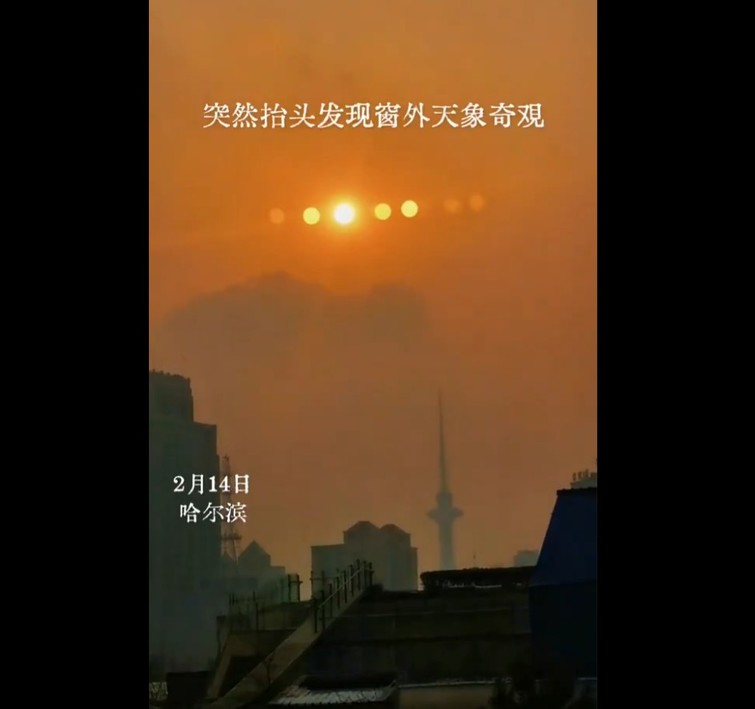
On the afternoon of February 14, a remarkable solar phenomenon was observed in the sky over Harbin. (Video screenshot)
[People News] The renowned British prophet Parker released a video on December 30 of last year, predicting the fortunes for 2026. He stated that 2026 will be a year of reckoning, where many lies will be uncovered, numerous lawsuits will emerge, and many truths will be revealed. The pivotal moment is expected to occur in February. The Chinese New Year also falls in February, and following the New Year, it will mark the disaster year of the 'Year of the Red Horse' as foretold in Chinese prophecies, which aligns with his observations. He mentioned the possibility of an accidental collision involving two aircraft or two submarines in the Taiwan Strait, which could serve as a catalyst for escalating tensions in the region, potentially drawing in Japan. However, he believes that this conflict will not lead to Taiwan's annexation; instead, it will signal the beginning of a 'glacial collapse' of the Chinese Communist Party (CCP) regime.
As of February 14, just before the Chinese New Year, unusual phenomena have been reported across China. For example, multiple suns were seen in Harbin, while Beijing experienced a solar halo. Historically, such celestial events have been interpreted as ominous signs, indicating that a dynasty may be on the verge of collapse.
On the afternoon of February 14, a netizen from Harbin shared a video claiming that he suddenly looked up to see several suns in the sky above Hongbo Central Park, asking, 'Can anyone explain this to me?'
'What is happening here?' a man filming the video said while standing by the window, 'Why are there so many suns?'
Video footage reveals the appearance of seven suns in the sky, with the third sun being the most dazzling, while the other three are also quite bright, and the remaining three suns only cast faint shadows.

On the morning of February 15, 2026, a halo was observed in the sky over Beijing. (Screenshot from the internet)
On that morning, an unusual phenomenon was also reported in Beijing. According to the Beijing Youth Daily, a large, colourful halo surrounded the sun, drawing many citizens to stop and take photos.
Ancient Chinese philosophy emphasised the unity of heaven and humanity, suggesting that phenomena like 'multiple suns competing for brilliance' and 'solar halos' often reflect changes in the human realm. In ancient China, a 'solar halo' was also known as a 'white rainbow,' typically foretelling military upheaval and instability within dynasties.
The phenomenon of 'multiple suns competing for brilliance' is regarded as an ominous sign. An old saying states, 'Since ancient times, there have been no two suns in the sky.' The presence of multiple suns indicates disputes over leadership.
Ancient Chinese texts such as 'Jingfang's Divination,' 'Spring and Autumn Weft,' and 'Records of the Jin Dynasty: Astronomical Treatise' document and interpret the phenomenon of 'multiple suns competing for brilliance,' suggesting it signifies 'war rising in the world, lords competing,' 'the instability of royal power, and powerful ministers usurping authority,' and 'disorder in yin and yang, leading to frequent disasters and anomalies.'
The Tang Dynasty divination master Li Chunfeng made a striking statement in 'Yisi Divination,' asserting that 'when many suns are seen together, the world will split,' indicating that the simultaneous appearance of multiple suns symbolises a dynasty facing division and the potential collapse of its regime.
The term 'Red Horse and Red Sheep' refers to the Bingwu year and the Dingwei year in the Chinese sexagenary cycle. Both Bing and Ding are associated with the fire element; Wu signifies the horse, while Wei signifies the sheep. Thus, this year, the Bingwu year, and next year, the Dingwei year, are characterised as the years of the Fire Horse and the Fire Sheep, indicating a strong fire energy, which is the origin of the phrase 'Red Horse and Red Sheep.' There is a popular saying: during the Bingwu and Dingwei years, significant turmoil often occurs. As early as the Southern Song Dynasty, a scholar named Chai Wang authored a book titled 'Bing Ding Gui Jian,' which meticulously documented disasters that transpired during the Bingwu and Dingwei years over a period of more than 1,200 years, from the Warring States period to the Five Dynasties. The statistics presented in this book reveal that these two years frequently coincide with dynastic shifts, the sudden deaths of emperors, and major political upheavals. Let’s first review a few historical instances from ancient times that align with the 'Red Horse and Red Sheep' years.
Now, let’s look at the two most recent examples. The first is the Dingwei year of 1907 during the Qing Dynasty, when the 38-year-old Emperor Guangxu unexpectedly passed away. Surprisingly, just 20 hours after Emperor Guangxu's death, Empress Dowager Cixi also died. This left the Qing court destabilised and on the brink of collapse, igniting the spark of the Xinhai Revolution, which ultimately led to the fall of the Qing Dynasty three years later.
The most recent occurrence of the 'Red Horse and Red Sheep' phenomenon was in the year of Bingwu, 1966. That year marked the outbreak of the unprecedented Cultural Revolution, during which no one anticipated that one of the primary targets of this movement would be intellectuals. The authorities incited the Red Guards to 'smash the four olds,' leading to the destruction and burning of nearly all ancient temples, artefacts, antiques, ancient books, and paintings across the country. The Red Guards desecrated the tombs of scholars, heroes, and generals, while temples and Taoist monasteries were obliterated, resulting in an unprecedented rupture in the continuity of traditional Chinese culture. The entire nation was plunged into a decade of turmoil. In August 1966, Mao Zedong addressed a million Red Guards at Tiananmen Square, proclaiming, 'Rebellion is justified.' The young Red Guards then embarked on a nationwide spree of arrests and denunciations: teachers were assaulted by students, veteran officials were paraded through the streets, and intellectuals faced home raids and confinement in cow sheds. National Chairman Liu Shaoqi was imprisoned in Kaifeng, where he starved and resorted to gnawing on corn husks, ultimately dying a tragic death; two marshals: Peng Dehuai had his ribs broken; He Long's diabetes deteriorated during house arrest, and he was administered high-concentration glucose, leading to his death, effectively a 'forced suicide.' Across the country, violent clashes erupted; Sichuan, Guangxi, and Chongqing resembled a civil war, with firearms and rocket launchers in use. In Wuxuan County, Guangxi, there were even horrific incidents of cannibalism, where Red Guards cooked and consumed the livers of members from rival factions.
Reflecting on these examples, one might notice a significant commonality: during the 'Red Horse and Red Sheep' years, the events that transpired were not major 'natural disasters,' but rather a 'systemic' or 'orderly' social collapse, which is why it is also referred to as the 'Red Horse and Red Sheep Calamity.'
The year 2026 marks the traditional Year of the Fire Horse, known as Bingwu (丙午) in the Chinese zodiac. The term 'Bing' (丙) is associated with the fire element in the Five Elements theory, symbolising the sun. In the context of Yin and Yang, it represents the energy of utmost Yang, and in colour symbolism, it corresponds to red. Consequently, the Year of the Fire Horse is also referred to as the 'Year of the Fire Horse,' 'Year of the Red Horse,' or 'Year of the Red Horse.'
As we approach the 'Year of the Red Horse,' a 'solar halo' has been observed in the skies over Beijing, while Harbin has experienced a phenomenon known as 'multiple suns.' This has led many to make political connections regarding the current situation in China.
On January 24, Zhang Youxia, Vice Chairman of the Central Military Commission, and Liu Zhenli, Chief of Staff of the Joint Staff Department of the Central Military Commission, were unexpectedly dismissed, shocking observers both at home and abroad. Zhang Youxia was previously seen as a close ally of Chinese Communist Party leader Xi Jinping within the military, and his rapid arrest underscores the fierce internal power struggles within the upper ranks of the Communist Party.
Since Zhang Youxia's arrest, the military has not publicly supported the central government's decision to detain him, which is quite unusual. Reports indicate that there are dissenting opinions within Zhongnanhai regarding his arrest, and the outcome remains uncertain.
As the 'Year of the Red Horse' draws near, numerous yellow lanterns, traditionally used for sacrificial purposes, have been displayed in the streets of Beijing, Hebei, Shandong, Xiamen, Sichuan, and other regions, prompting public mockery: 'Beijing is about to turn yellow!'
Historian Professor Zhang Tianliang remarked: 'In some northern rural areas or during specific funerals, yellow and white lanterns are used together as guiding lights for souls, carrying a sense of solemnity and farewell. Thus, many people find the sight of large numbers of yellow lanterns odd or inauspicious. Additionally, some interpret these yellow lanterns as a symbol that everything has turned yellow and is lost, indicating an ominous sign.'
Zhang Tianliang noted that yellow has historically symbolised imperial authority, and its extensive use by the public is seen as an ominous sign of a change in dynasties.
Following the intense debate surrounding the yellow lanterns and their association with the decline of the Chinese Communist Party regime, numerous locations across China have quietly reverted to red lanterns, prompting public jest: 'Zhongnanhai is afraid!' △







News magazine bootstrap themes!
I like this themes, fast loading and look profesional
Thank you Carlos!
You're welcome!
Please support me with give positive rating!
Yes Sure!