
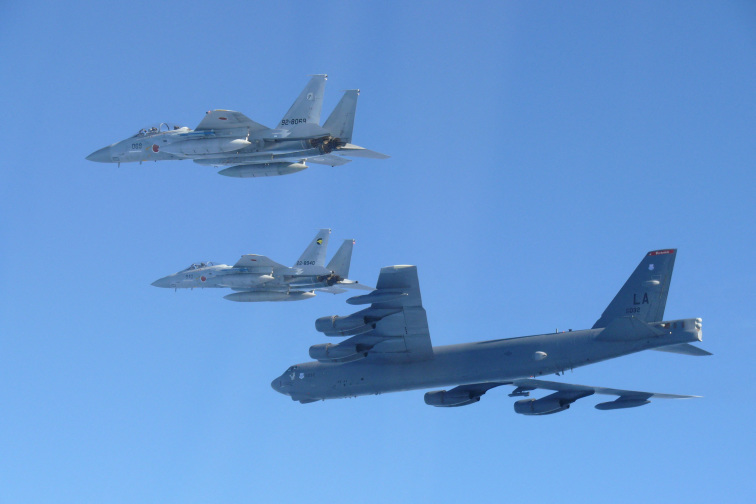
TOKYO, Dec 11 (Reuters) - U.S. nuclear-capable bombers flew over the Sea of Japan alongside Japanese fighter jets on Wednesday, Tokyo said, in a show of force following Chinese and Russian drills in the skies and seas around Japan and South Korea.
Japan and the U.S. "reaffirmed their strong resolve to prevent any unilateral attempt to change the status quo by force and confirmed the readiness posture of both the Self-Defense Forces (SDF) and U.S. forces," Japan's defence ministry said in a press release on Thursday.
The flight of two U.S. B-52 strategic bombers with three Japanese F-35 stealth fighters and three F-15 air-superiority jets was the first time the U.S. had asserted its military presence since China began military exercises in the region last week.
The display follows a joint flight of Chinese and Russian strategic bombers in the East China Sea and western Pacific on Tuesday and separate Chinese aircraft carrier drills that prompted Japan to scramble jets that Tokyo said were targeted by radar beams.
The encounter drew ;criticism from Washington, which said the incident was "not conducive to regional peace and stability" and reaffirmed that its alliance with Japan was "unwavering."
Both Japan and South Korea host U.S. forces, with Japan home to the biggest concentration of American military power overseas, including an aircraft carrier strike group and a U.S. Marine expeditionary force.
China denied Tokyo’s accusation, saying Japanese jets flying near the carrier had endangered its air operations south of Japan.
South Korea’s military said it also scrambled fighter jets when the Chinese and Russian aircraft entered its air defence identification zone on Tuesday, an area that extends beyond its airspace and is used for early warning.
Regional tensions have risen since Japanese Prime Minister Sanae Takaichi triggered a dispute with ;Beijing last month with her remarks on how Tokyo might react to a hypothetical Chinese attack on Taiwan.
China claims democratically governed Taiwan and has not ruled out using force to take control of the island, which sits just over 100 km (62 ;miles) from Japanese territory and is surrounded by sea lanes on which Tokyo relies.
(Reporting by Kaori Kaneko and Tim KellyEditing by Chang-Ran Kim, Lincoln Feast and Michael Perry)




News magazine bootstrap themes!
I like this themes, fast loading and look profesional
Thank you Carlos!
You're welcome!
Please support me with give positive rating!
Yes Sure!