
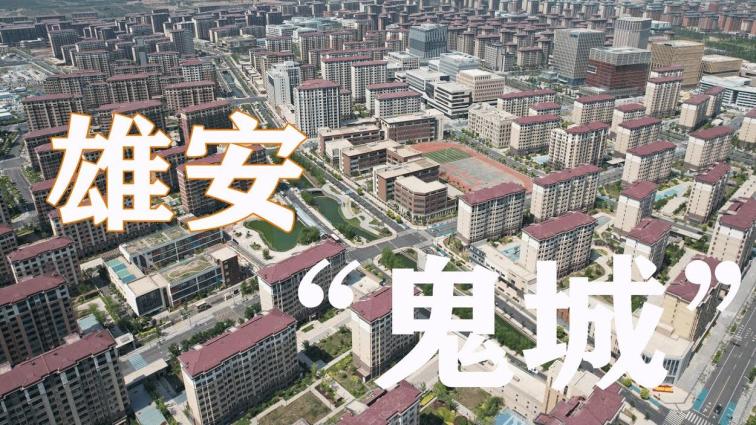
Xiong’an New Area is like a “ghost city,” with hardly a person in sight. (Internet Photo)
[People News] Following the news on August 3 that Politburo Standing Committee member Cai Qi visited experts vacationing in Beidaihe—signaling that the much-watched Beidaihe meeting had begun—China’s top leaders have largely disappeared from state media, except for daily reports about the Party leader himself, such as his love of sports or his leadership in so-called “major-power diplomacy.”
On August 5, Xinhua News Agency published a lengthy report titled A Chronicle of the CPC Central Committee with Xi Jinping at the Core Leading the Economic and Social Development of the ‘14th Five-Year Plan’. This was intended to summarise the “achievements” of the past five years. Unsurprisingly, the report was filled with praise, even portraying the three years of the pandemic as though the CCP had not inflicted great suffering on the Chinese people—very much in line with the Party’s usual self-glorifying narrative.
Interestingly, among all the listed achievements over the past five years, there was not a single mention of Xiong’an New Area. Regarding urban development, the report merely stated in its latter half: “Cities are an important carrier of modernisation, embodying the people’s aspirations for a better life.” It then mentioned that at the July 2025 Central Urban Work Conference, Xi Jinping attended and gave a major speech, setting “building modern people’s cities” as the goal for current and future urban work.
Yet, in a Xinhua report from July 13 this year titled Forging a Path of Urban Development with Chinese Characteristics, Xiong’an New Area was mentioned first. It described: “In the start-up area, greenery abounds and buildings rise from the ground; in Rongdong district, the bustle of daily life mingles with accelerated construction of key facilities; in the high-tech zone, a dense road network emerges and the integration of station-city, industry-city, and green-city is taking shape; lotus flowers bloom in Baiyangdian Lake, and the Millennium Forest is lush with greenery…” The report praised the city—personally planned, deployed, and promoted by Xi Jinping—as a high-level modern metropolis “growing by leaps and bounds, changing with each passing day,” intended as a “millennium plan and a benchmark for the era.”
Back in October 2020, in an official chronicle of “13th Five-Year Plan” achievements, Xiong’an was highlighted near the very beginning: “With thousands of cranes and over 100,000 builders… in the autumn of this year, the North China Plain’s Xiong’an New Area became the world’s largest construction site, growing by the day. The future city, carrying a millennium plan and a matter of national significance, was a scene of intense construction.” It also recalled that on February 23, 2017, Xi Jinping left Zhongnanhai, drove over 100 km to the site, and declared: “Building Xiong’an New Area is a historic project.” Only after this did the report go on to mention Shenzhen.
According to CCTV’s April 2024 report, Xiong’an had completed more than 380 key projects with a total investment of over 670 billion yuan; more than 200 central state-owned enterprises had established offices or subsidiaries there; highways, underground utility corridors, and cloud-based smart services had been built—touted as “remarkable achievements.”
In May 2023, Xi personally returned to Xiong’an, declaring that his decision was “absolutely correct” and urging against impatience. In Hebei, he convened meetings to personally push for the relocation of Beijing-based central SOE headquarters and subsidiaries, warning: “This is not about personal preferences—if you need to move, you must move.”
And yet, this same new area—personally planned, deployed, and promoted by the top leader during the “13th Five-Year Plan,” hailed as a “millennium plan” and “benchmark for the era,” still under heavy investment and construction in the “14th Five-Year Plan,” and claimed to be a completely correct decision—was not included in the list of “14th Five-Year Plan” achievements. Is this not unusual? The omission suggests that investing in Xiong’an was a failed decision, and not mentioning it is, in fact, a denial of that decision—and of the person who made it.
In addition, on May 18 this year, Chinese state media announced that the CCP Central Committee and the State Council had recently issued a revised version of the Regulations on Practicing Thrift and Opposing Waste in Party and Government Organs. This is the first revision of the regulations in 12 years. The document consists of 11 chapters and includes several new provisions.
One notable addition in the General Principles is Article 7, which states: “Leading bodies and leading cadres at all levels must establish the correct view of political achievements, set an example, take the lead from the top, strictly prohibit ‘vanity projects’ and ‘political achievement projects’ that waste resources and exhaust the people, prevent major decision-making errors that cause serious waste, and resolutely oppose formalism, bureaucratism, hedonism, and extravagance.” Between the lines, this language inevitably calls to mind Xiong’an as a “vanity project” and “political achievement project.” Could this be connected to the omission of Xiong’an from the list of “14th Five-Year Plan” achievements?
At present, it appears that Xiong’an New Area is becoming unsustainable. Beyond intangible factors such as the need to cultivate education and cultural environments over the long term, a key issue is that the Xiong’an area itself does not have abundant water resources. The Baiyangdian region’s ecosystem is fragile and not sufficient to sustain a massive city over time.
Another major problem is that Xiong’an lies in a low-lying area, meaning flood prevention and drainage must be taken into account during construction. At the end of July 2023, heavy rains struck Beijing and Hebei, and Zhuozhou in Hebei suddenly became the latest disaster zone—most of the urban area and multiple townships were flooded, with damage far worse than in Beijing. At the time, there was public speculation that floodwaters had been deliberately diverted to Zhuozhou to protect Xiong’an New Area. More recently, the same pattern occurred when Beijing’s Miyun Reservoir released floodwaters that again inundated Zhuozhou and surrounding areas.
Therefore, after rumours of a power reshuffle in Beijing’s Zhongnanhai, scaling back the emphasis on Xiong’an became an inevitable choice. A clear signal of this is its exclusion from the “14th Five-Year Plan” achievements. Once a leadership change at the top of the CCP is confirmed, Xiong’an’s fate will be sealed.



News magazine bootstrap themes!
I like this themes, fast loading and look profesional
Thank you Carlos!
You're welcome!
Please support me with give positive rating!
Yes Sure!